 Add to Chrome
 Add to Firefox
 Add to Edge
ST-EVO: Towards Generative Spatio-Temporal Evolution of Multi-Agent Communication Topologies
Feb 16, 2026
LLM-powered Multi-Agent Systems (MAS) have emerged as an effective approach towards collaborative intelligence, and have attracted wide research interests. Among them, ``self-evolving'' MAS, treated as a more flexible and powerful technical route, can construct task-adaptive workflows or communication topologies, instead of relying on a predefined static structue template. Current self-evolving MAS mainly focus on Spatial Evolving or Temporal Evolving paradigm, which only considers the single dimension of evolution and does not fully incentivize LLMs' collaborative capability. In this work, we start from a novel Spatio-Temporal perspective by proposing ST-EVO, which supports dialogue-wise communication scheduling with a compact yet powerful flow-matching based Scheduler. To make precise Spatio-Temporal scheduling, ST-EVO can also perceive the uncertainty of MAS, and possesses self-feedback ability to learn from accumulated experience. Extensive experiments on nine benchmarks demonstrate the state-of-the-art performance of ST-EVO, achieving about 5%--25% accuracy improvement.

SEER: Transformer-based Robust Time Series Forecasting via Automated Patch Enhancement and Replacement
Jan 31, 2026Time series forecasting is important in many fields that require accurate predictions for decision-making. Patching techniques, commonly used and effective in time series modeling, help capture temporal dependencies by dividing the data into patches. However, existing patch-based methods fail to dynamically select patches and typically use all patches during the prediction process. In real-world time series, there are often low-quality issues during data collection, such as missing values, distribution shifts, anomalies and white noise, which may cause some patches to contain low-quality information, negatively impacting the prediction results. To address this issue, this study proposes a robust time series forecasting framework called SEER. Firstly, we propose an Augmented Embedding Module, which improves patch-wise representations using a Mixture-of-Experts (MoE) architecture and obtains series-wise token representations through a channel-adaptive perception mechanism. Secondly, we introduce a Learnable Patch Replacement Module, which enhances forecasting robustness and model accuracy through a two-stage process: 1) a dynamic filtering mechanism eliminates negative patch-wise tokens; 2) a replaced attention module substitutes the identified low-quality patches with global series-wise token, further refining their representations through a causal attention mechanism. Comprehensive experimental results demonstrate the SOTA performance of SEER.
Bridging Time and Frequency: A Joint Modeling Framework for Irregular Multivariate Time Series Forecasting
Jan 31, 2026Irregular multivariate time series forecasting (IMTSF) is challenging due to non-uniform sampling and variable asynchronicity. These irregularities violate the equidistant assumptions of standard models, hindering local temporal modeling and rendering classical frequency-domain methods ineffective for capturing global periodic structures. To address this challenge, we propose TFMixer, a joint time-frequency modeling framework for IMTS forecasting. Specifically, TFMixer incorporates a Global Frequency Module that employs a learnable Non-Uniform Discrete Fourier Transform (NUDFT) to directly extract spectral representations from irregular timestamps. In parallel, the Local Time Module introduces a query-based patch mixing mechanism to adaptively aggregate informative temporal patches and alleviate information density imbalance. Finally, TFMixer fuses the time-domain and frequency-domain representations to generate forecasts and further leverages inverse NUDFT for explicit seasonal extrapolation. Extensive experiments on real-world datasets demonstrate the state--of-the-art performance of TFMixer.
Rethinking Irregular Time Series Forecasting: A Simple yet Effective Baseline
May 16, 2025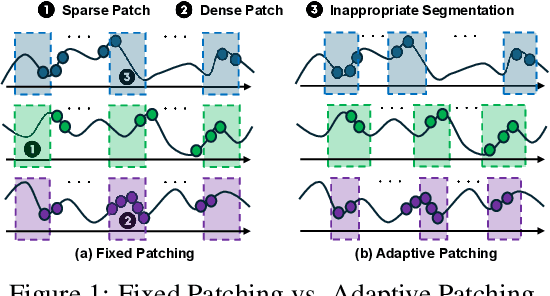
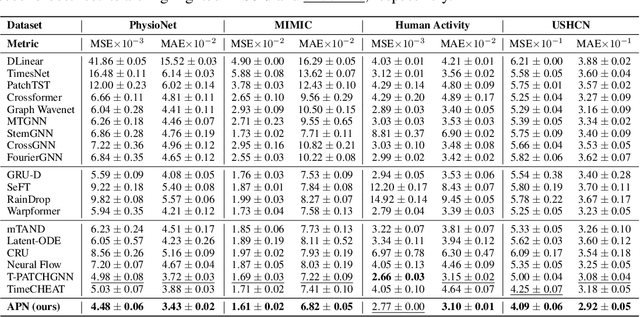
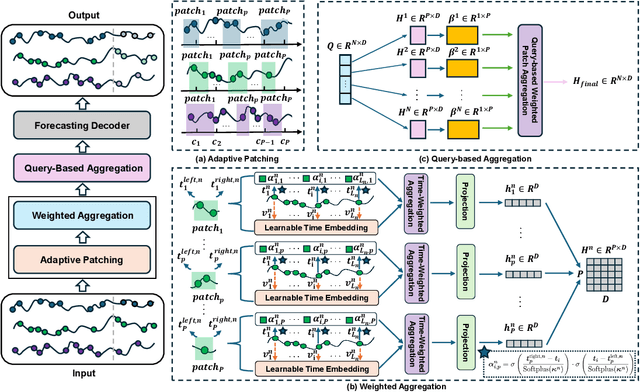
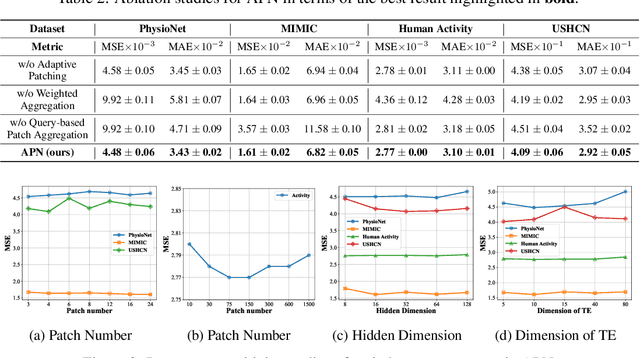
The forecasting of irregular multivariate time series (IMTS) is crucial in key areas such as healthcare, biomechanics, climate science, and astronomy. However, achieving accurate and practical predictions is challenging due to two main factors. First, the inherent irregularity and data missingness in irregular time series make modeling difficult. Second, most existing methods are typically complex and resource-intensive. In this study, we propose a general framework called APN to address these challenges. Specifically, we design a novel Time-Aware Patch Aggregation (TAPA) module that achieves adaptive patching. By learning dynamically adjustable patch boundaries and a time-aware weighted averaging strategy, TAPA transforms the original irregular sequences into high-quality, regularized representations in a channel-independent manner. Additionally, we use a simple query module to effectively integrate historical information while maintaining the model's efficiency. Finally, predictions are made by a shallow MLP. Experimental results on multiple real-world datasets show that APN outperforms existing state-of-the-art methods in both efficiency and accuracy.