 Add to Chrome
 Add to Firefox
 Add to Edge
Teaching MLLMs to Say No: Generalized Referring Expression Comprehension via Refusal Calibrated GRPO
Aug 05, 2026
We tackle the challenging yet underexplored task of Generalized Referring Expression Comprehension (GREC), which requires a model to localize the object described by a textual expression when it exists (positive sample) and to refuse output when it does not (negative sample). Although Multimodal Large Language Models (MLLMs) excel at localizing existing objects, they often fail to reject nonexistent ones due to the absence of negative samples during training, producing hallucinated bounding boxes. Existing post-training approaches such as supervised fine-tuning (SFT) and reinforcement learning (RL) enhance refusal behavior but usually degrade localization accuracy on positive samples, undermining the model's core competence. To address this, we propose Refusal-Calibrated Group Relative Policy Optimization (RC-GRPO), a calibrated RL strategy that strengthens the refusal ability of MLLMs while preserving localization performance. It enforces "None" outputs in rollouts for valid advantage estimation on negative samples and applies a penalty to prevent over-refusal on positives, achieving a balanced trade-off between accuracy and reliability. A second-stage reasoning reinforcement further consolidates causal understanding and interpretability. Experiments on three GREC benchmarks demonstrate that RC-GRPO attains superior localization accuracy while maintaining strong refusal capability.

New Dataset and Methods for Fine-Grained Compositional Referring Expression Comprehension via Specialist-MLLM Collaboration
Feb 28, 2025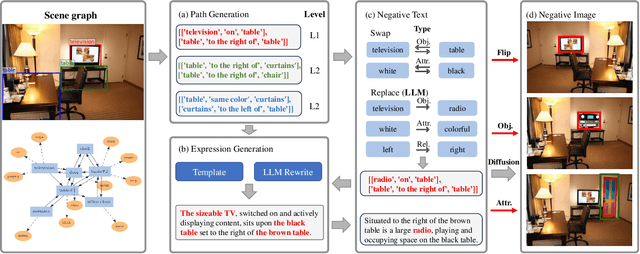
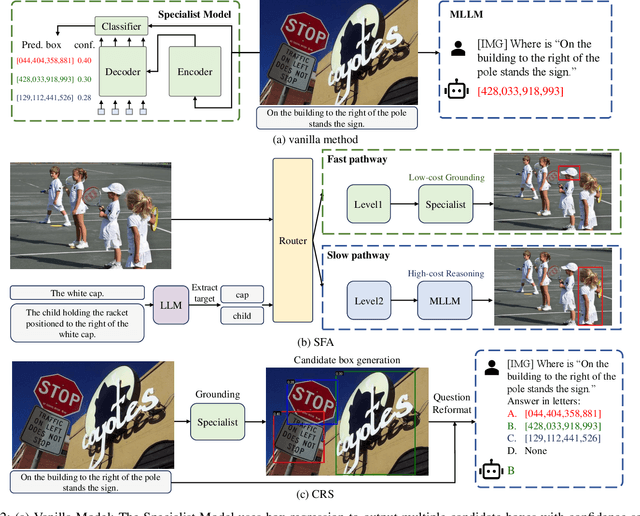
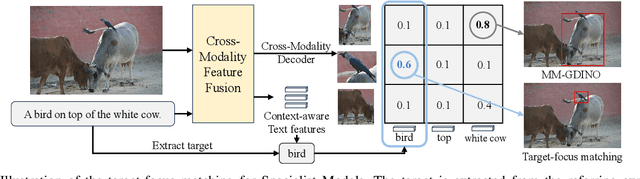
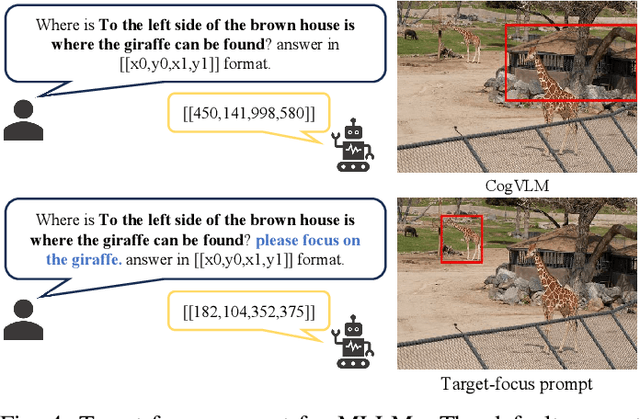
Referring Expression Comprehension (REC) is a foundational cross-modal task that evaluates the interplay of language understanding, image comprehension, and language-to-image grounding. To advance this field, we introduce a new REC dataset with two key features. First, it is designed with controllable difficulty levels, requiring fine-grained reasoning across object categories, attributes, and relationships. Second, it incorporates negative text and images generated through fine-grained editing, explicitly testing a model's ability to reject non-existent targets, an often-overlooked yet critical challenge in existing datasets. To address fine-grained compositional REC, we propose novel methods based on a Specialist-MLLM collaboration framework, leveraging the complementary strengths of them: Specialist Models handle simpler tasks efficiently, while MLLMs are better suited for complex reasoning. Based on this synergy, we introduce two collaborative strategies. The first, Slow-Fast Adaptation (SFA), employs a routing mechanism to adaptively delegate simple tasks to Specialist Models and complex tasks to MLLMs. Additionally, common error patterns in both models are mitigated through a target-refocus strategy. The second, Candidate Region Selection (CRS), generates multiple bounding box candidates based on Specialist Model and uses the advanced reasoning capabilities of MLLMs to identify the correct target. Extensive experiments on our dataset and other challenging compositional benchmarks validate the effectiveness of our approaches. The SFA strategy achieves a trade-off between localization accuracy and efficiency, and the CRS strategy greatly boosts the performance of both Specialist Models and MLLMs. We aim for this work to offer valuable insights into solving complex real-world tasks by strategically combining existing tools for maximum effectiveness, rather than reinventing them.