 Add to Chrome
 Add to Firefox
 Add to Edge
Crowded Video Individual Counting Informed by Social Grouping and Spatial-Temporal Displacement Priors
Jan 03, 2026
Video Individual Counting (VIC) is a recently introduced task aiming to estimate pedestrian flux from a video. It extends Video Crowd Counting (VCC) beyond the per-frame pedestrian count. In contrast to VCC that learns to count pedestrians across frames, VIC must identify co-existent pedestrians between frames, which turns out to be a correspondence problem. Existing VIC approaches, however, can underperform in congested scenes such as metro commuting. To address this, we build WuhanMetroCrowd, one of the first VIC datasets that characterize crowded, dynamic pedestrian flows. It features sparse-to-dense density levels, short-to-long video clips, slow-to-fast flow variations, front-to-back appearance changes, and light-to-heavy occlusions. To better adapt VIC approaches to crowds, we rethink the nature of VIC and recognize two informative priors: i) the social grouping prior that indicates pedestrians tend to gather in groups and ii) the spatial-temporal displacement prior that informs an individual cannot teleport physically. The former inspires us to relax the standard one-to-one (O2O) matching used by VIC to one-to-many (O2M) matching, implemented by an implicit context generator and a O2M matcher; the latter facilitates the design of a displacement prior injector, which strengthens not only O2M matching but also feature extraction and model training. These designs jointly form a novel and strong VIC baseline OMAN++. Extensive experiments show that OMAN++ not only outperforms state-of-the-art VIC baselines on the standard SenseCrowd, CroHD, and MovingDroneCrowd benchmarks, but also indicates a clear advantage in crowded scenes, with a 38.12% error reduction on our WuhanMetroCrowd dataset. Code, data, and pretrained models are available at https://github.com/tiny-smart/OMAN.

Video Individual Counting With Implicit One-to-Many Matching
Jun 16, 2025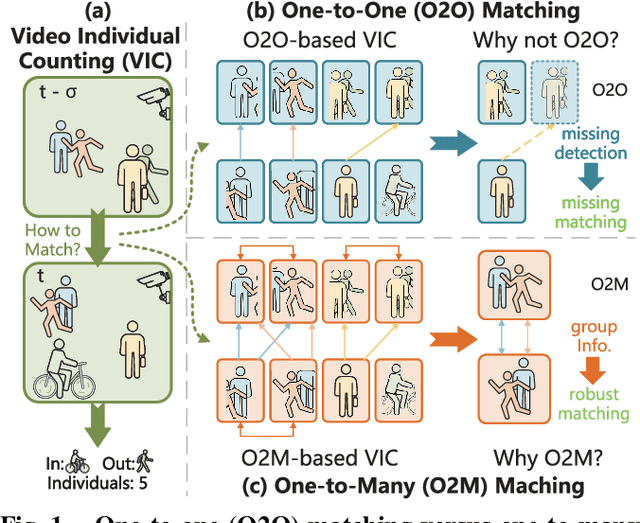
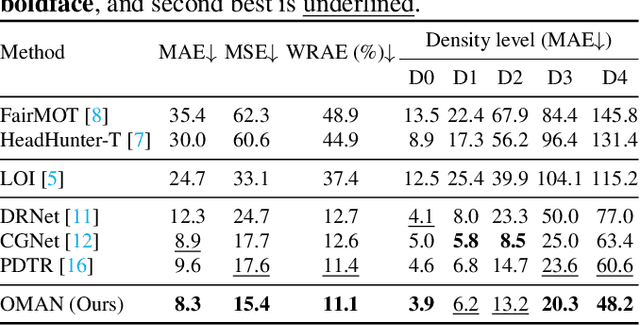
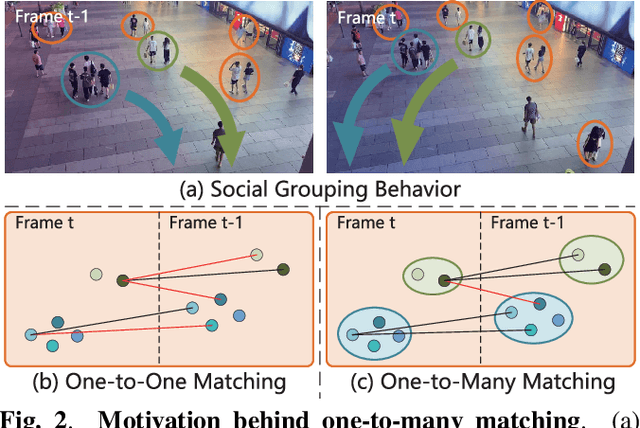
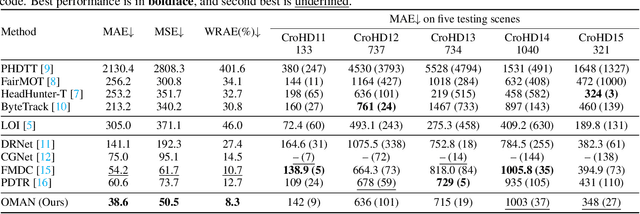
Video Individual Counting (VIC) is a recently introduced task that aims to estimate pedestrian flux from a video. It extends conventional Video Crowd Counting (VCC) beyond the per-frame pedestrian count. In contrast to VCC that only learns to count repeated pedestrian patterns across frames, the key problem of VIC is how to identify co-existent pedestrians between frames, which turns out to be a correspondence problem. Existing VIC approaches, however, mainly follow a one-to-one (O2O) matching strategy where the same pedestrian must be exactly matched between frames, leading to sensitivity to appearance variations or missing detections. In this work, we show that the O2O matching could be relaxed to a one-to-many (O2M) matching problem, which better fits the problem nature of VIC and can leverage the social grouping behavior of walking pedestrians. We therefore introduce OMAN, a simple but effective VIC model with implicit One-to-Many mAtchiNg, featuring an implicit context generator and a one-to-many pairwise matcher. Experiments on the SenseCrowd and CroHD benchmarks show that OMAN achieves the state-of-the-art performance. Code is available at \href{https://github.com/tiny-smart/OMAN}{OMAN}.