 Add to Chrome
 Add to Firefox
 Add to Edge
Optimizing Resource-Constrained Non-Pharmaceutical Interventions for Multi-Cluster Outbreak Control Using Hierarchical Reinforcement Learning
Mar 19, 2026
Non-pharmaceutical interventions (NPIs), such as diagnostic testing and quarantine, are crucial for controlling infectious disease outbreaks but are often constrained by limited resources, particularly in early outbreak stages. In real-world public health settings, resources must be allocated across multiple outbreak clusters that emerge asynchronously, vary in size and risk, and compete for a shared resource budget. Here, a cluster corresponds to a group of close contacts generated by a single infected index case. Thus, decisions must be made under uncertainty and heterogeneous demands, while respecting operational constraints. We formulate this problem as a constrained restless multi-armed bandit and propose a hierarchical reinforcement learning framework. A global controller learns a continuous action cost multiplier that adjusts global resource demand, while a generalized local policy estimates the marginal value of allocating resources to individuals within each cluster. We evaluate the proposed framework in a realistic agent-based simulator of SARS-CoV-2 with dynamically arriving clusters. Across a wide range of system scales and testing budgets, our method consistently outperforms RMAB-inspired and heuristic baselines, improving outbreak control effectiveness by 20%-30%. Experiments on up to 40 concurrently active clusters further demonstrate that the hierarchical framework is highly scalable and enables faster decision-making than the RMAB-inspired method.

Optimizing Convolutional Neural Network Architecture via Information Field
Sep 11, 2020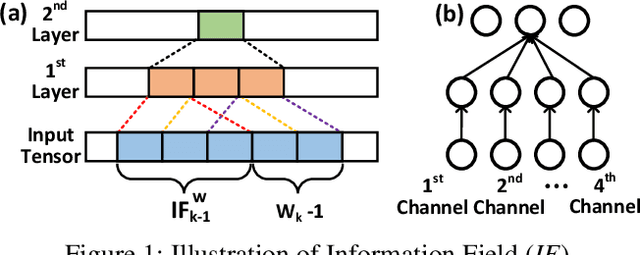
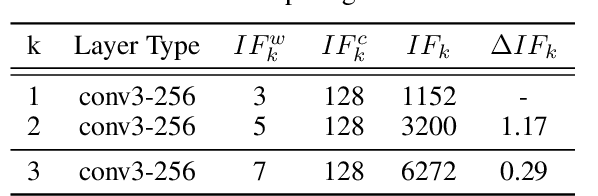
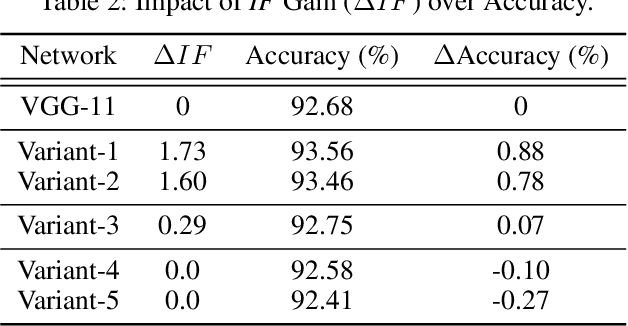
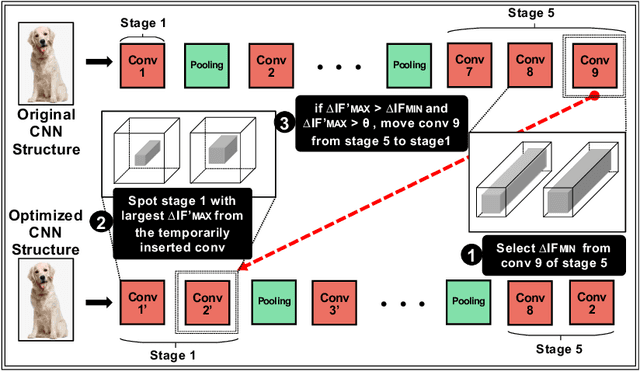
CNN architecture design has attracted tremendous attention of improving model accuracy or reducing model complexity. However, existing works either introduce repeated training overhead in the search process or lack an interpretable metric to guide the design. To clear the hurdles, we propose Information Field (IF), an explainable and easy-to-compute metric, to estimate the quality of a CNN architecture and guide the search process of designs. To validate the effectiveness of IF, we build a static optimizer to improve the CNN architectures at both the stage level and the kernel level. Our optimizer not only provides a clear and reproducible procedure but also mitigates unnecessary training efforts in the architecture search process. Experiments show that the models generated by our optimizer can achieve up to 5.47% accuracy improvement and up to 65.38% parameters deduction, compared with state-of-the-art CNN structures like MobileNet and ResNet.
SGQuant: Squeezing the Last Bit on Graph Neural Networks with Specialized Quantization
Jul 09, 2020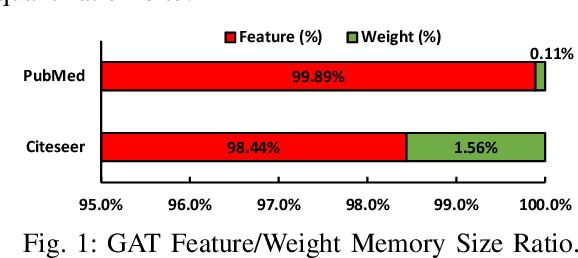
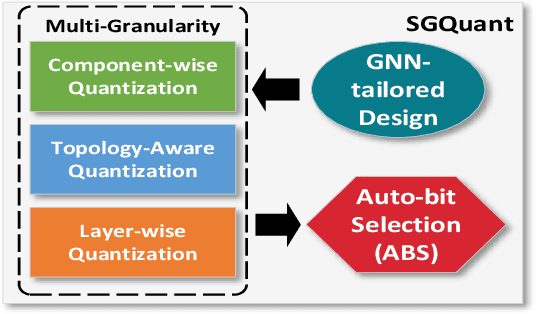
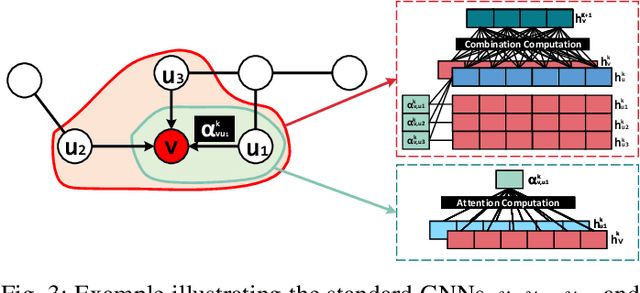
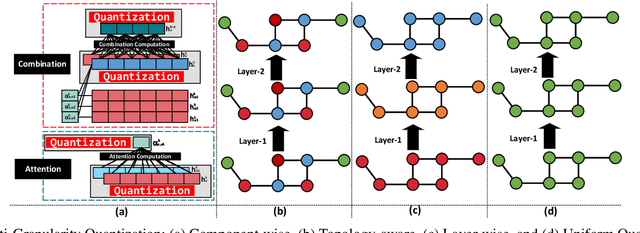
With the increasing popularity of graph-based learning, Graph Neural Networks (GNNs) win lots of attention from the research and industry field because of their high accuracy. However, existing GNNs suffer from high memory footprints (e.g., node embedding features). This high memory footprint hurdles the potential applications towards memory-constrained devices, such as the widely-deployed IoT devices. To this end, we propose a specialized GNN quantization scheme, SGQuant, to systematically reduce the GNN memory consumption. Specifically, we first propose a GNN-tailored quantization algorithm design and a GNN quantization fine-tuning scheme to reduce memory consumption while maintaining accuracy. Then, we investigate the multi-granularity quantization strategy that operates at different levels (components, graph topology, and layers) of GNN computation. Moreover, we offer an automatic bit-selecting (ABS) to pinpoint the most appropriate quantization bits for the above multi-granularity quantizations. Intensive experiments show that SGQuant can effectively reduce the memory footprint from 4.25x to 31.9x compared with the original full-precision GNNs while limiting the accuracy drop to 0.4% on average.