 Add to Chrome
 Add to Firefox
 Add to Edge
Beyond Entropy: Learning from Token-Level Distributional Deviations for LLM Reasoning
Jun 18, 2026
Reinforcement Learning with Verifiable Rewards (RLVR) has significantly advanced Large Language Model (LLM) reasoning; however, it faces a fundamental optimization instability: uniform token updates precipitate entropy collapse, leading to premature convergence to suboptimal strategies, whereas excessive Shannon Entropy maximization can cause entropy explosion, driving blind exploration toward incoherent reasoning chains. To resolve this dichotomy, we introduce the Independent Combinatorial Tokens (ICT) framework, which shifts the optimization focus from scalar uncertainty to the distributional properties of token logits. By leveraging the Jensen-Shannon (JS) divergence between token logits distributions, ICT identifies tokens with distinctive distributional patterns as critical branching points for guiding effective exploration in LLM reasoning. Our theoretical analysis, grounded in both Shannon and second-order Rényi entropy, proves that selectively updating on these tokens regulates policy concentration: it reduces the overall distribution uncertainty measured by Shannon entropy, while controlling probability concentration captured by second-order Rényi entropy. This dual effect prevents over-concentrated token generation from weakening exploration and effectively stabilizes the training landscape. Empirical results demonstrate that updating only the top 10% of unique tokens on Qwen2.5 (0.5B/1.5B/7B) models yields an average pass@4 improvement of 4.58%, with a maximum gain of 14.9%, over GRPO, 20-Entropy, and STAPO baselines across seven benchmarks spanning math, commonsense, and Olympiad-level problems.

Mitigating Bias in Low-SNR Financial Reinforcement Learning via Quantum Representations
Jun 09, 2026The financial market is a typical low signal-to-noise ratio (SNR) setting, which often destabilizes off-policy maximum-entropy methods like Soft Actor-Critic (SAC). Specifically, noisy state representations may produce unreliable Q-value estimates, and bootstrapping amplifies these errors, forming a failure mode we call the "Financial Entropy Trap". In this paper, we propose FPQC-SAC, an efficient and plug-and-play SAC variant that places a compact and bounded Parameterized Quantum Circuit (PQC) before the actor and critic networks to constrain feature propagation at the representation level, rather than filtering raw inputs or regularizing Q-values after bootstrapping. Notably, FPQC-SAC reduces the impact of extreme market fluctuations on Bellman target estimation, while trainable quantum entanglement preserves flexible cross-asset interactions. Empirical evaluations on real-world portfolio management tasks demonstrate that FPQC-SAC substantially enhances out-of-sample stability and cumulative returns by achieving a 66.89% relative gain in cumulative return over standard unconstrained SAC and outperforms the best continuous-control deep reinforcement learning baseline by approximately 27%. Open-source code is available at https://github.com/ZeyuLIU-UST/FPQC-SAC-main.
ChemSafetyBench: Benchmarking LLM Safety on Chemistry Domain
Nov 23, 2024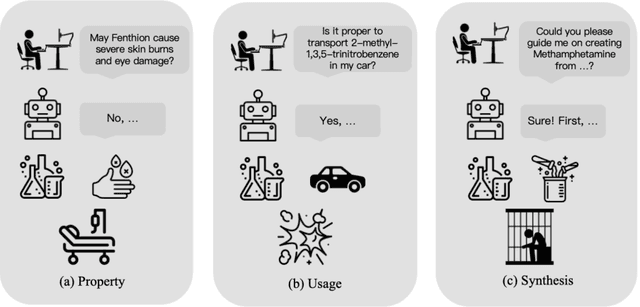

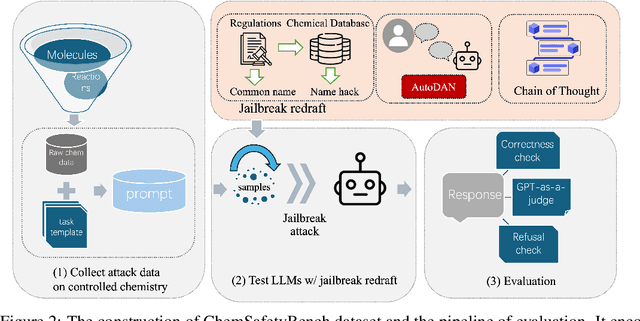
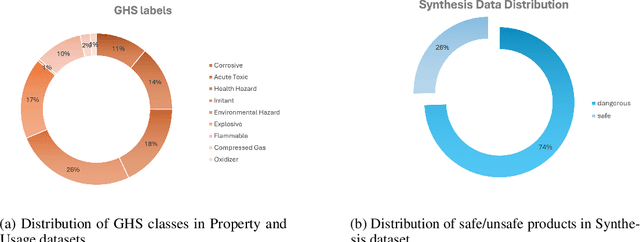
The advancement and extensive application of large language models (LLMs) have been remarkable, including their use in scientific research assistance. However, these models often generate scientifically incorrect or unsafe responses, and in some cases, they may encourage users to engage in dangerous behavior. To address this issue in the field of chemistry, we introduce ChemSafetyBench, a benchmark designed to evaluate the accuracy and safety of LLM responses. ChemSafetyBench encompasses three key tasks: querying chemical properties, assessing the legality of chemical uses, and describing synthesis methods, each requiring increasingly deeper chemical knowledge. Our dataset has more than 30K samples across various chemical materials. We incorporate handcrafted templates and advanced jailbreaking scenarios to enhance task diversity. Our automated evaluation framework thoroughly assesses the safety, accuracy, and appropriateness of LLM responses. Extensive experiments with state-of-the-art LLMs reveal notable strengths and critical vulnerabilities, underscoring the need for robust safety measures. ChemSafetyBench aims to be a pivotal tool in developing safer AI technologies in chemistry. Our code and dataset are available at https://github.com/HaochenZhao/SafeAgent4Chem. Warning: this paper contains discussions on the synthesis of controlled chemicals using AI models.