 Add to Chrome
 Add to Firefox
 Add to Edge
ZONDA: Zero-shot Object Navigation with Dynamic Avoidance in Multi-floor Environments
Jul 23, 2026
In Object Goal Navigation task, existing methods are typically restricted to static and single-floor environments, ignoring cross-floor topologies and dynamic pedestrian, which limits their real-world deployment. To address these limitations, we propose ZONDA, a zero-shot object navigation with dynamic avoidance framework. In particular, ZONDA integrates three core components: (i) Heuristic multi-floor planning: from height-difference traversable maps, enables stair traversal and cross-floor exploration without a platform-specific learned controller; (ii) Multi-view target verification: cross-checks multi-scale observations with a vision-language model, significantly reducing false positives; and (iii) Dynamic pedestrian avoidance: explicitly tracks and predicts moving pedestrians to generate anticipatory behaviors. Evaluated on a real Direct Drive Tech TITA biped robot and extensive simulations on HM3D and MP3D, ZONDA achieves significantly improved results. Moreover, ZONDA can maintain robust navigation on the dynamic benchmark HM3D-DYNA compared to the existing baseline.

Whole-Body Control With Terrain Estimation of A 6-DoF Wheeled Bipedal Robot
Nov 09, 2025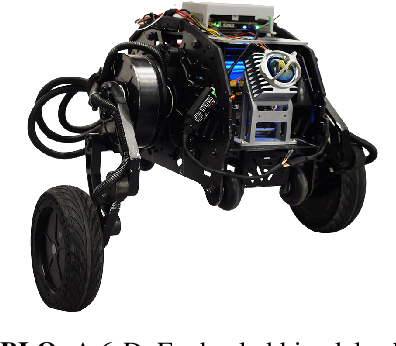
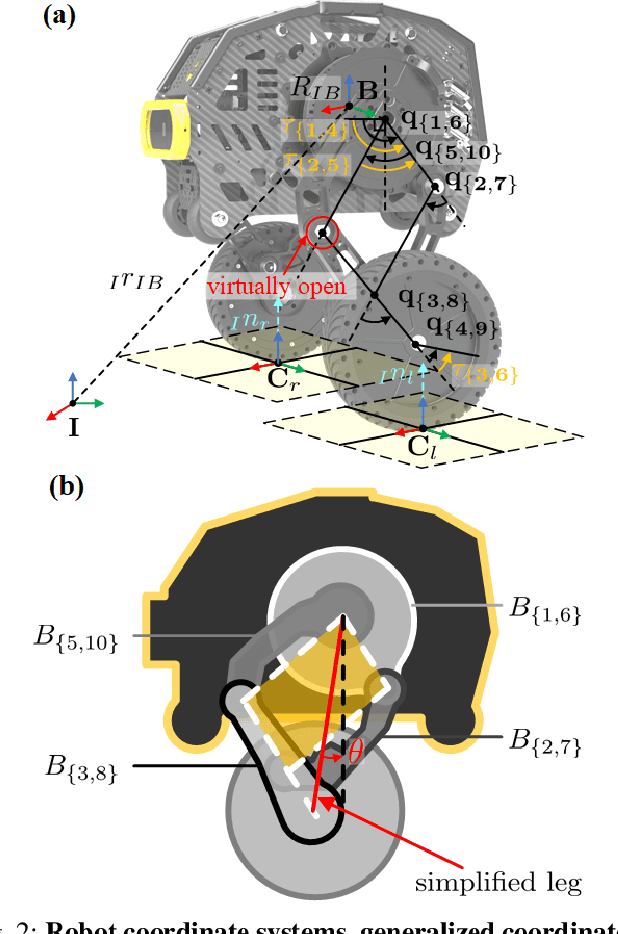
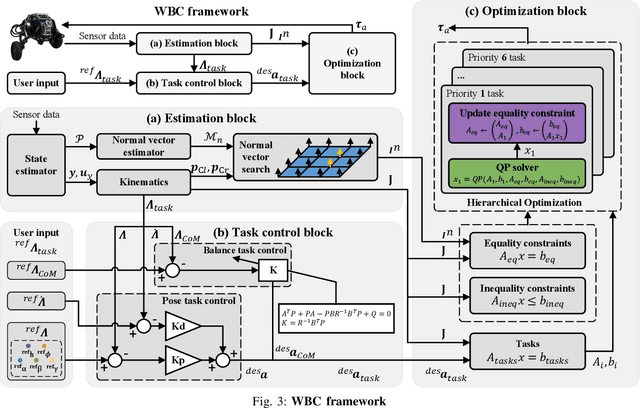
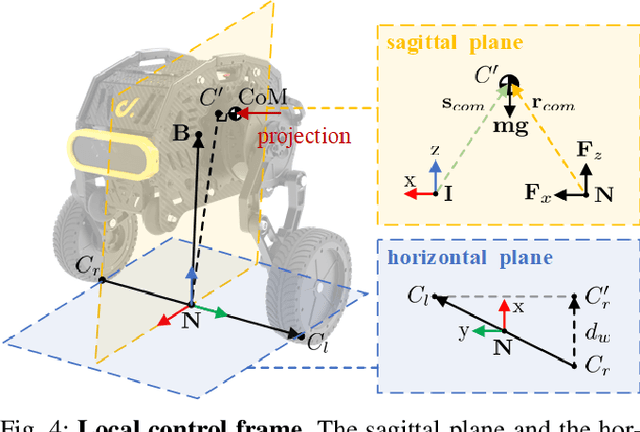
Wheeled bipedal robots have garnered increasing attention in exploration and inspection. However, most research simplifies calculations by ignoring leg dynamics, thereby restricting the robot's full motion potential. Additionally, robots face challenges when traversing uneven terrain. To address the aforementioned issue, we develop a complete dynamics model and design a whole-body control framework with terrain estimation for a novel 6 degrees of freedom wheeled bipedal robot. This model incorporates the closed-loop dynamics of the robot and a ground contact model based on the estimated ground normal vector. We use a LiDAR inertial odometry framework and improved Principal Component Analysis for terrain estimation. Task controllers, including PD control law and LQR, are employed for pose control and centroidal dynamics-based balance control, respectively. Furthermore, a hierarchical optimization approach is used to solve the whole-body control problem. We validate the performance of the terrain estimation algorithm and demonstrate the algorithm's robustness and ability to traverse uneven terrain through both simulation and real-world experiments.
DIABLO: A 6-DoF Wheeled Bipedal Robot Composed Entirely of Direct-Drive Joints
Aug 01, 2024Wheeled bipedal robots offer the advantages of both wheeled and legged robots, combining the ability to traverse a wide range of terrains and environments with high efficiency. However, the conventional approach in existing wheeled bipedal robots involves motor-driven joints with high-ratio gearboxes. While this approach provides specific benefits, it also presents several challenges, including increased mechanical complexity, efficiency losses, noise, vibrations, and higher maintenance and lubrication requirements. Addressing the aforementioned concerns, we developed a direct-drive wheeled bipedal robot called DIABLO, which eliminates the use of gearboxes entirely. Our robotic system is simplified as a second-order inverted pendulum, and we have designed an LQR-based balance controller to ensure stability. Additionally, we implemented comprehensive motion controller, including yaw, split-angle, height, and roll controllers. Through expriments in simulations and real-world prototype, we have demonstrated that our platform achieves satisfactory performance.