 Add to Chrome
 Add to Firefox
 Add to Edge
From Bounding Boxes to Visual Reasoning: An On-Policy Data Annotation Tool for Vision-Language Models
Jun 17, 2026
Vision-language models (VLMs) are rapidly advancing toward sophisticated grounded structured visual reasoning. Training models for such advanced capabilities demands a new genre of data that seamlessly unifies spatial coordinates, open-vocabulary descriptions, structured attributes, and topological relationships into a singular representation. However, existing data annotation tools fundamentally fail to meet these intricate demands, suffering from three systematic bottlenecks: limited expressiveness, severe annotation-training decoupling, and poor data reusability. To bridge this infrastructure gap, we introduce an open-source annotation tool, ScreenAnnotator. First, we define a unified annotation atom schema that binds spatial, semantic, and structural primitives into a single unit. Second, we implement an on-policy annotation loop embedded with a Bayesian Annotation Verifier (BAV). Finally, we design a template-driven multi-task data synthesis process dynamically transforms static atoms into diverse multi-dimensional reasoning tasks, eliminating redundant re-annotation. The on-policy loop drives the annotation accept rate to nearly 100% on flowcharts and 77% on GUI screenshots, while steadily reducing per-image annotation time as labeled data accumulate. In the flowchart scenario, fine-tuning a VLM yields 76.1% average accuracy, which is a 35.1% point absolute gain. Our code is available at: https://github.com/WnQinm/Annotator.

ScreenAgent: A Vision Language Model-driven Computer Control Agent
Feb 09, 2024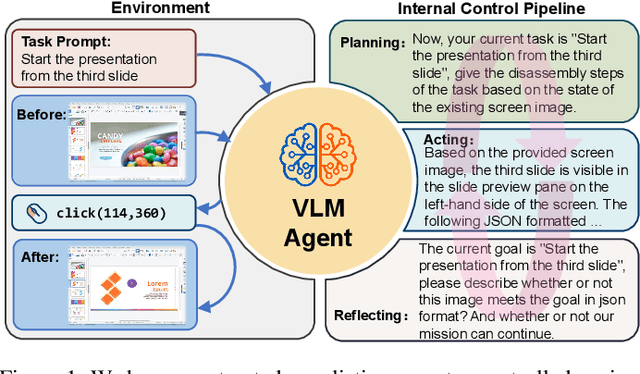
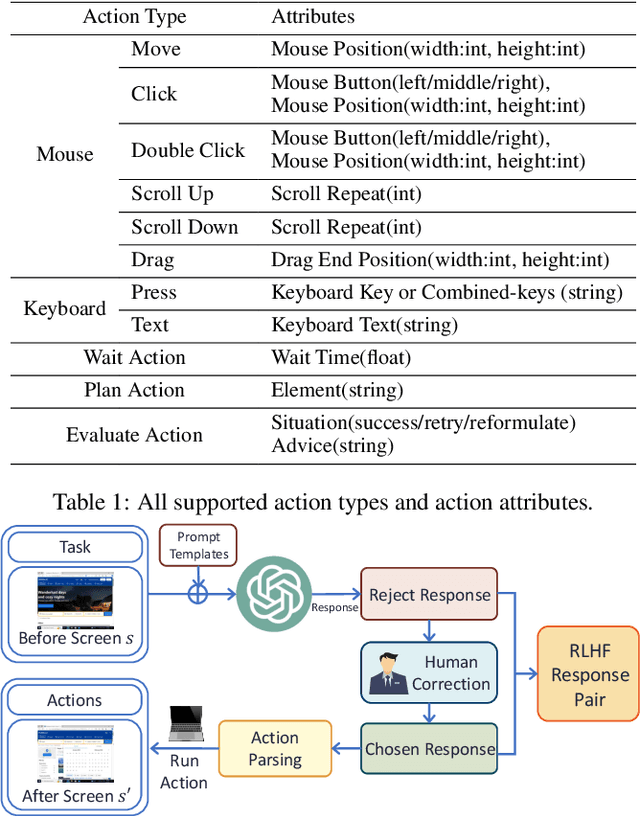
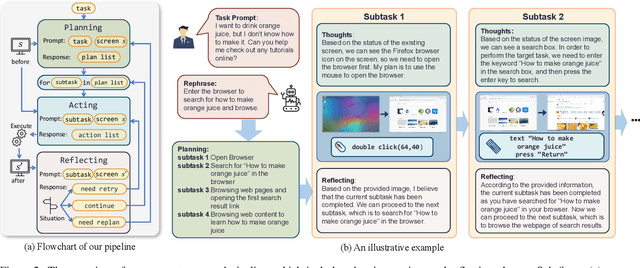
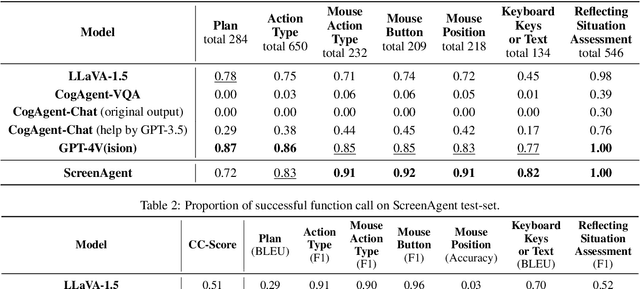
Existing Large Language Models (LLM) can invoke a variety of tools and APIs to complete complex tasks. The computer, as the most powerful and universal tool, could potentially be controlled directly by a trained LLM agent. Powered by the computer, we can hopefully build a more generalized agent to assist humans in various daily digital works. In this paper, we construct an environment for a Vision Language Model (VLM) agent to interact with a real computer screen. Within this environment, the agent can observe screenshots and manipulate the Graphics User Interface (GUI) by outputting mouse and keyboard actions. We also design an automated control pipeline that includes planning, acting, and reflecting phases, guiding the agent to continuously interact with the environment and complete multi-step tasks. Additionally, we construct the ScreenAgent Dataset, which collects screenshots and action sequences when completing a variety of daily computer tasks. Finally, we trained a model, ScreenAgent, which achieved computer control capabilities comparable to GPT-4V and demonstrated more precise UI positioning capabilities. Our attempts could inspire further research on building a generalist LLM agent. The code is available at \url{https://github.com/niuzaisheng/ScreenAgent}.