 Add to Chrome
 Add to Firefox
 Add to Edge
Calibrated Harmonic Overlaid Implicit Neural Representations for Multi-Dimensional Data
Jun 25, 2026
Implicit neural representation (INR) has emerged as a powerful prior for multi-dimensional data (e.g., multispectral images and videos). However, most INR methods employing periodic activation functions (e.g., Sine) predominantly rely on function composition. This mechanism introduces optimization instability as network depth increases, thereby limiting their performance. Meanwhile, these methods fail to incorporate proper physical priors to effectively alleviate spectrum bias. To address these issues, inspired by the commonalities between deep periodic networks and generalized Fourier series, we propose a novel Calibrated Harmonic Overlaid Implicit Neural Representation (CHOIR). Specifically, we utilize Coordinated Harmonic Superposition (CHS) to replace the conventional function composition used in most INRs, thereby ensuring optimization stability when scaling network depth. Furthermore, we introduce a Perceptual Spectrum Calibration (PSC) to mitigate spectrum bias. This calibration embeds the ubiquitous power-law spectrum prior of natural images and adjusts the globally fixed spectrum towards a physically plausible log-uniform distribution. Extensive experiments on various multidimensional data recovery problems demonstrate that our method achieves superior performance over state-of-the-art approaches. Code is available at https://github.com/chorl0229/CHOIR.

VEDAL: Variational Error-Driven Asynchronous Learning for 3D Gaussian Splatting Pruning
Jun 01, 20263D Gaussian Splatting (3DGS) achieves remarkable novel view synthesis quality with real-time rendering, yet suffers from excessive memory consumption due to millions of Gaussian primitives. Existing pruning methods rely on heuristic importance scores or synchronous batch updates, leading to suboptimal compression and training instability. We propose VEDAL, a principled framework that formulates Gaussian pruning as variational free energy minimization. Our approach introduces (1) a prediction-error gating mechanism that asynchronously activates pruning based on per-Gaussian reconstruction uncertainty, and (2) a variational uncertainty head that models pruning decisions as latent variables with learnable priors. The free energy objective naturally balances reconstruction fidelity against model complexity through an information-theoretic lens. Extensive experiments on Mip-NeRF 360, Tanks&Temples, and Deep Blending demonstrate that VEDAL achieves 5.2x compression with only 0.31 dB PSNR drop, outperforming PUP 3D-GS by +0.05 dB at a higher compression ratio and LightGaussian by +0.35 dB at comparable quality, while maintaining real-time rendering at 185 FPS.
Beyond Spherical Wavefront: Near-Field Channel Estimation Under Wavefront Anisotropy
May 21, 2026Extremely large aperture arrays (ELAAs) and millimeter-wave (mmWave) technologies are essential for achieving high data rates in future wireless communication systems. To perform precise beamforming, these systems require accurate channel estimation, in which the near-field wavefront curvature effect must be taken into account. Existing channel estimation methods rely on the spherical wavefront channel (SWC) model, which is suitable for near-field propagation with point sources, scatterers, and reflection planes. However, when a near-field curved reflecting surface exists, the wavefront of the reflected wave becomes anisotropic rather than spherical, causing the SWC model to become inaccurate. To address this problem, in this paper, we formulate a parameterized model for the anisotropic wavefront channel (AWC). Using this model, we propose a channel estimation algorithm based on physical parameter recovery for the AWC. Simulation results reveal that the AWC no longer retains sparsity in the angle-distance domain. Furthermore, the results demonstrate how different physical characteristics of the propagation scenario affect the degree of wavefront anisotropy, and confirm the effectiveness of our proposed algorithm in AWC scenarios.
Constructing Knowledge Map for MIMO-OFDM Clustered Channel Estimation
Feb 26, 2026Channel knowledge map (CKM) exploits environ-ment information to assist channel estimation during communi-cation. For clustered channels, which represent a typical type ofwireless propagation environment, there has been no researchdevoted to designing an appropriate CKM to enhance theirestimation. To exploit environment information for clusteredchannel, improve channel estimation accuracy and reduce pilotoverhead, we propose ClusterCKM, a CKM providing the rangeof clustered multipath parameters for any pair of transmitter-receiver links in the region of interest. Firstly, we construct Clus-terCKM through estimating the spatial range of scatterer clustersfrom historical channel information. From these spatial range ofscatterer clusters, ClusterCKM infers the range of multipathparameters for the target link. Furthermore, a ClusterCKM-based channel estimation algorithm is developed to utilize theparameter range provided by ClusterCKM. Simulation resultsshow that, more accurate channel estimation can be achievedand pilot overhead can also be reduced by ClusterCKM and theClusterCKM-based estimation algorithm.
SFormer: SNR-guided Transformer for Underwater Image Enhancement from the Frequency Domain
Aug 26, 2025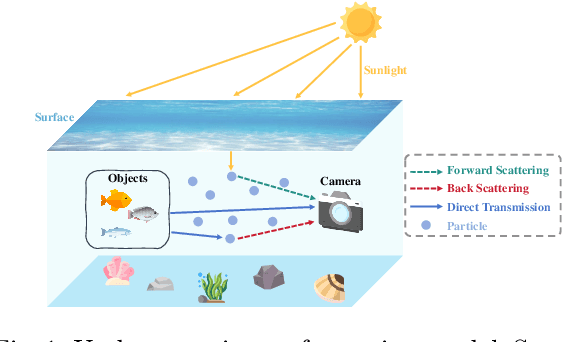
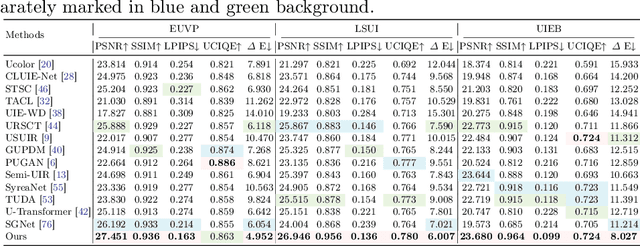
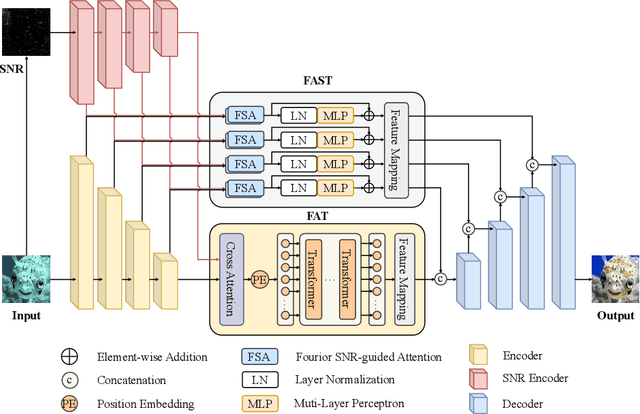
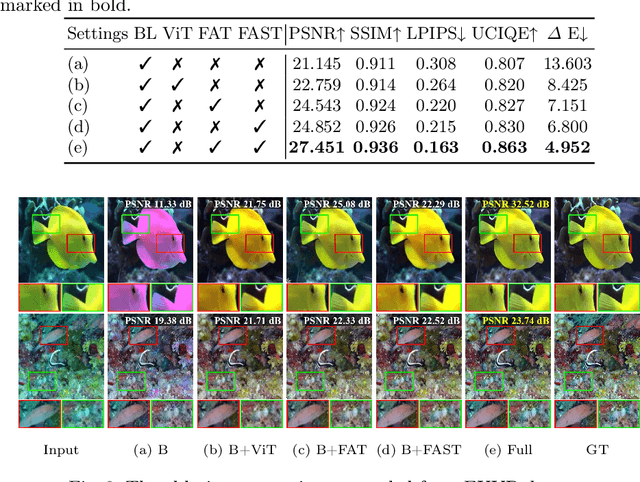
Recent learning-based underwater image enhancement (UIE) methods have advanced by incorporating physical priors into deep neural networks, particularly using the signal-to-noise ratio (SNR) prior to reduce wavelength-dependent attenuation. However, spatial domain SNR priors have two limitations: (i) they cannot effectively separate cross-channel interference, and (ii) they provide limited help in amplifying informative structures while suppressing noise. To overcome these, we propose using the SNR prior in the frequency domain, decomposing features into amplitude and phase spectra for better channel modulation. We introduce the Fourier Attention SNR-prior Transformer (FAST), combining spectral interactions with SNR cues to highlight key spectral components. Additionally, the Frequency Adaptive Transformer (FAT) bottleneck merges low- and high-frequency branches using a gated attention mechanism to enhance perceptual quality. Embedded in a unified U-shaped architecture, these modules integrate a conventional RGB stream with an SNR-guided branch, forming SFormer. Trained on 4,800 paired images from UIEB, EUVP, and LSUI, SFormer surpasses recent methods with a 3.1 dB gain in PSNR and 0.08 in SSIM, successfully restoring colors, textures, and contrast in underwater scenes.
Channel Correlation Matrix Extrapolation Based on Roughness Calibration of Scatterers
Sep 17, 2024To estimate the channel correlation matrix (CCM) in areas where channel information cannot be collected in advance, this paper proposes a way to spatially extrapolate CCM based on the calibration of the surface roughness parameters of scatterers in the propagation scene. We calibrate the roughness parameters of scene scatters based on CCM data in some specific areas. From these calibrated roughness parameters, we are able to generate a good prediction of the CCM for any other area in the scene by performing ray tracing. Simulation results show that the channel extrapolation method proposed in this paper can effectively realize the extrapolation of the CCM between different areas in frequency domain, or even from one domain to another.
A Dynamic Resource Scheduling Algorithm Based on Traffic Prediction for Coexistence of eMBB and Random Arrival URLLC
Sep 04, 2024In this paper, we propose a joint design for the coexistence of enhanced mobile broadband (eMBB) and ultra-reliable and random low-latency communication (URLLC) with different transmission time intervals (TTI): an eMBB scheduler operating at the beginning of each eMBB TTI to decide the coding redundancy of eMBB code blocks, and a URLLC scheduler at the beginning of each mini-slot to perform immediate preemption to ensure that the randomly arriving URLLC traffic is allocated with enough radio resource and the eMBB traffic keeps acceptable one-shot transmission successful probability and throughput. The framework for schedulers under hybrid-TTI is developed and a method to configure eMBB code block based on URLLC traffic arrival prediction is implemented. Simulations show that our work improves the throughput of eMBB traffic without sacrificing the reliablity while supporting randomly arriving URLLC traffic.