 Add to Chrome
 Add to Firefox
 Add to Edge
Exploring Dualistic Meta-Learning to Enhance Domain Generalization in Open Set Scenarios
Jun 24, 2026
Domain generalization learns from multiple source domains to generalize to unseen target domains. However, it often neglects the realistic case of label mismatch between source and target. Open set domain generalization is then proposed to recognize unseen classes in unseen domains. A simple approach trains one-vs-all classifiers to separate each class and detect outliers as unknown. Yet, the imbalance between few positive samples and many negative samples skews the decision boundary towards the positive ones, leading the model to over-reject out-of-distribution data, even from known classes in unseen domains. In this paper, we propose a novel meta-learning stategy called dualistic MEta-learning with joint DomaIn-Class matching (MEDIC), which considers implicit gradient matching towards inter-domain and inter-class task splits simultaneously to find optimal boundaries balanced for both domains and classes. Experimental results show that MEDIC not only outperforms prior methods in open set scenarios, but also maintains competitive close set generalization ability.

JoyAI-LLM Flash: Advancing Mid-Scale LLMs with Token Efficiency
Apr 03, 2026We introduce JoyAI-LLM Flash, an efficient Mixture-of-Experts (MoE) language model designed to redefine the trade-off between strong performance and token efficiency in the sub-50B parameter regime. JoyAI-LLM Flash is pretrained on a massive corpus of 20 trillion tokens and further optimized through a rigorous post-training pipeline, including supervised fine-tuning (SFT), Direct Preference Optimization (DPO), and large-scale reinforcement learning (RL) across diverse environments. To improve token efficiency, JoyAI-LLM Flash strategically balances \emph{thinking} and \emph{non-thinking} cognitive modes and introduces FiberPO, a novel RL algorithm inspired by fibration theory that decomposes trust-region maintenance into global and local components, providing unified multi-scale stability control for LLM policy optimization. To enhance architectural sparsity, the model comprises 48B total parameters while activating only 2.7B parameters per forward pass, achieving a substantially higher sparsity ratio than contemporary industry leading models of comparable scale. To further improve inference throughput, we adopt a joint training-inference co-design that incorporates dense Multi-Token Prediction (MTP) and Quantization-Aware Training (QAT). We release the checkpoints for both JoyAI-LLM-48B-A3B Base and its post-trained variants on Hugging Face to support the open-source community.
Generalizable Decision Boundaries: Dualistic Meta-Learning for Open Set Domain Generalization
Aug 18, 2023Domain generalization (DG) is proposed to deal with the issue of domain shift, which occurs when statistical differences exist between source and target domains. However, most current methods do not account for a common realistic scenario where the source and target domains have different classes. To overcome this deficiency, open set domain generalization (OSDG) then emerges as a more practical setting to recognize unseen classes in unseen domains. An intuitive approach is to use multiple one-vs-all classifiers to define decision boundaries for each class and reject the outliers as unknown. However, the significant class imbalance between positive and negative samples often causes the boundaries biased towards positive ones, resulting in misclassification for known samples in the unseen target domain. In this paper, we propose a novel meta-learning-based framework called dualistic MEta-learning with joint DomaIn-Class matching (MEDIC), which considers gradient matching towards inter-domain and inter-class splits simultaneously to find a generalizable boundary balanced for all tasks. Experimental results demonstrate that MEDIC not only outperforms previous methods in open set scenarios, but also maintains competitive close set generalization ability at the same time. Our code is available at https://github.com/zzwdx/MEDIC.
Automatic Foreground Extraction using Multi-Agent Consensus Equilibrium
Aug 24, 2018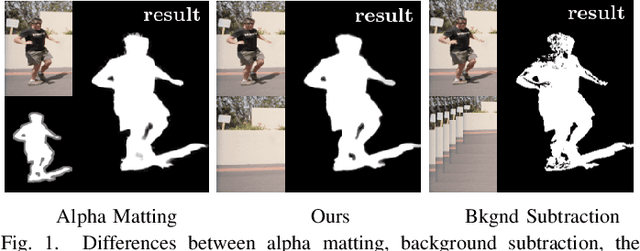

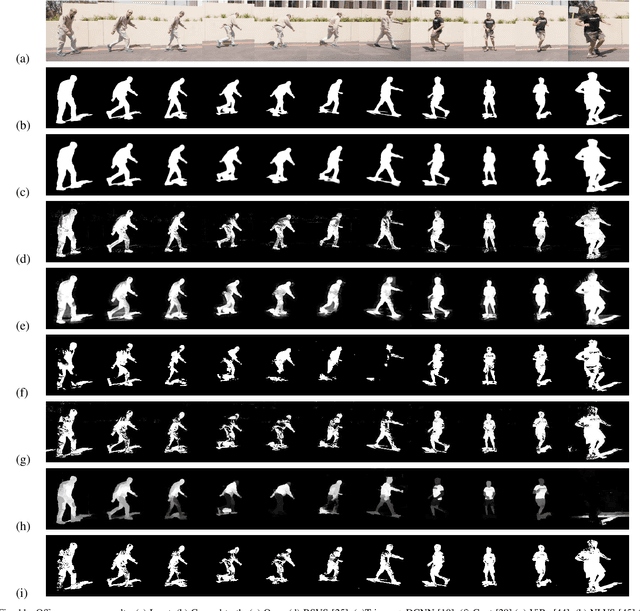

While foreground extraction is fundamental to virtual reality systems and has been studied for decades, majority of the professional softwares today still rely substantially on human interventions, e.g., providing trimaps or labeling key frames. This is not only time consuming, but is also sensitive to human error. In this paper, we present a fully automatic foreground extraction algorithm which does not require any trimap or scribble. Our solution is based on a newly developed concept called the Multi-Agent Consensus Equilibrium (MACE), a framework which allows us to integrate multiple sources of expertise to produce an overall superior result. The MACE framework consists of three agents: (1) A new dual layer closed-form matting agent to estimate the foreground mask using the color image and a background image; (2) A background probability estimator using color difference and object segmentation; (3) A total variation minimization agent to control the smoothness of the foreground masks. We show how these agents are constructed, and how their interactions lead to better performance. We evaluate the performance of the proposed algorithm by comparing to several state-of-the-art methods. On the real datasets we tested, our results show less error compared to the other methods.
Plug-and-Play ADMM for Image Restoration: Fixed Point Convergence and Applications
Nov 11, 2016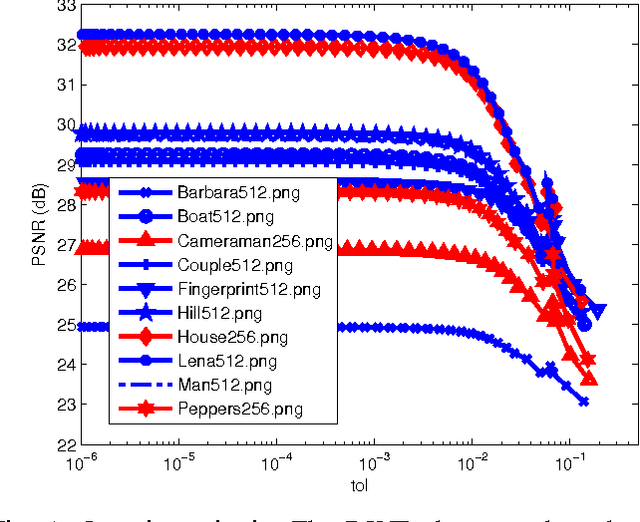
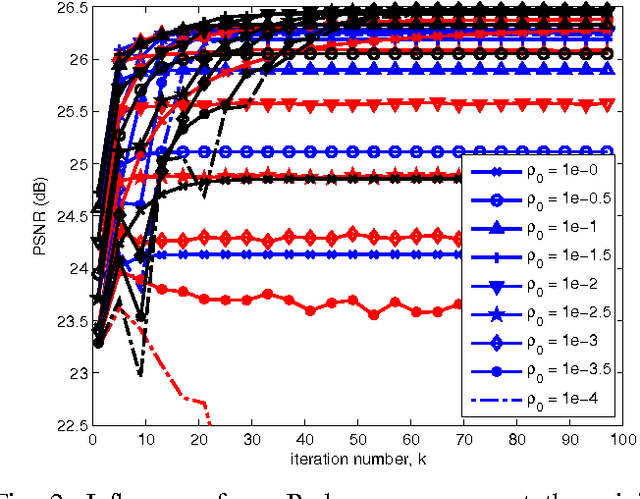
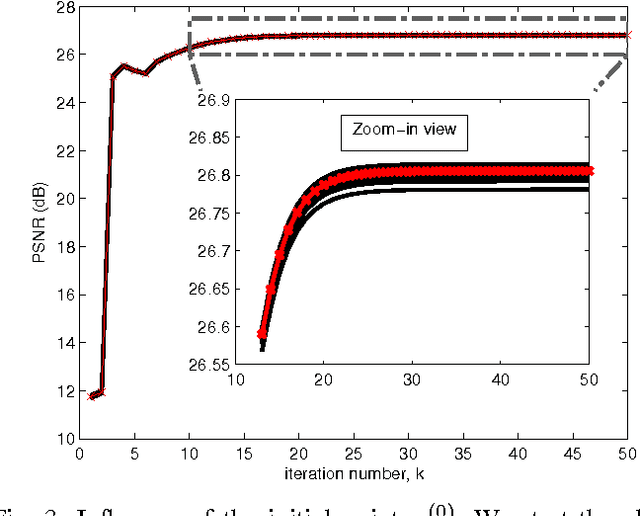
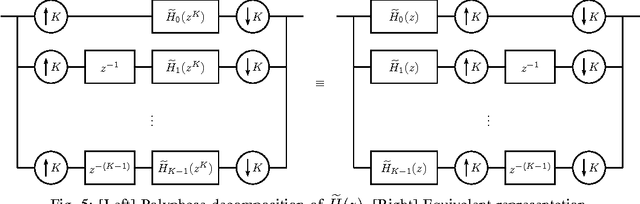
Alternating direction method of multiplier (ADMM) is a widely used algorithm for solving constrained optimization problems in image restoration. Among many useful features, one critical feature of the ADMM algorithm is its modular structure which allows one to plug in any off-the-shelf image denoising algorithm for a subproblem in the ADMM algorithm. Because of the plug-in nature, this type of ADMM algorithms is coined the name "Plug-and-Play ADMM". Plug-and-Play ADMM has demonstrated promising empirical results in a number of recent papers. However, it is unclear under what conditions and by using what denoising algorithms would it guarantee convergence. Also, since Plug-and-Play ADMM uses a specific way to split the variables, it is unclear if fast implementation can be made for common Gaussian and Poissonian image restoration problems. In this paper, we propose a Plug-and-Play ADMM algorithm with provable fixed point convergence. We show that for any denoising algorithm satisfying an asymptotic criteria, called bounded denoisers, Plug-and-Play ADMM converges to a fixed point under a continuation scheme. We also present fast implementations for two image restoration problems on super-resolution and single-photon imaging. We compare Plug-and-Play ADMM with state-of-the-art algorithms in each problem type, and demonstrate promising experimental results of the algorithm.