 Add to Chrome
 Add to Firefox
 Add to Edge
Spatial Memory Agent: Experience-Grounded Procedure Memory for Spatial Intelligence
Aug 13, 2026
Spatial intelligence is becoming a foundation for embodied agents, robotic planning, and multimodal assistants. To improve the spatial reasoning ability of VLM agents, existing work has mainly followed two lines. One line uses post-training methods, such as supervised fine-tuning and reinforcement learning. Another line adopts an agentic paradigm in which the model calls external spatial tools, such as depth estimation and 3D reconstruction tools, to gather intermediate spatial evidence. We study a complementary and underexplored route: Can a frozen VLM agent improve its spatial reasoning through \textbf{parameter-update-free self-evolution}, without depending on external expert spatial tools at inference time? We present \textbf{Spatial Memory Agent (SMA)}, an \textbf{experience-grounded runtime framework} that converts verified spatial experience into reusable transferable lessons. In a verifiable spatial environment, SMA queries the frozen VLM, obtains a predicted answer and reward, and uses \textbf{verifier-guided reflection} to distill compact transferable lessons from spatial experience. SMA further assigns each lesson a \textbf{Transfer Reliability Score (TRS)}, which is initialized uniformly and calibrated from later retrieval outcomes as visit evidence of future transfer reliability. During \textbf{read-only deployment}, SMA retrieves lessons by semantic filter and similarity-TRS combined ranking, allowing the retrieved memory to guide frozen model inference. Across five representative spatial benchmarks and four base VLMs, SMA achieves the highest macro average in every base-model block and the best accuracy among the evaluated methods in most of the 20 evaluations, establishing a practical parameter-update-free path for spatial self-evolution across the evaluated frozen model scales and environments.

Dimension-Free Average Treatment Effect Inference with Deep Neural Networks
Dec 02, 2021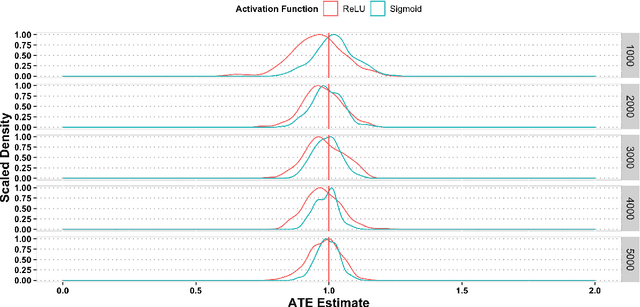
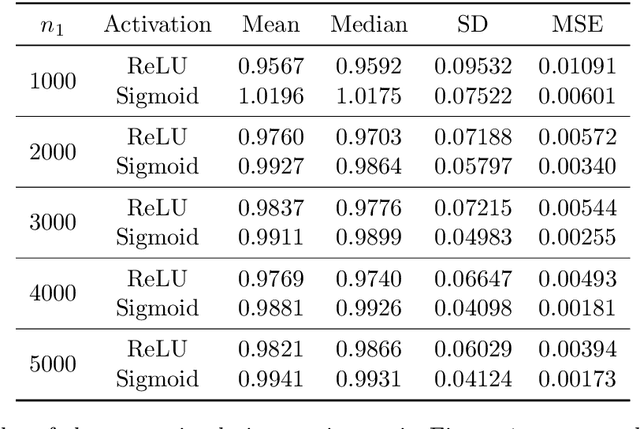
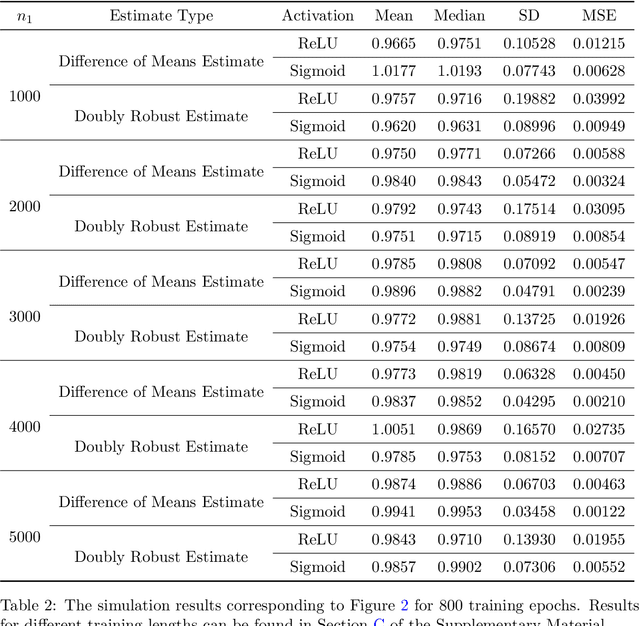
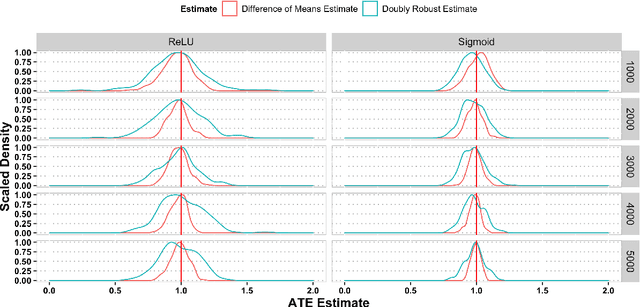
This paper investigates the estimation and inference of the average treatment effect (ATE) using deep neural networks (DNNs) in the potential outcomes framework. Under some regularity conditions, the observed response can be formulated as the response of a mean regression problem with both the confounding variables and the treatment indicator as the independent variables. Using such formulation, we investigate two methods for ATE estimation and inference based on the estimated mean regression function via DNN regression using a specific network architecture. We show that both DNN estimates of ATE are consistent with dimension-free consistency rates under some assumptions on the underlying true mean regression model. Our model assumptions accommodate the potentially complicated dependence structure of the observed response on the covariates, including latent factors and nonlinear interactions between the treatment indicator and confounding variables. We also establish the asymptotic normality of our estimators based on the idea of sample splitting, ensuring precise inference and uncertainty quantification. Simulation studies and real data application justify our theoretical findings and support our DNN estimation and inference methods.