 Add to Chrome
 Add to Firefox
 Add to Edge
PAct: Part-Decomposed Single-View Articulated Object Generation
Feb 16, 2026
Articulated objects are central to interactive 3D applications, including embodied AI, robotics, and VR/AR, where functional part decomposition and kinematic motion are essential. Yet producing high-fidelity articulated assets remains difficult to scale because it requires reliable part decomposition and kinematic rigging. Existing approaches largely fall into two paradigms: optimization-based reconstruction or distillation, which can be accurate but often takes tens of minutes to hours per instance, and inference-time methods that rely on template or part retrieval, producing plausible results that may not match the specific structure and appearance in the input observation. We introduce a part-centric generative framework for articulated object creation that synthesizes part geometry, composition, and articulation under explicit part-aware conditioning. Our representation models an object as a set of movable parts, each encoded by latent tokens augmented with part identity and articulation cues. Conditioned on a single image, the model generates articulated 3D assets that preserve instance-level correspondence while maintaining valid part structure and motion. The resulting approach avoids per-instance optimization, enables fast feed-forward inference, and supports controllable assembly and articulation, which are important for embodied interaction. Experiments on common articulated categories (e.g., drawers and doors) show improved input consistency, part accuracy, and articulation plausibility over optimization-based and retrieval-driven baselines, while substantially reducing inference time.

GAT-Grasp: Gesture-Driven Affordance Transfer for Task-Aware Robotic Grasping
Mar 08, 2025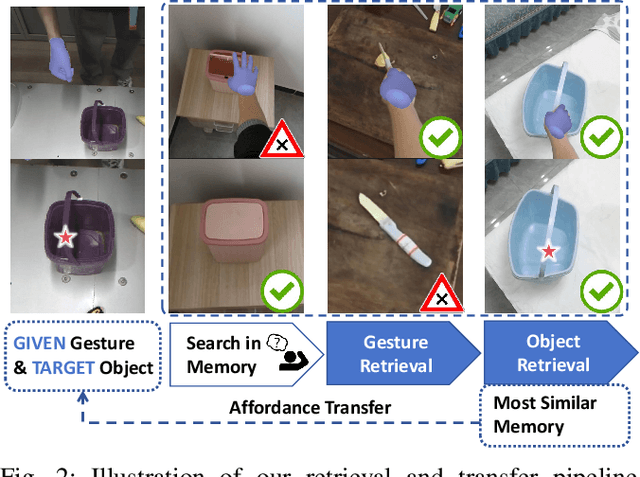
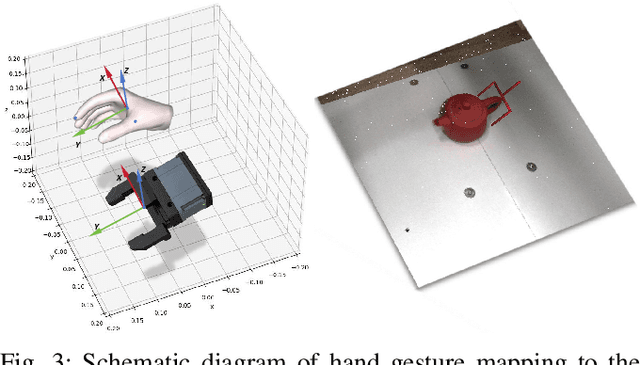
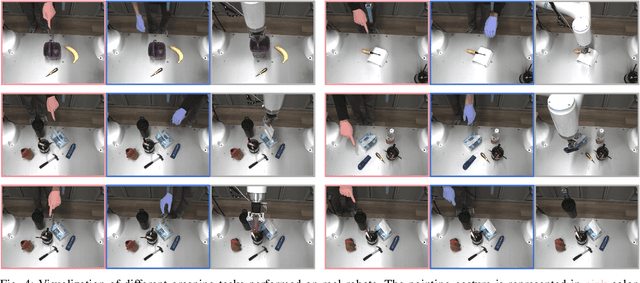
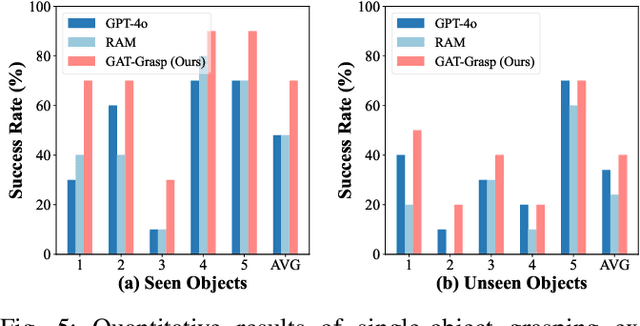
Achieving precise and generalizable grasping across diverse objects and environments is essential for intelligent and collaborative robotic systems. However, existing approaches often struggle with ambiguous affordance reasoning and limited adaptability to unseen objects, leading to suboptimal grasp execution. In this work, we propose GAT-Grasp, a gesture-driven grasping framework that directly utilizes human hand gestures to guide the generation of task-specific grasp poses with appropriate positioning and orientation. Specifically, we introduce a retrieval-based affordance transfer paradigm, leveraging the implicit correlation between hand gestures and object affordances to extract grasping knowledge from large-scale human-object interaction videos. By eliminating the reliance on pre-given object priors, GAT-Grasp enables zero-shot generalization to novel objects and cluttered environments. Real-world evaluations confirm its robustness across diverse and unseen scenarios, demonstrating reliable grasp execution in complex task settings.