 Add to Chrome
 Add to Firefox
 Add to Edge
V-CAST: Video Curvature-Aware Spatio-Temporal Pruning for Efficient Video Large Language Models
Mar 29, 2026
Video large language models (VideoLLMs) show strong capability in video understanding, yet long-context inference is still dominated by massive redundant visual tokens in the prefill stage. We revisit token compression for VideoLLMs under a tight budget and identify a key bottleneck, namely insufficient spatio-temporal information coverage. Existing methods often introduce discontinuous coverage through coarse per-frame allocation or scene segmentation, and token merging can further misalign spatio-temporal coordinates under MRoPE-style discrete (t,h,w) bindings. To address these issues, we propose V-CAST (Video Curvature-Aware Spatio-Temporal Pruning), a training-free, plug-and-play pruning policy for long-context video inference. V-CAST casts token compression as a trajectory approximation problem and introduces a curvature-guided temporal allocation module that routes per-frame token budgets to semantic turns and event boundaries. It further adopts a dual-anchor spatial selection mechanism that preserves high-entropy visual evidence without attention intervention, while keeping retained tokens at their original coordinates to maintain positional alignment. Extensive experiments across multiple VideoLLMs of different architectures and scales demonstrate that V-CAST achieves 98.6% of the original performance, outperforms the second-best method by +1.1% on average, and reduces peak memory and total latency to 86.7% and 86.4% of vanilla Qwen3-VL-8B-Instruct.

Perception- and Fidelity-aware Reduced-Reference Super-Resolution Image Quality Assessment
May 15, 2024

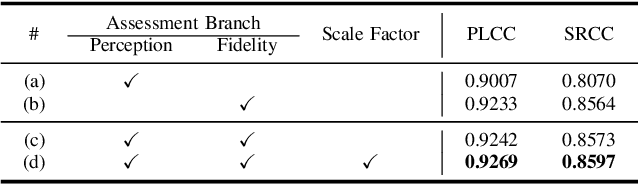

With the advent of image super-resolution (SR) algorithms, how to evaluate the quality of generated SR images has become an urgent task. Although full-reference methods perform well in SR image quality assessment (SR-IQA), their reliance on high-resolution (HR) images limits their practical applicability. Leveraging available reconstruction information as much as possible for SR-IQA, such as low-resolution (LR) images and the scale factors, is a promising way to enhance assessment performance for SR-IQA without HR for reference. In this letter, we attempt to evaluate the perceptual quality and reconstruction fidelity of SR images considering LR images and scale factors. Specifically, we propose a novel dual-branch reduced-reference SR-IQA network, \ie, Perception- and Fidelity-aware SR-IQA (PFIQA). The perception-aware branch evaluates the perceptual quality of SR images by leveraging the merits of global modeling of Vision Transformer (ViT) and local relation of ResNet, and incorporating the scale factor to enable comprehensive visual perception. Meanwhile, the fidelity-aware branch assesses the reconstruction fidelity between LR and SR images through their visual perception. The combination of the two branches substantially aligns with the human visual system, enabling a comprehensive SR image evaluation. Experimental results indicate that our PFIQA outperforms current state-of-the-art models across three widely-used SR-IQA benchmarks. Notably, PFIQA excels in assessing the quality of real-world SR images.