 Add to Chrome
 Add to Firefox
 Add to Edge
Is Mathematical Problem-Solving Expertise in Large Language Models Associated with Assessment Performance?
Mar 26, 2026
Large Language Models (LLMs) are increasingly used in math education not only as problem solvers but also as assessors of learners' reasoning. However, it remains unclear whether stronger math problem-solving ability is associated with stronger step-level assessment performance. This study examines that relationship using the GSM8K and MATH subsets of PROCESSBENCH, a human-annotated benchmark for identifying the earliest erroneous step in mathematical reasoning. We evaluate two LLM-based math tutor agent settings, instantiated with GPT-4 and GPT-5, in two independent tasks on the same math problems: solving the original problem and assessing a benchmark-provided solution by predicting the earliest erroneous step. Results show a consistent within-model pattern: assessment accuracy is substantially higher on math problem items the same model solved correctly than on items it solved incorrectly, with statistically significant associations across both models and datasets. At the same time, assessment remains more difficult than direct problem solving, especially on error-present solutions. These findings suggest that math problem-solving expertise supports stronger assessment performance, but reliable step-level diagnosis also requires additional capabilities such as step tracking, monitoring, and precise error localization. The results have implications for the design and evaluation of AI-supported Adaptive Instructional Systems (AISs) for formative assessment in math education.

Kimi K2.5: Visual Agentic Intelligence
Feb 02, 2026We introduce Kimi K2.5, an open-source multimodal agentic model designed to advance general agentic intelligence. K2.5 emphasizes the joint optimization of text and vision so that two modalities enhance each other. This includes a series of techniques such as joint text-vision pre-training, zero-vision SFT, and joint text-vision reinforcement learning. Building on this multimodal foundation, K2.5 introduces Agent Swarm, a self-directed parallel agent orchestration framework that dynamically decomposes complex tasks into heterogeneous sub-problems and executes them concurrently. Extensive evaluations show that Kimi K2.5 achieves state-of-the-art results across various domains including coding, vision, reasoning, and agentic tasks. Agent Swarm also reduces latency by up to $4.5\times$ over single-agent baselines. We release the post-trained Kimi K2.5 model checkpoint to facilitate future research and real-world applications of agentic intelligence.
Kimi K2: Open Agentic Intelligence
Jul 28, 2025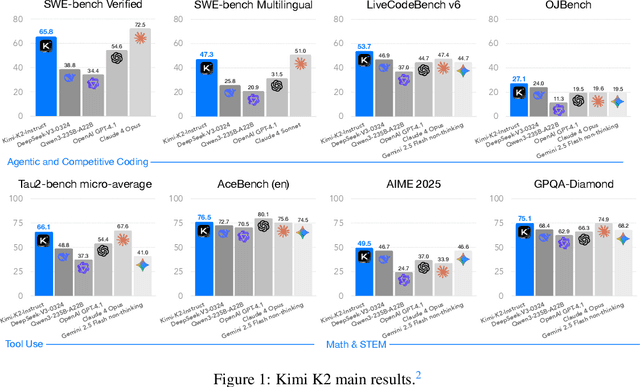
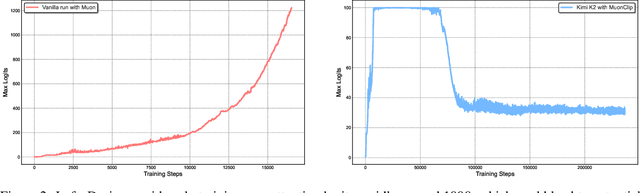
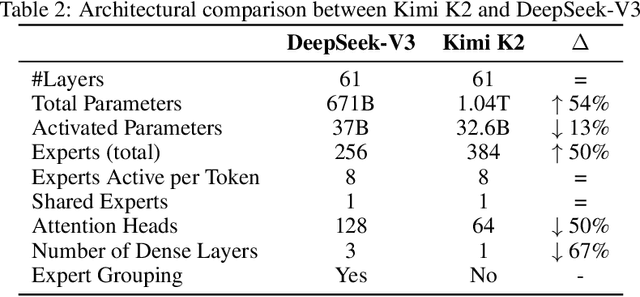
We introduce Kimi K2, a Mixture-of-Experts (MoE) large language model with 32 billion activated parameters and 1 trillion total parameters. We propose the MuonClip optimizer, which improves upon Muon with a novel QK-clip technique to address training instability while enjoying the advanced token efficiency of Muon. Based on MuonClip, K2 was pre-trained on 15.5 trillion tokens with zero loss spike. During post-training, K2 undergoes a multi-stage post-training process, highlighted by a large-scale agentic data synthesis pipeline and a joint reinforcement learning (RL) stage, where the model improves its capabilities through interactions with real and synthetic environments. Kimi K2 achieves state-of-the-art performance among open-source non-thinking models, with strengths in agentic capabilities. Notably, K2 obtains 66.1 on Tau2-Bench, 76.5 on ACEBench (En), 65.8 on SWE-Bench Verified, and 47.3 on SWE-Bench Multilingual -- surpassing most open and closed-sourced baselines in non-thinking settings. It also exhibits strong capabilities in coding, mathematics, and reasoning tasks, with a score of 53.7 on LiveCodeBench v6, 49.5 on AIME 2025, 75.1 on GPQA-Diamond, and 27.1 on OJBench, all without extended thinking. These results position Kimi K2 as one of the most capable open-source large language models to date, particularly in software engineering and agentic tasks. We release our base and post-trained model checkpoints to facilitate future research and applications of agentic intelligence.