 Add to Chrome
 Add to Firefox
 Add to Edge
Quantum Incremental Learning with Mixed State Prototypes
Aug 11, 2026
Incremental learning models are required to learn new classes sequentially without catastrophic forgetting, while operating under parameter and memory constraints. In the Noisy Intermediate-Scale Quantum (NISQ) era, although quantum neural networks offer advantages in feature mapping, hardware limitations restrict circuit width. Furthermore, traditional quantum classifiers are constrained by the number of orthogonal basis states, limiting their capacity to accommodate a continually growing number of categories. Thus, we introduce a novel quantum incremental learning framework based on trainable mixed-state prototypes. Its original design incorporates new classes by adding class prototypes rather than increasing the circuit width of the shared quantum backbone. The use of mixed-state prototypes is another key contribution, since they have representation capabilities to represent information than a single pure-state prototype. And the decomposable mixed-state calculation provides lower production costs and a convenient Hilbert-Schmidt (HS) distance metric for classification. Simulation results show that our model achieves high-dimensional feature concentration using a minimal number of qubits, while demonstrating lower computational complexity and robust representation in incremental learning tasks compared with classical baselines.

DataRx: Missingness-Aware Sampling for Safer Large Language Model Task-Specific Fine-Tuning
Aug 05, 2026Task-specific fine-tuning can improve the performance of large language models (LLMs) on downstream tasks. However, our study reveals that task-specific fine-tuning can also weaken the safety guardrails of aligned LLMs. A widely adopted strategy for preserving safety during fine-tuning is to incorporate safety data. Although previous studies have shown that randomly mixing safety data can alleviate safety degradation, the underlying principle determining why some safety examples are more effective than others still remains unclear. In this paper, we propose DataRx, a missingness-aware sampling method for selecting safety-critical examples. DataRx is based on the hypothesis that a safety sample is more effective when the selected examples provide safety signals that fill the missing parts of LLMs' safety capabilities. DataRx's key insight is leveraging high-dimensional hidden representations rather than discrete tokens to quantify the safety signal gap between the target model's native response and the safety reference response. The results show that, with only 1% additional safety samples from BeaverTails, DataRx reduces the average attack success rate of Llama3-8B-Instruct across seven downstream tasks from 59.23% under random sampling to 13.70%. In addition, DataRx can be combined with the existing safety data synthesis method to further enhance safety defenses during fine-tuning. We hope that DataRx will inspire more data-centric defense research.
DataShield: Safety-degrading Data Filtering for LLM Benign Instruction Fine-Tuning
May 29, 2026Large language models (LLMs) suffer from degraded safety capabilities even when fine-tuned with benign datasets. However, existing methods for identifying safety-degrading samples in benign datasets suffer from high computational costs and significant noise issues. In this paper, we propose DataShield to efficiently and effectively identify potential safety-degrading samples. Our key intuition is based on the observation that benign fine-tuning increases the overall response compliance of LLMs. DataShield's key technical insight is to quantify each sample's contribution to the model's compliance behavior as its safety degradation score. DataShield consists of three core components: (1) Compliance Vector Extraction, which captures the LLM's compliance behavior tendency; (2) a novel Compliance-Aware Score (CAS), which automatically identifies the optimal safety-critical layer; and (3) Safety-degrading Sample Filtering, which quantifies the projection shift of training data along the compliance direction. Extensive experimental evaluation on Llama3-8B, Llama3.1-8B, and Qwen2.5-7B using the Alpaca and Dolly benign datasets validates our method's effectiveness in identifying high-risk and low-risk data subsets. We also observe that open-ended question answering is more likely to trigger safety degradation, and corresponding responses tend to be longer. We hope this work can provide new insights into data-centric defense methods. The source code is available at: https://github.com/ZJunBo/DataShield.
Feature Entanglement-based Quantum Multimodal Fusion Neural Network
Jan 09, 2026Multimodal learning aims to enhance perceptual and decision-making capabilities by integrating information from diverse sources. However, classical deep learning approaches face a critical trade-off between the high accuracy of black-box feature-level fusion and the interpretability of less outstanding decision-level fusion, alongside the challenges of parameter explosion and complexity. This paper discusses the accuracy-interpretablity-complexity dilemma under the quantum computation framework and propose a feature entanglement-based quantum multimodal fusion neural network. The model is composed of three core components: a classical feed-forward module for unimodal processing, an interpretable quantum fusion block, and a quantum convolutional neural network (QCNN) for deep feature extraction. By leveraging the strong expressive power of quantum, we have reduced the complexity of multimodal fusion and post-processing to linear, and the fusion process also possesses the interpretability of decision-level fusion. The simulation results demonstrate that our model achieves classification accuracy comparable to classical networks with dozens of times of parameters, exhibiting notable stability and performance across multimodal image datasets.
Sample-agnostic Adversarial Perturbation for Vision-Language Pre-training Models
Aug 06, 2024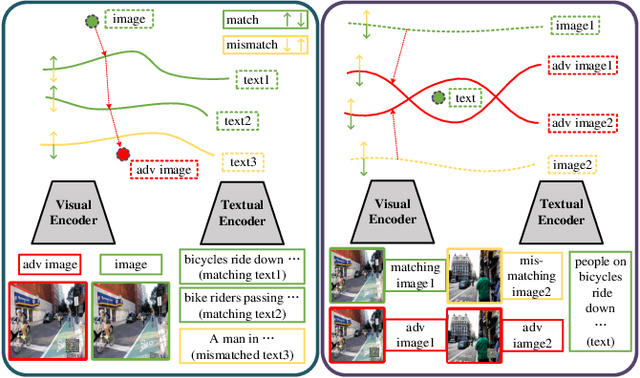
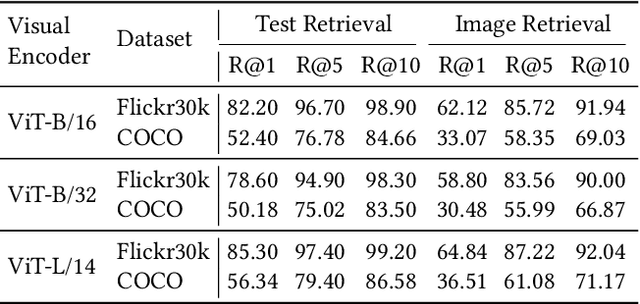
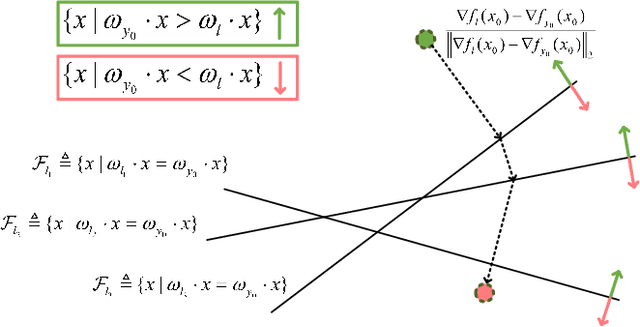
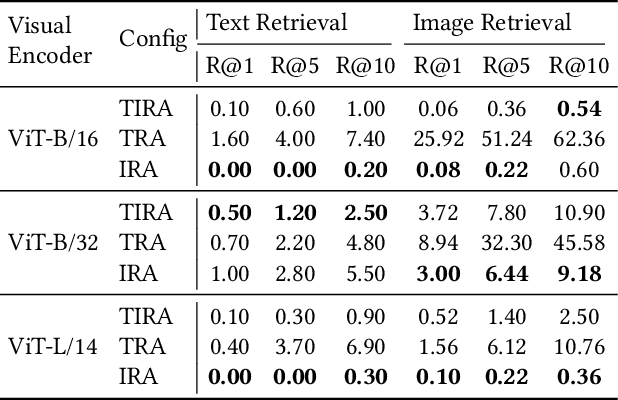
Recent studies on AI security have highlighted the vulnerability of Vision-Language Pre-training (VLP) models to subtle yet intentionally designed perturbations in images and texts. Investigating multimodal systems' robustness via adversarial attacks is crucial in this field. Most multimodal attacks are sample-specific, generating a unique perturbation for each sample to construct adversarial samples. To the best of our knowledge, it is the first work through multimodal decision boundaries to explore the creation of a universal, sample-agnostic perturbation that applies to any image. Initially, we explore strategies to move sample points beyond the decision boundaries of linear classifiers, refining the algorithm to ensure successful attacks under the top $k$ accuracy metric. Based on this foundation, in visual-language tasks, we treat visual and textual modalities as reciprocal sample points and decision hyperplanes, guiding image embeddings to traverse text-constructed decision boundaries, and vice versa. This iterative process consistently refines a universal perturbation, ultimately identifying a singular direction within the input space which is exploitable to impair the retrieval performance of VLP models. The proposed algorithms support the creation of global perturbations or adversarial patches. Comprehensive experiments validate the effectiveness of our method, showcasing its data, task, and model transferability across various VLP models and datasets. Code: https://github.com/LibertazZ/MUAP
A Unified Understanding of Adversarial Vulnerability Regarding Unimodal Models and Vision-Language Pre-training Models
Jul 25, 2024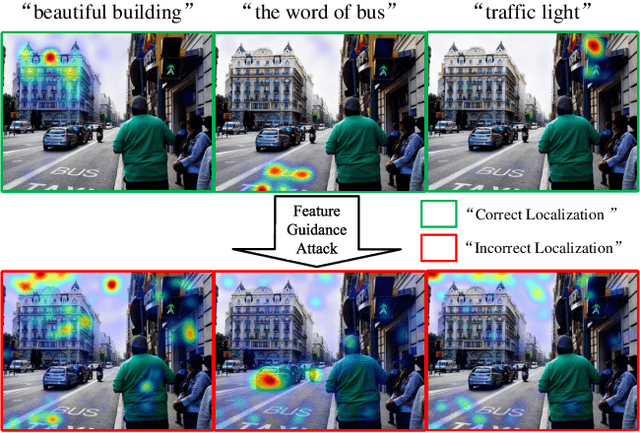
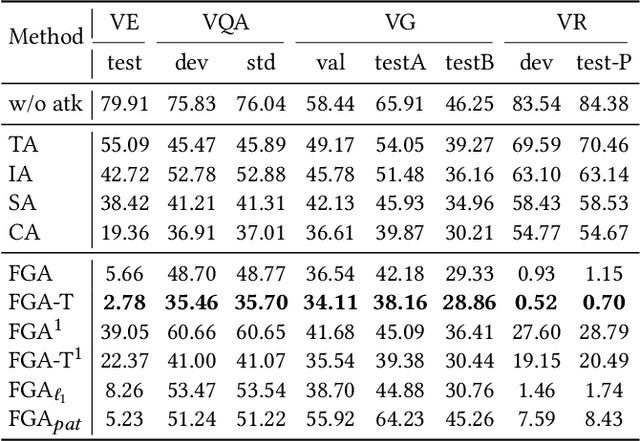
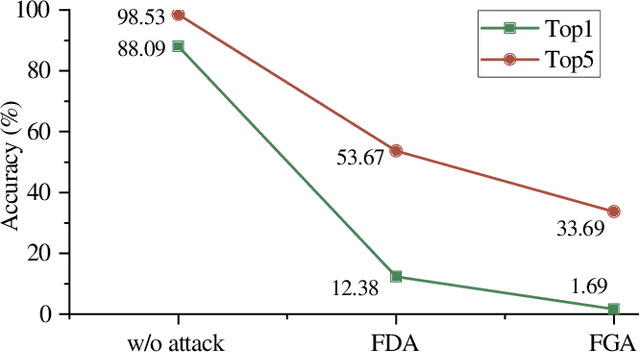
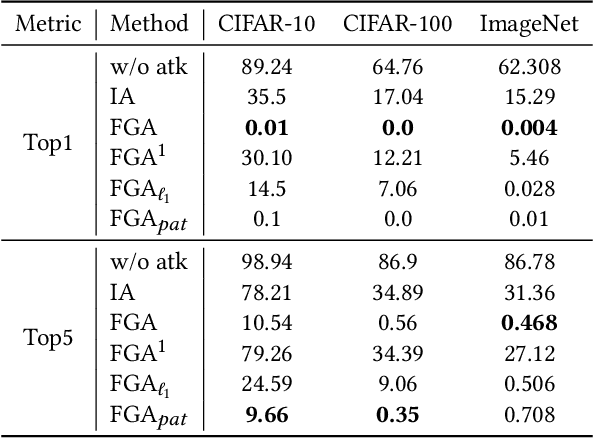
With Vision-Language Pre-training (VLP) models demonstrating powerful multimodal interaction capabilities, the application scenarios of neural networks are no longer confined to unimodal domains but have expanded to more complex multimodal V+L downstream tasks. The security vulnerabilities of unimodal models have been extensively examined, whereas those of VLP models remain challenging. We note that in CV models, the understanding of images comes from annotated information, while VLP models are designed to learn image representations directly from raw text. Motivated by this discrepancy, we developed the Feature Guidance Attack (FGA), a novel method that uses text representations to direct the perturbation of clean images, resulting in the generation of adversarial images. FGA is orthogonal to many advanced attack strategies in the unimodal domain, facilitating the direct application of rich research findings from the unimodal to the multimodal scenario. By appropriately introducing text attack into FGA, we construct Feature Guidance with Text Attack (FGA-T). Through the interaction of attacking two modalities, FGA-T achieves superior attack effects against VLP models. Moreover, incorporating data augmentation and momentum mechanisms significantly improves the black-box transferability of FGA-T. Our method demonstrates stable and effective attack capabilities across various datasets, downstream tasks, and both black-box and white-box settings, offering a unified baseline for exploring the robustness of VLP models.
Basic concepts, definitions, and methods in D number theory
Mar 21, 2020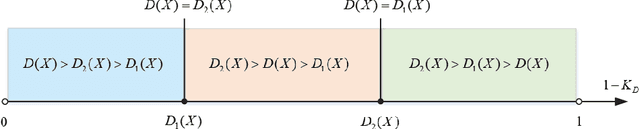
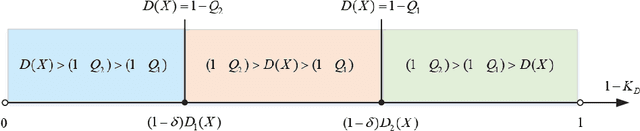
As a generalization of Dempster-Shafer theory, D number theory (DNT) aims to provide a framework to deal with uncertain information with non-exclusiveness and incompleteness. Although there are some advances on DNT in previous studies, however, they lack of systematicness, and many important issues have not yet been solved. In this paper, several crucial aspects in constructing a perfect and systematic framework of DNT are considered. At first the non-exclusiveness in DNT is formally defined and discussed. Secondly, a method to combine multiple D numbers is proposed by extending previous exclusive conflict redistribution (ECR) rule. Thirdly, a new pair of belief and plausibility measures for D numbers are defined and many desirable properties are satisfied by the proposed measures. Fourthly, the combination of information-incomplete D numbers is studied specially to show how to deal with the incompleteness of information in DNT. In this paper, we mainly give relative math definitions, properties, and theorems, concrete examples and applications will be considered in the future study.
Belief and plausibility measures for D numbers
Nov 30, 2019As a generalization of Dempster-Shafer theory, D number theory provides a framework to deal with uncertain information with non-exclusiveness and incompleteness. However, some basic concepts in D number theory are not well defined. In this note, the belief and plausibility measures for D numbers have been proposed, and basic properties of these measures have been revealed as well.
On the negation of a Dempster-Shafer belief structure based on maximum uncertainty allocation
Jan 29, 2019Probability theory and Dempster-Shafer theory are two germane theories to represent and handle uncertain information. Recent study suggested a transformation to obtain the negation of a probability distribution based on the maximum entropy. Correspondingly, determining the negation of a belief structure, however, is still an open issue in Dempster-Shafer theory, which is very important in theoretical research and practical applications. In this paper, a negation transformation for belief structures is proposed based on maximum uncertainty allocation, and several important properties satisfied by the transformation have been studied. The proposed negation transformation is more general and could totally compatible with existing transformation for probability distributions.
A total uncertainty measure for D numbers based on belief intervals
Dec 25, 2017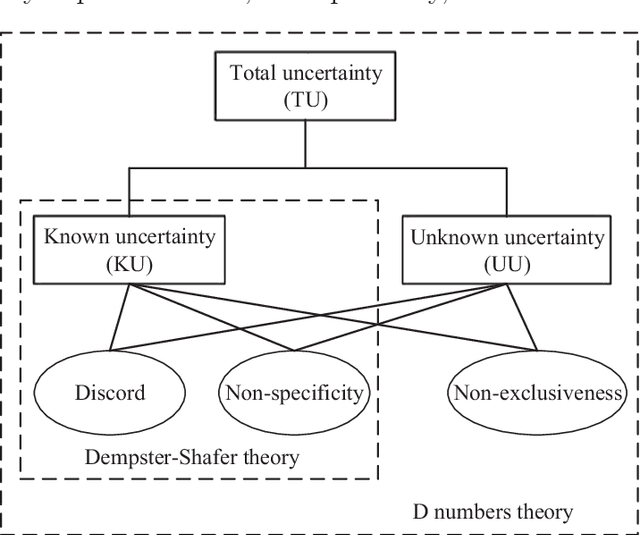
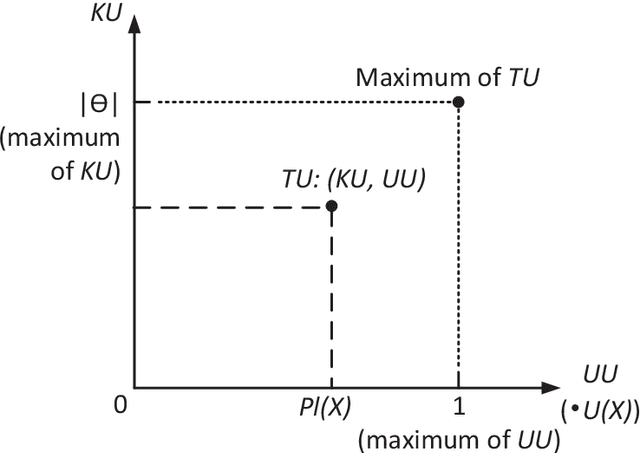
As a generalization of Dempster-Shafer theory, the theory of D numbers is a new theoretical framework for uncertainty reasoning. Measuring the uncertainty of knowledge or information represented by D numbers is an unsolved issue in that theory. In this paper, inspired by distance based uncertainty measures for Dempster-Shafer theory, a total uncertainty measure for a D number is proposed based on its belief intervals. The proposed total uncertainty measure can simultaneously capture the discord, and non-specificity, and non-exclusiveness involved in D numbers. And some basic properties of this total uncertainty measure, including range, monotonicity, generalized set consistency, are also presented.