 Add to Chrome
 Add to Firefox
 Add to Edge
Dual-LoRA and Quality-Enhanced Pseudo Replay for Multimodal Continual Food Learning
Nov 17, 2025
Food analysis has become increasingly critical for health-related tasks such as personalized nutrition and chronic disease prevention. However, existing large multimodal models (LMMs) in food analysis suffer from catastrophic forgetting when learning new tasks, requiring costly retraining from scratch. To address this, we propose a novel continual learning framework for multimodal food learning, integrating a Dual-LoRA architecture with Quality-Enhanced Pseudo Replay. We introduce two complementary low-rank adapters for each task: a specialized LoRA that learns task-specific knowledge with orthogonal constraints to previous tasks' subspaces, and a cooperative LoRA that consolidates shared knowledge across tasks via pseudo replay. To improve the reliability of replay data, our Quality-Enhanced Pseudo Replay strategy leverages self-consistency and semantic similarity to reduce hallucinations in generated samples. Experiments on the comprehensive Uni-Food dataset show superior performance in mitigating forgetting, representing the first effective continual learning approach for complex food tasks.

RoDE: Linear Rectified Mixture of Diverse Experts for Food Large Multi-Modal Models
Jul 17, 2024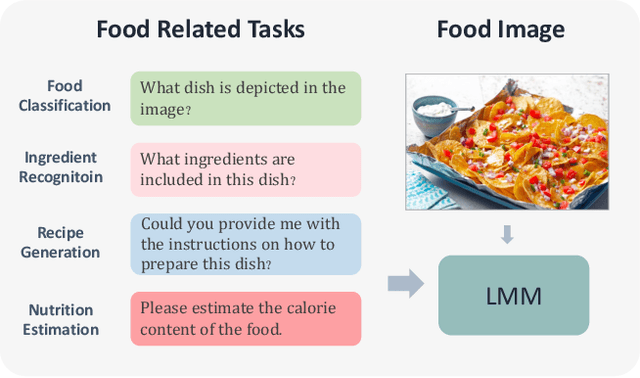
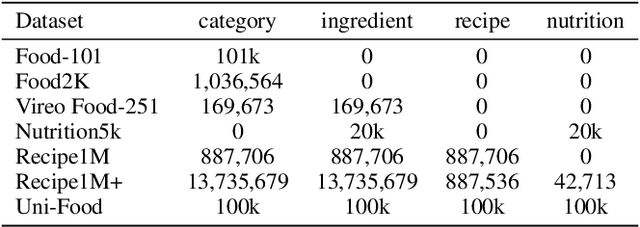


Large Multi-modal Models (LMMs) have significantly advanced a variety of vision-language tasks. The scalability and availability of high-quality training data play a pivotal role in the success of LMMs. In the realm of food, while comprehensive food datasets such as Recipe1M offer an abundance of ingredient and recipe information, they often fall short of providing ample data for nutritional analysis. The Recipe1M+ dataset, despite offering a subset for nutritional evaluation, is limited in the scale and accuracy of nutrition information. To bridge this gap, we introduce Uni-Food, a unified food dataset that comprises over 100,000 images with various food labels, including categories, ingredients, recipes, and ingredient-level nutritional information. Uni-Food is designed to provide a more holistic approach to food data analysis, thereby enhancing the performance and capabilities of LMMs in this domain. To mitigate the conflicts arising from multi-task supervision during fine-tuning of LMMs, we introduce a novel Linear Rectification Mixture of Diverse Experts (RoDE) approach. RoDE utilizes a diverse array of experts to address tasks of varying complexity, thereby facilitating the coordination of trainable parameters, i.e., it allocates more parameters for more complex tasks and, conversely, fewer parameters for simpler tasks. RoDE implements linear rectification union to refine the router's functionality, thereby enhancing the efficiency of sparse task allocation. These design choices endow RoDE with features that ensure GPU memory efficiency and ease of optimization. Our experimental results validate the effectiveness of our proposed approach in addressing the inherent challenges of food-related multitasking.