 Add to Chrome
 Add to Firefox
 Add to Edge
RDGen: Demonstration Generation for High-Quality Robot Learning via Reinforcement Learning
May 29, 2026
Vision-Language-Action (VLA) models have emerged as a promising paradigm for general-purpose robot control. However, their performance remains fundamentally constrained by the availability of high-quality robot trajectory data. In current robot learning practice, such data are primarily collected through human teleoperation, which is labor-intensive, costly, and difficult to scale. In this paper, we propose RDGen, a sim-to-real reinforcement learning framework for generating high-quality robot demonstrations. Rather than employing reinforcement learning solely as the final control policy, RDGen leverages trained RL policies as a structured trajectory generator. The system consists of a VLM-based task parser that identifies task-relevant objects, a Grounding DINO-based object localizer, and an RL policy transferred from simulation to the real robot. Successful rollouts are then harvested as clean, high-quality demonstrations for downstream VLA training, while the simulation stage further provides a scalable source of additional trajectories at little marginal cost. Experiments on a pick-and-place task demonstrate that the transferred RL policy achieves a high task success rate. Compared with human teleoperation, RDGen produces significantly smoother trajectories and yields superior downstream VLA performance. These results indicate that RL-generated demonstrations can serve as more reliable and consistent supervisory signals for robot policy learning.

CoRMA: Contrastive RMA for Contact-Rich Meta-Adaptation
May 21, 2026We present CoRMA(Contrastive Robotic Motor Adaptation), a context-based meta-adaptation framework that modifies RMA for force-dominant assembly. CoRMA replaces raw simulator-parameter adaptation with a compact 6D simulator-only semantic contact context describing contact onset, lateral engagement, guided transition, contact direction, and jamming. A deployable causal Transformer adapter infers this context online from force, proprioceptive, and action histories using semantic regression and a force-regime contrastive objective. At deployment, oracle context is removed and replaced by the inferred context, enabling within-episode adaptation without demonstrations, privileged inputs, or gradient updates. We evaluate CoRMA on PegInsert, GearMesh, and NutThread in Isaac Lab / Isaac Sim~5.0 and on a real Marvin arm. Compared with FORGE baselines that achieve high simulation success but degrade substantially on hardware, CoRMA retains higher verified real success under controlled target-pose noise. These results support semantic contact inference as a reusable adaptation interface within a related assembly task family, while broader unseen-task generalization and Real2Sim calibration remain future work.
ROI-Driven Foveated Attention for Unified Egocentric Representations in Vision-Language-Action Systems
Mar 21, 2026The development of embodied AI systems is increasingly constrained by the availability and structure of physical interaction data. Despite recent advances in vision-language-action (VLA) models, current pipelines suffer from high data collection cost, limited cross-embodiment alignment, and poor transfer from internet-scale visual data to robot control. We propose a region-of-interest (ROI) driven engineering workflow that introduces an egocentric, geometry-grounded data representation. By projecting end-effector poses via forward kinematics (FK) into a single external camera, we derive movement-aligned hand-centric ROIs without requiring wrist-mounted cameras or multi-view systems. Unlike directly downsampling the full frame, ROI is cropped from the original image before resizing, preserving high local information density for contact-critical regions while retaining global context. We present a reproducible pipeline covering calibration, synchronization, ROI generation, deterministic boundary handling, and metadata governance. The resulting representation is embodiment-aligned and viewpoint-normalized, enabling data reuse across heterogeneous robots. We argue that egocentric ROI serves as a practical data abstraction for scalable collection and cross-embodiment learning, bridging internet-scale perception and robot-specific control.
SaiVLA-0: Cerebrum--Pons--Cerebellum Tripartite Architecture for Compute-Aware Vision-Language-Action
Mar 09, 2026We revisit Vision-Language-Action through a neuroscience-inspired triad. Biologically, the Cerebrum provides stable high-level multimodal priors and remains frozen; the Pons Adapter integrates these cortical features with real-time proprioceptive inputs and compiles intent into execution-ready tokens; and the Cerebellum (ParaCAT) performs fast, parallel categorical decoding for online control, with hysteresis/EMA/temperature/entropy for stability. A fixed-ratio schedule and two-stage feature caching make the system compute-aware and reproducible. Inspired by active, foveated vision, our wrist ROIs are geometrically tied to the end-effector via calibrated projection, providing a movement-stabilized, high-resolution view that is sensitive to fine-grained pose changes and complements the global context of the main view. The design is modular: upgrading the Cerebrum only retrains the Pons; changing robots only trains the Cerebellum; cerebellum-only RL can further refine control without touching high-level semantics. As a concept-and-protocol paper with preliminary evidence, we outline a timing protocol under matched conditions (GPU, resolution, batch) to verify anticipated efficiency gains. We also report preliminary LIBERO evidence showing that split feature caching reduces training time (7.5h to 4.5h) and improves average success (86.5% to 92.5%) under official N1.5 head-only training, and that SaiVLA0 reaches 99.0% mean success.
Reinforcement Inference: Leveraging Uncertainty for Self-Correcting Language Model Reasoning
Feb 09, 2026Modern large language models (LLMs) are often evaluated and deployed under a \emph{one-shot, greedy} inference protocol, especially in professional settings that require deterministic behavior. This regime can systematically under-estimate a fixed model's true capability: many errors arise not from missing knowledge, but from premature commitment under internal ambiguity. We introduce \emph{Reinforcement Inference}, an entropy-aware inference-time control strategy that uses the model's own uncertainty to selectively invoke a second, more deliberate reasoning attempt, enabling stronger performance \emph{without any retraining}. On 12,032 MMLU-Pro questions across 14 subjects, using DeepSeek-v3.2 with deterministic decoding in a zero-shot setting, Reinforcement Inference improves accuracy from 60.72\% to 84.03\%, while only incurring 61.06\% additional inference calls. A 100\% re-asking ablation reaches 84.35\%, indicating that uncertainty-aware selection captures most of the attainable improvement with substantially less compute. Moreover, a \emph{prompt-only} ablation underperforms the baseline, suggesting that the gains are not explained by generic `` your output had high entropy, think step-by-step'' prompting alone. Beyond providing a practical inference-time upgrade, our results suggest a broader \emph{entropy-aware} paradigm for measuring and expanding model capability: because modern decoder-based models generate outputs autoregressively, entropy and related confidence measures arise naturally as first-class control signals during generation. The resulting gap between one-pass greedy inference and uncertainty-conditioned deliberation offers a diagnostic lens on an LLM's latent reasoning horizon and motivates future training objectives that explicitly constrain correctness--confidence alignment.
Geometry-Aware Sparse Depth Sampling for High-Fidelity RGB-D Depth Completion in Robotic Systems
Dec 09, 2025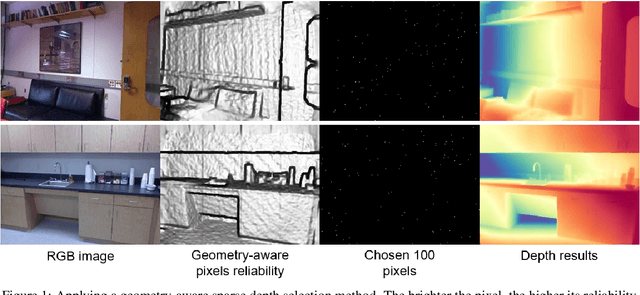

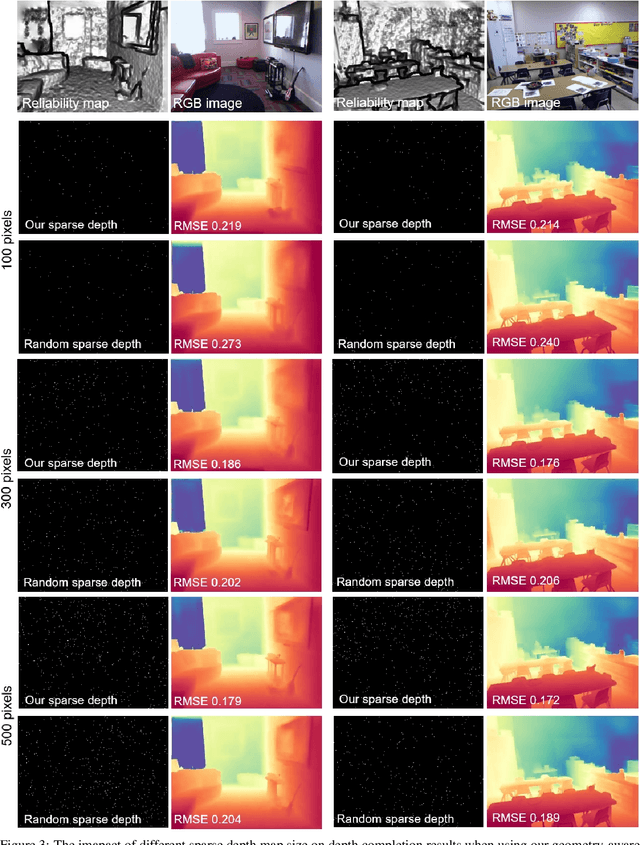
Accurate three-dimensional perception is essential for modern industrial robotic systems that perform manipulation, inspection, and navigation tasks. RGB-D and stereo vision sensors are widely used for this purpose, but the depth maps they produce are often noisy, incomplete, or biased due to sensor limitations and environmental conditions. Depth completion methods aim to generate dense, reliable depth maps from RGB images and sparse depth input. However, a key limitation in current depth completion pipelines is the unrealistic generation of sparse depth: sparse pixels are typically selected uniformly at random from dense ground-truth depth, ignoring the fact that real sensors exhibit geometry-dependent and spatially nonuniform reliability. In this work, we propose a normal-guided sparse depth sampling strategy that leverages PCA-based surface normal estimation on the RGB-D point cloud to compute a per-pixel depth reliability measure. The sparse depth samples are then drawn according to this reliability distribution. We integrate this sampling method with the Marigold-DC diffusion-based depth completion model and evaluate it on NYU Depth v2 using the standard metrics. Experiments show that our geometry-aware sparse depth improves accuracy, reduces artifacts near edges and discontinuities, and produces more realistic training conditions that better reflect real sensor behavior.