 Add to Chrome
 Add to Firefox
 Add to Edge
CoRMA: Contrastive RMA for Contact-Rich Meta-Adaptation
May 21, 2026
We present CoRMA(Contrastive Robotic Motor Adaptation), a context-based meta-adaptation framework that modifies RMA for force-dominant assembly. CoRMA replaces raw simulator-parameter adaptation with a compact 6D simulator-only semantic contact context describing contact onset, lateral engagement, guided transition, contact direction, and jamming. A deployable causal Transformer adapter infers this context online from force, proprioceptive, and action histories using semantic regression and a force-regime contrastive objective. At deployment, oracle context is removed and replaced by the inferred context, enabling within-episode adaptation without demonstrations, privileged inputs, or gradient updates. We evaluate CoRMA on PegInsert, GearMesh, and NutThread in Isaac Lab / Isaac Sim~5.0 and on a real Marvin arm. Compared with FORGE baselines that achieve high simulation success but degrade substantially on hardware, CoRMA retains higher verified real success under controlled target-pose noise. These results support semantic contact inference as a reusable adaptation interface within a related assembly task family, while broader unseen-task generalization and Real2Sim calibration remain future work.

Geometry-Aware Sparse Depth Sampling for High-Fidelity RGB-D Depth Completion in Robotic Systems
Dec 09, 2025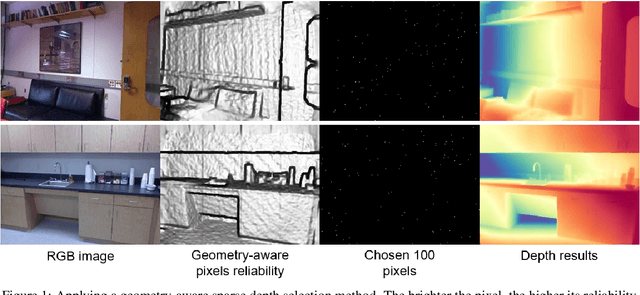

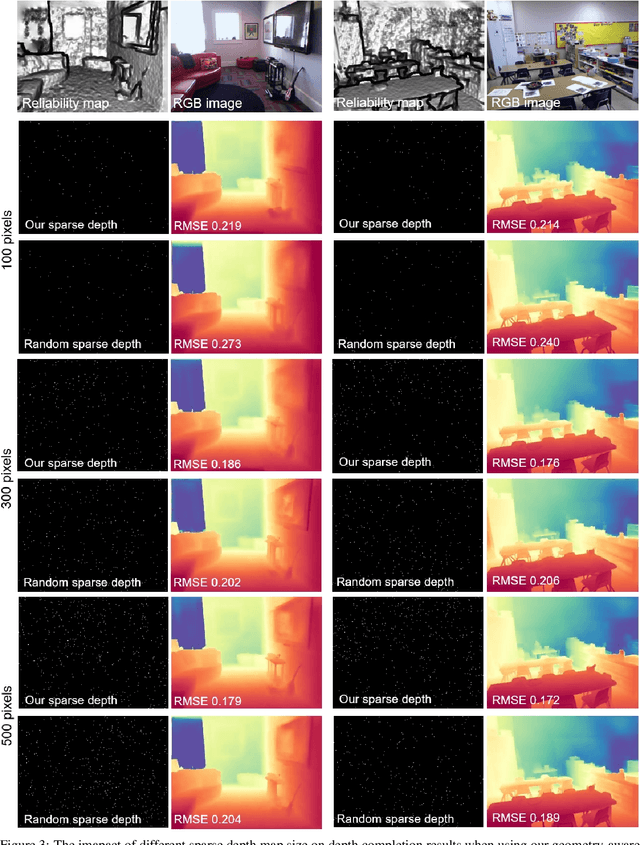
Accurate three-dimensional perception is essential for modern industrial robotic systems that perform manipulation, inspection, and navigation tasks. RGB-D and stereo vision sensors are widely used for this purpose, but the depth maps they produce are often noisy, incomplete, or biased due to sensor limitations and environmental conditions. Depth completion methods aim to generate dense, reliable depth maps from RGB images and sparse depth input. However, a key limitation in current depth completion pipelines is the unrealistic generation of sparse depth: sparse pixels are typically selected uniformly at random from dense ground-truth depth, ignoring the fact that real sensors exhibit geometry-dependent and spatially nonuniform reliability. In this work, we propose a normal-guided sparse depth sampling strategy that leverages PCA-based surface normal estimation on the RGB-D point cloud to compute a per-pixel depth reliability measure. The sparse depth samples are then drawn according to this reliability distribution. We integrate this sampling method with the Marigold-DC diffusion-based depth completion model and evaluate it on NYU Depth v2 using the standard metrics. Experiments show that our geometry-aware sparse depth improves accuracy, reduces artifacts near edges and discontinuities, and produces more realistic training conditions that better reflect real sensor behavior.