 Add to Chrome
 Add to Firefox
 Add to Edge
TACO: Efficient Communication Compression of Intermediate Tensors for Scalable Tensor-Parallel LLM Training
Apr 27, 2026
Handling communication overhead in large-scale tensor-parallel training remains a critical challenge due to the dense, near-zero distributions of intermediate tensors, which exacerbate errors under frequent communication and introduce significant computational overhead during compression. To this end, we propose TACO (Tensor-parallel Adaptive COmmunication compression), a robust FP8-based framework for compressing TP intermediate tensors. First, we employ a data-driven reshaping strategy combined with an Adaptive Scale-Hadamard Transform to enable high-fidelity FP8 quantization, while its Dual-Scale Quantization mechanism ensures numerical stability throughout training. Second, we design a highly fused compression operator to reduce memory traffic and kernel launch overhead, allowing efficient overlap with communication. Finally, we integrate TACO with existing state-of-the-art methods for Data and Pipeline Parallelism to develop a compression-enabled 3D-parallel training framework. Detailed experiments on GPT models and Qwen model demonstrate up to 1.87X end-to-end throughput improvement while maintaining near-lossless accuracy, validating the effectiveness and efficiency of TACO in large-scale training.

On the Adversarial Vulnerabilities of Transfer Learning in Remote Sensing
Jan 20, 2025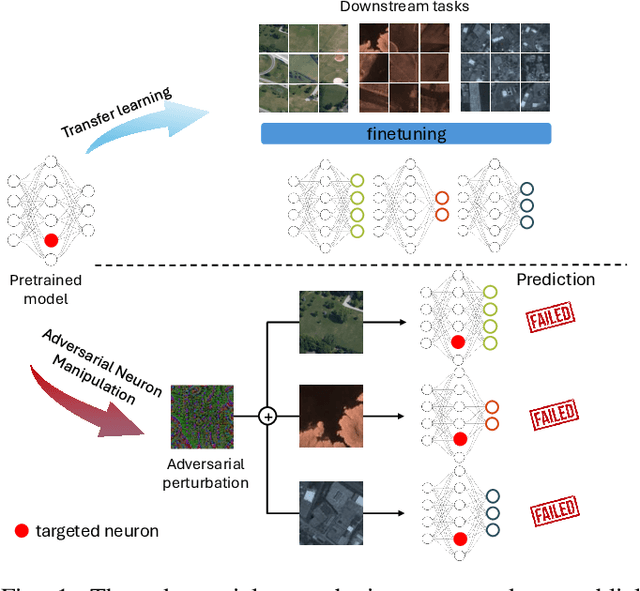
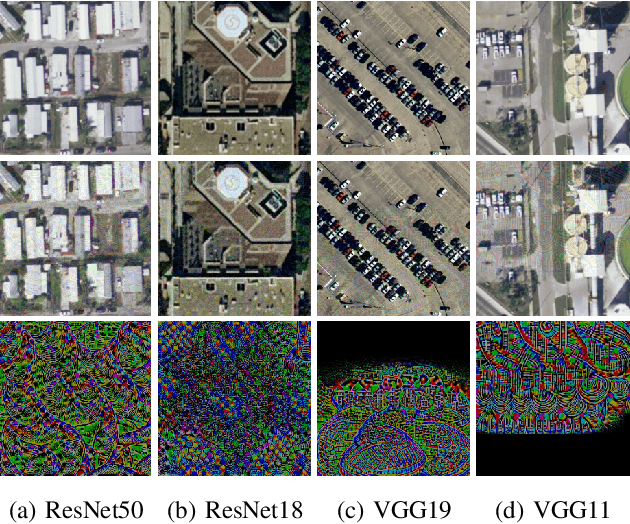
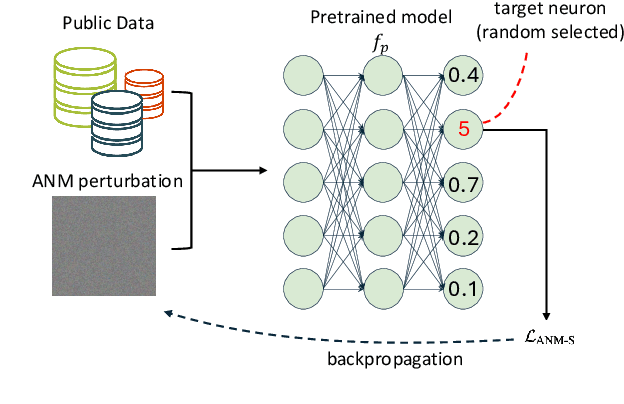
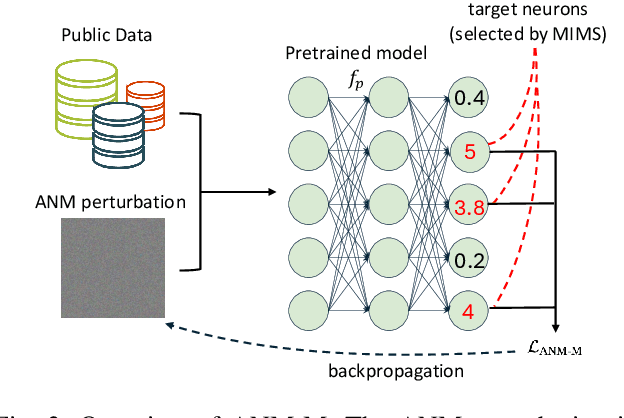
The use of pretrained models from general computer vision tasks is widespread in remote sensing, significantly reducing training costs and improving performance. However, this practice also introduces vulnerabilities to downstream tasks, where publicly available pretrained models can be used as a proxy to compromise downstream models. This paper presents a novel Adversarial Neuron Manipulation method, which generates transferable perturbations by selectively manipulating single or multiple neurons in pretrained models. Unlike existing attacks, this method eliminates the need for domain-specific information, making it more broadly applicable and efficient. By targeting multiple fragile neurons, the perturbations achieve superior attack performance, revealing critical vulnerabilities in deep learning models. Experiments on diverse models and remote sensing datasets validate the effectiveness of the proposed method. This low-access adversarial neuron manipulation technique highlights a significant security risk in transfer learning models, emphasizing the urgent need for more robust defenses in their design when addressing the safety-critical remote sensing tasks.