 Add to Chrome
 Add to Firefox
 Add to Edge
Air-Chamber Based Soft Six-Axis Force/Torque Sensor for Human-Robot Interaction
Nov 17, 2025
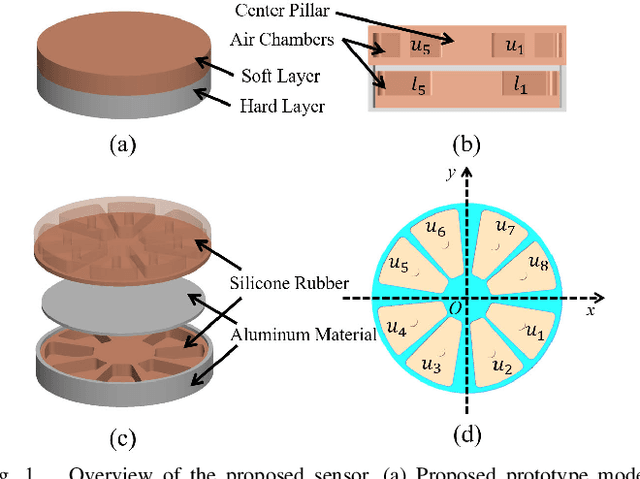
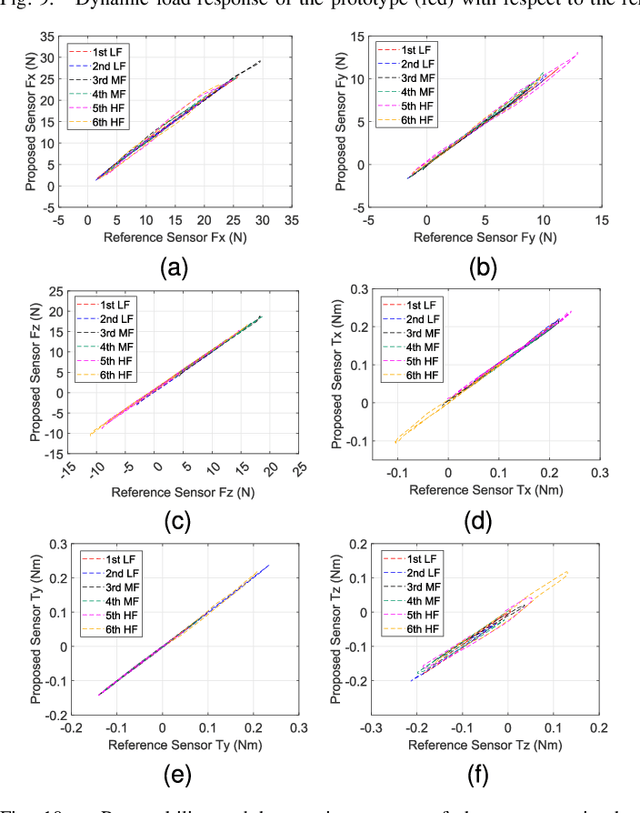
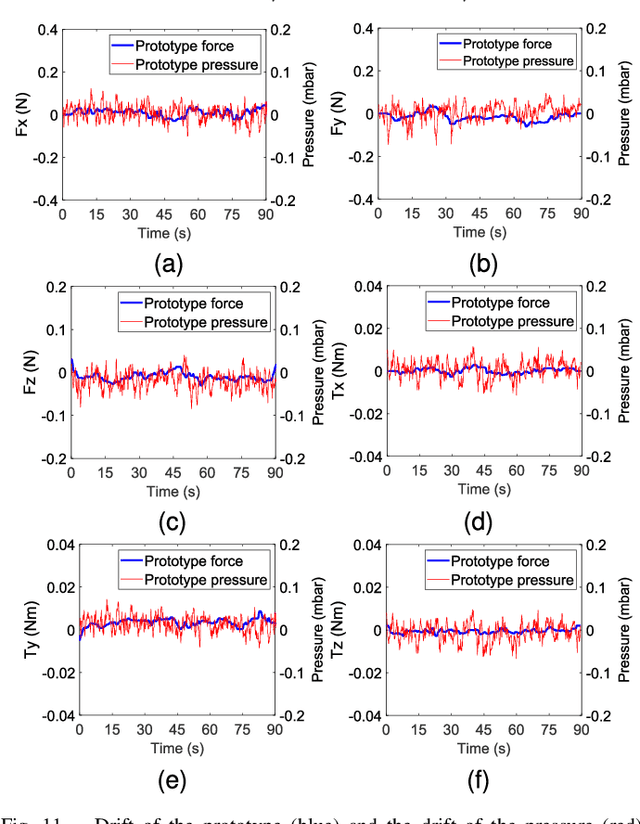
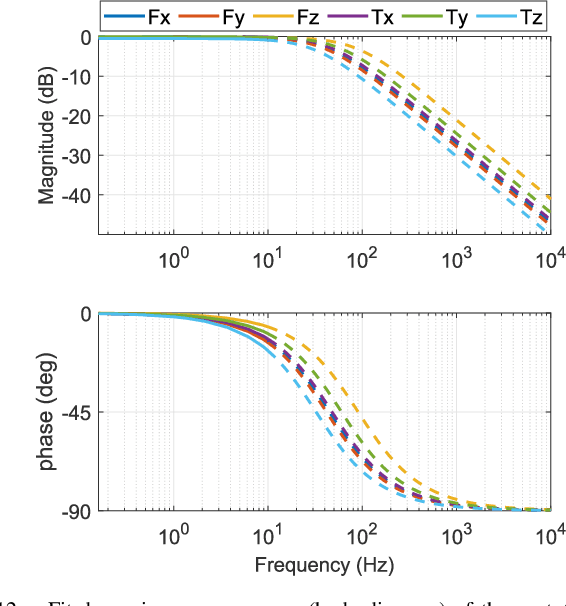
Soft multi-axis force/torque sensors provide safe and precise force interaction. Capturing the complete degree-of-freedom of force is imperative for accurate force measurement with six-axis force/torque sensors. However, cross-axis coupling can lead to calibration issues and decreased accuracy. In this instance, developing a soft and accurate six-axis sensor is a challenging task. In this paper, a soft air-chamber type six-axis force/torque sensor with 16-channel barometers is introduced, which housed in hyper-elastic air chambers made of silicone rubber. Additionally, an effective decoupling method is proposed, based on a rigid-soft hierarchical structure, which reduces the six-axis decoupling problem to two three-axis decoupling problems. Finite element model simulation and experiments demonstrate the compatibility of the proposed approach with reality. The prototype's sensing performance is quantitatively measured in terms of static load response, dynamic load response and dynamic response characteristic. It possesses a measuring range of 50 N force and 1 Nm torque, and the average deviation, repeatability, non-linearity and hysteresis are 4.9$\%$, 2.7$\%$, 5.8$\%$ and 6.7$\%$, respectively. The results indicate that the prototype exhibits satisfactory sensing performance while maintaining its softness due to the presence of soft air chambers.

GCN-Based Linkage Prediction for Face Clustering on Imbalanced Datasets: An Empirical Study
Jul 07, 2021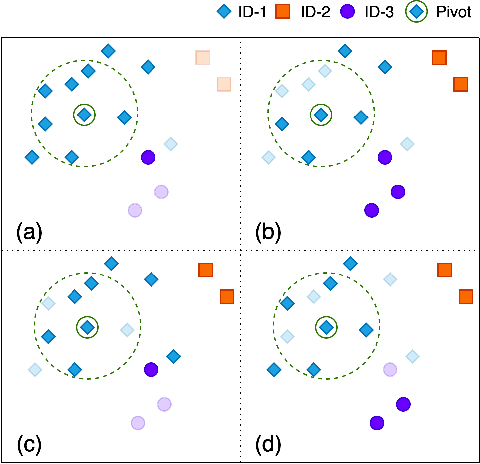
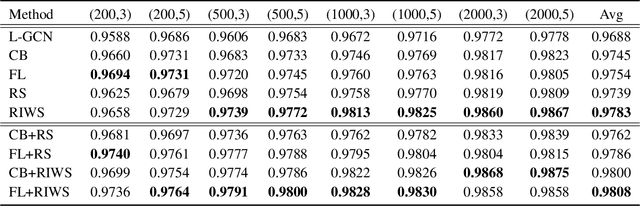
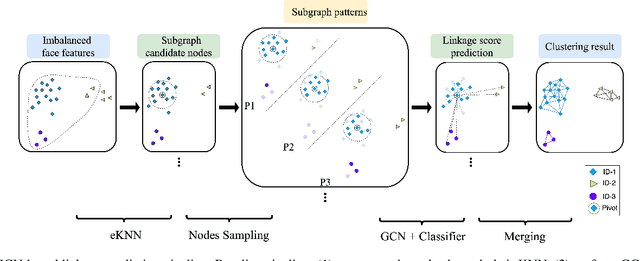
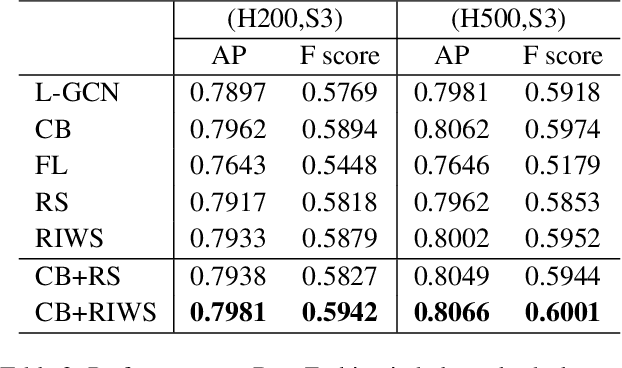
In recent years, benefiting from the expressive power of Graph Convolutional Networks (GCNs), significant breakthroughs have been made in face clustering. However, rare attention has been paid to GCN-based clustering on imbalanced data. Although imbalance problem has been extensively studied, the impact of imbalanced data on GCN-based linkage prediction task is quite different, which would cause problems in two aspects: imbalanced linkage labels and biased graph representations. The problem of imbalanced linkage labels is similar to that in image classification task, but the latter is a particular problem in GCN-based clustering via linkage prediction. Significantly biased graph representations in training can cause catastrophic overfitting of a GCN model. To tackle these problems, we evaluate the feasibility of those existing methods for imbalanced image classification problem on graphs with extensive experiments, and present a new method to alleviate the imbalanced labels and also augment graph representations using a Reverse-Imbalance Weighted Sampling (RIWS) strategy, followed with insightful analyses and discussions. The code and a series of imbalanced benchmark datasets synthesized from MS-Celeb-1M and DeepFashion are available on https://github.com/espectre/GCNs_on_imbalanced_datasets.