 Add to Chrome
 Add to Firefox
 Add to Edge
Enhancing LLM-Based Data Annotation with Error Decomposition
Jan 17, 2026
Large language models offer a scalable alternative to human coding for data annotation tasks, enabling the scale-up of research across data-intensive domains. While LLMs are already achieving near-human accuracy on objective annotation tasks, their performance on subjective annotation tasks, such as those involving psychological constructs, is less consistent and more prone to errors. Standard evaluation practices typically collapse all annotation errors into a single alignment metric, but this simplified approach may obscure different kinds of errors that affect final analytical conclusions in different ways. Here, we propose a diagnostic evaluation paradigm that incorporates a human-in-the-loop step to separate task-inherent ambiguity from model-driven inaccuracies and assess annotation quality in terms of their potential downstream impacts. We refine this paradigm on ordinal annotation tasks, which are common in subjective annotation. The refined paradigm includes: (1) a diagnostic taxonomy that categorizes LLM annotation errors along two dimensions: source (model-specific vs. task-inherent) and type (boundary ambiguity vs. conceptual misidentification); (2) a lightweight human annotation test to estimate task-inherent ambiguity from LLM annotations; and (3) a computational method to decompose observed LLM annotation errors following our taxonomy. We validate this paradigm on four educational annotation tasks, demonstrating both its conceptual validity and practical utility. Theoretically, our work provides empirical evidence for why excessively high alignment is unrealistic in specific annotation tasks and why single alignment metrics inadequately reflect the quality of LLM annotations. In practice, our paradigm can be a low-cost diagnostic tool that assesses the suitability of a given task for LLM annotation and provides actionable insights for further technical optimization.

The Quick Red Fox gets the best Data Driven Classroom Interviews: A manual for an interview app and its associated methodology
Nov 17, 2025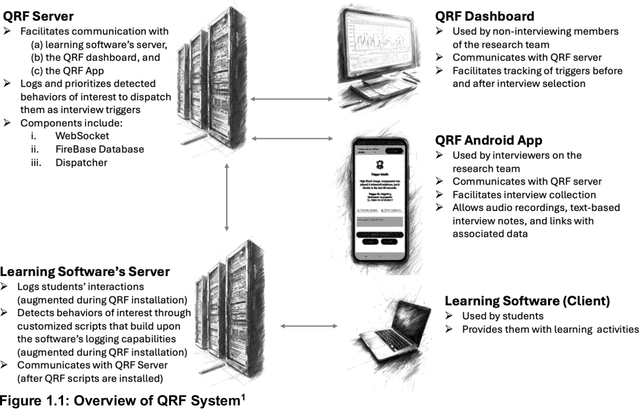
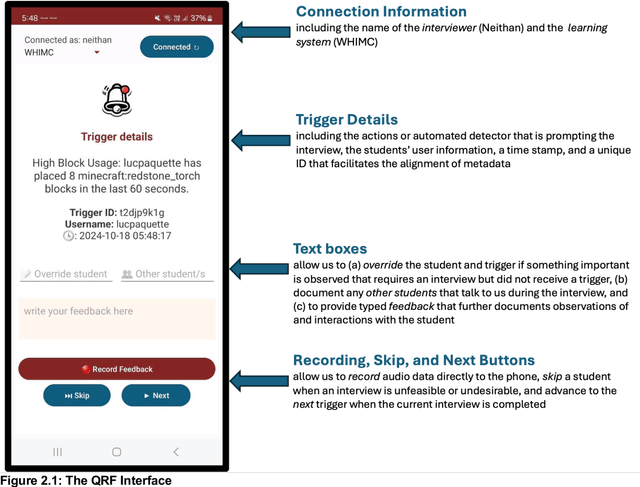
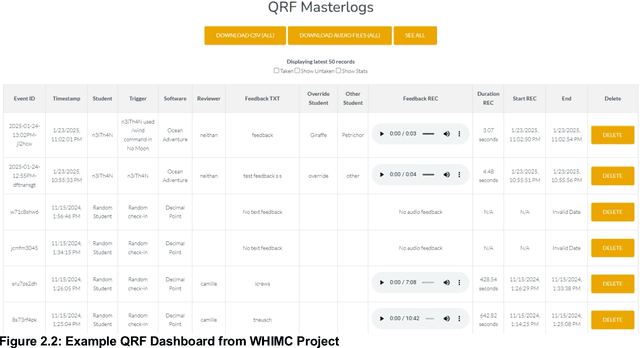
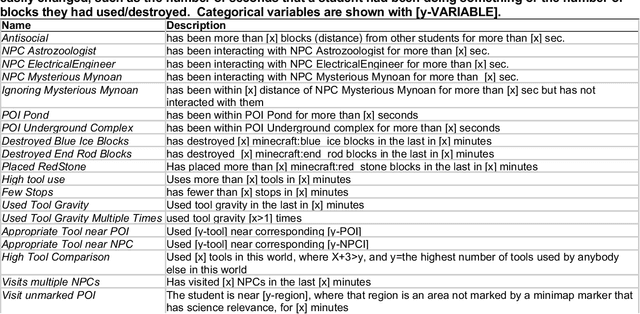
Data Driven Classroom Interviews (DDCIs) are an interviewing technique that is facilitated by recent technological developments in the learning analytics community. DDCIs are short, targeted interviews that allow researchers to contextualize students' interactions with a digital learning environment (e.g., intelligent tutoring systems or educational games) while minimizing the amount of time that the researcher interrupts that learning experience, and focusing researcher time on the events they most want to focus on DDCIs are facilitated by a research tool called the Quick Red Fox (QRF)--an open-source server-client Android app that optimizes researcher time by directing interviewers to users that have just displayed an interesting behavior (previously defined by the research team). QRF integrates with existing student modeling technologies (e.g., behavior-sensing, affect-sensing, detection of self-regulated learning) to alert researchers to key moments in a learner's experience. This manual documents the tech while providing training on the processes involved in developing triggers and interview techniques; it also suggests methods of analyses.