 Add to Chrome
 Add to Firefox
 Add to Edge
Ordered Network Analysis of Epistemic Emotions during Collaborative Problem Solving
Jul 25, 2026
Investigating how affective states such as confusion and frustration persist and transition during co-situated collaborative problem solving (CPS) is important for understanding the dynamics of epistemic emotions. However, the accurate identification of affective states remain challenging as there is no gold-standard truth in this space. Here, we analyze affective states collected through retrospective cued-recall during an in-person CPS task. Using ordered network analysis (ONA), we examine (1) the overall ordered structure of affective states and how this structure differs across self-caught and probe-caught reporting methods, and (2) what aspects of this ordered structure are emphasized differently in slower and faster groups. We find that ONA reveals differences in persistence and transition patterns that are not apparent from descriptive summaries alone. In particular, we observe a stable epistemic core linking curiosity, optimism, and confusion, with different reporting methods emphasizing different connections among states. An analysis between faster and slower groups show that roles of confusion and disengagement also shift significantly during collaboration, particularly in their relationship to conflict. We interpret our findings in the context of collaboration and discuss their implications in developing AI systems that support CPS.

The Quick Red Fox gets the best Data Driven Classroom Interviews: A manual for an interview app and its associated methodology
Nov 17, 2025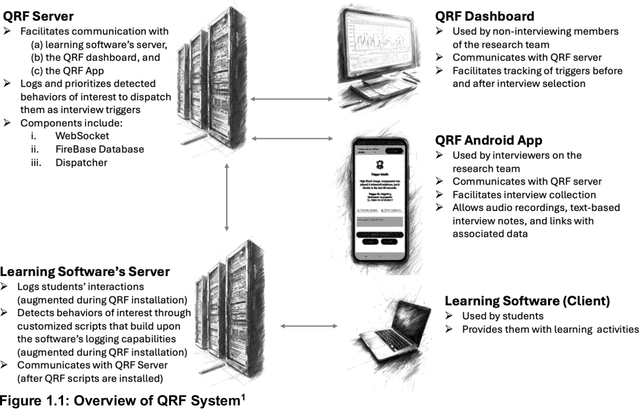
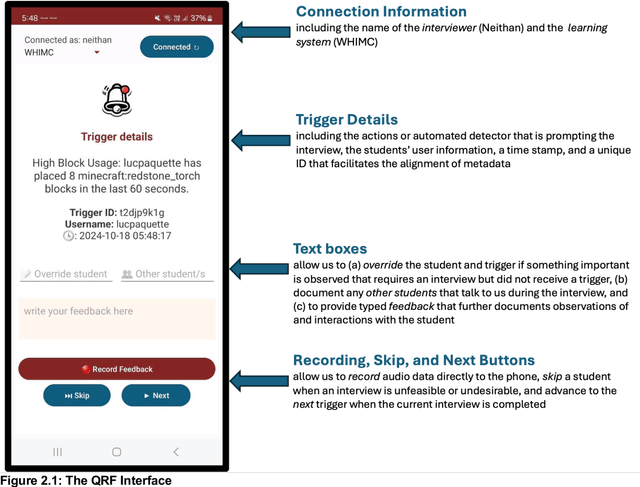
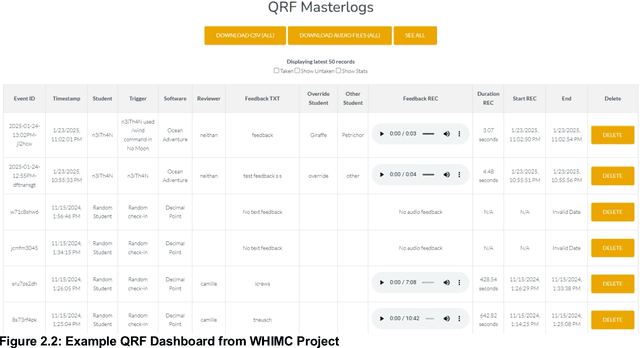
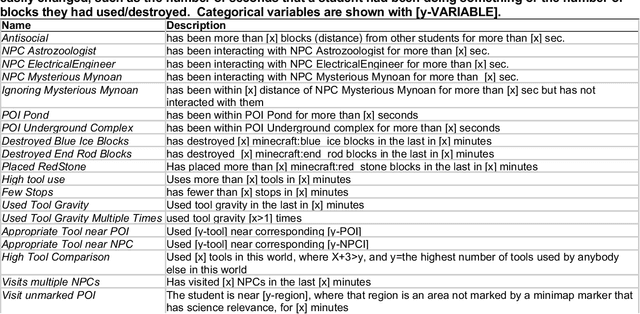
Data Driven Classroom Interviews (DDCIs) are an interviewing technique that is facilitated by recent technological developments in the learning analytics community. DDCIs are short, targeted interviews that allow researchers to contextualize students' interactions with a digital learning environment (e.g., intelligent tutoring systems or educational games) while minimizing the amount of time that the researcher interrupts that learning experience, and focusing researcher time on the events they most want to focus on DDCIs are facilitated by a research tool called the Quick Red Fox (QRF)--an open-source server-client Android app that optimizes researcher time by directing interviewers to users that have just displayed an interesting behavior (previously defined by the research team). QRF integrates with existing student modeling technologies (e.g., behavior-sensing, affect-sensing, detection of self-regulated learning) to alert researchers to key moments in a learner's experience. This manual documents the tech while providing training on the processes involved in developing triggers and interview techniques; it also suggests methods of analyses.