 Add to Chrome
 Add to Firefox
 Add to Edge
FedCoE: Bridging Generalization and Personalization via Federated Coordinated Dual-level MoEs
May 20, 2026
Federated Learning (FL) has emerged as a promising paradigm for privacy-preserving distributed learning. However, existing FL methods face a fundamental challenge. Traditional averaging-based approaches suffer from parameter divergence under non-IID conditions, while personalized FL methods overfit to local data and fail to generalize to new clients (cold-start problem). Mixture-of-Experts naturally addresses this by routing heterogeneous data to specialized experts rather than forcing uniform aggregation. In this paper, we propose FedCoE, a Federated Coordinated dual-level mixture-of-Experts framework that effectively balances global generalization with local personalization. FedCoE maintains multiple independent global expert models on the server and employs a shared gating network to dynamically model client-expert correlations during aggregation, effectively mitigating expert drift and gating inconsistency. To address the cold-start challenge, we introduce an adaptive mechanism that enables new clients to immediately leverage the global expert pool without extensive local training. Extensive experiments demonstrate that FedCoE achieves 78.00% global accuracy and 89.32% personalized accuracy on average, outperforming the baseline by 8.82% and 29.19%, respectively. In cold-start scenarios, FedCoE delivers 77.27% accuracy without any local fine-tuning, outperforming baselines by over 12.54%.

AutoMCU: Feasibility-First MCU Neural Network Customization via LLM-based Multi-Agent Systems
May 20, 2026Deploying neural networks on microcontroller units (MCUs) is critical for edge intelligence but remains challenging due to tight memory, storage, and computation constraints. Existing approaches, such as model compression and hardware-aware neural architecture search (HW-NAS), often depend on proxy metrics, incur high search cost, and do not fully bridge the gap between architecture design and verified deployment. This paper presents AutoMCU, a feasibility-first large language model (LLM)-based multi-agent system for automated neural network customization under MCU constraints. Given natural-language task requirements and hardware specifications, AutoMCU iteratively generates structured architecture candidates, filters infeasible designs through vendor toolchain feedback before training, evaluates feasible models under a controlled protocol, and verifies deployability through backend-grounded deployment analysis. AutoMCU includes two key mechanisms: 1) hardware-in-the-loop architecture generation for early elimination of undeployable candidates under RAM and Flash constraints, and 2) state-isolated multi-agent scheduling for stable coordination of proposal, training, evaluation, and deployment stages. Experiments on CIFAR-10 and CIFAR-100 under strict MCU constraints show that AutoMCU achieves competitive accuracy while reducing customization time to about 1--2 hours, compared with hundreds of GPU hours for representative MCU-oriented HW-NAS baselines. Comparisons with ColabNAS and the LLM-based NAS method GENIUS on NAS-Bench-201 further demonstrate the effectiveness and stability of AutoMCU. Real-device deployments on multiple STM32 microcontrollers validate its practical applicability to MCU-scale edge intelligence.
Enabling Digital Twin in Vehicular Edge Computing: A Multi-Agent Multi-Objective Deep Reinforcement Learning Solution
Oct 31, 2022
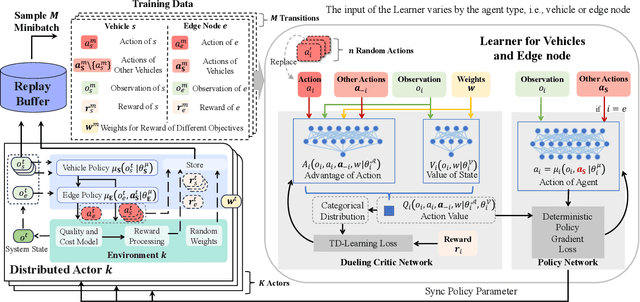


With recent advances in sensing technologies, wireless communications, and computing paradigms, traditional vehicles are evolving to electronic consumer products, driving the research on digital twins in vehicular edge computing (DT-VEC). This paper makes the first attempt to achieve the quality-cost tradeoff in DT-VEC. First, a DT-VEC architecture is presented, where the heterogeneous information can be sensed by vehicles and uploaded to the edge node via vehicle-to-infrastructure (V2I) communications. The DT-VEC are modeled at the edge node, forming a logical view to reflect the physical vehicular environment. Second, we model the DT-VEC by deriving an ISAC (integrated sensing and communication)-assisted sensing model and a reliability-guaranteed uploading model. Third, we define the quality of DT-VEC by considering the timeliness and consistency, and define the cost of DT-VEC by considering the redundancy, sensing cost, and transmission cost. Then, a bi-objective problem is formulated to maximize the quality and minimize the cost. Fourth, we propose a multi-agent multi-objective (MAMO) deep reinforcement learning solution implemented distributedly in the vehicles and the edge nodes. Specifically, a dueling critic network is proposed to evaluate the advantage of action over the average of random actions. Finally, we give a comprehensive performance evaluation, demonstrating the superiority of the proposed MAMO.