 Add to Chrome
 Add to Firefox
 Add to Edge
Optimizing Decoding Paths in Masked Diffusion Models by Quantifying Uncertainty
Dec 24, 2025
Masked Diffusion Models (MDMs) offer flexible, non-autoregressive generation, but this freedom introduces a challenge: final output quality is highly sensitive to the decoding order. We are the first to formalize this issue, attributing the variability in output quality to the cumulative predictive uncertainty along a generative path. To quantify this uncertainty, we introduce Denoising Entropy, a computable metric that serves as an internal signal for evaluating generative process. Leveraging this metric, we propose two algorithms designed to optimize the decoding path: a post-hoc selection method and a real-time guidance strategy. Experiments demonstrate that our entropy-guided methods significantly improve generation quality, consistently boosting accuracy on challenging reasoning, planning, and code benchmarks. Our work establishes Denoising Entropy as a principled tool for understanding and controlling generation, effectively turning the uncertainty in MDMs from a liability into a key advantage for discovering high-quality solutions.

From Laws to Motivation: Guiding Exploration through Law-Based Reasoning and Rewards
Nov 24, 2024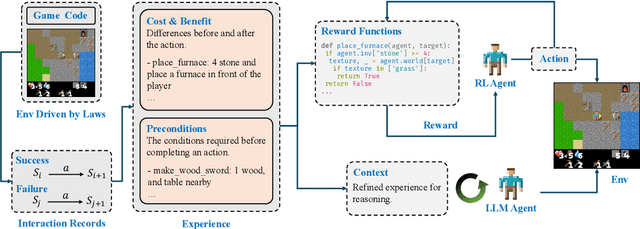

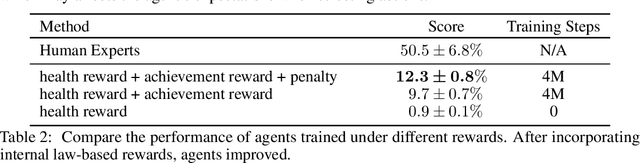
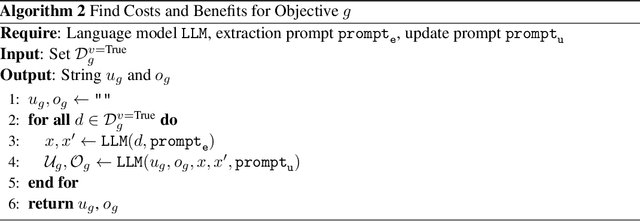
Large Language Models (LLMs) and Reinforcement Learning (RL) are two powerful approaches for building autonomous agents. However, due to limited understanding of the game environment, agents often resort to inefficient exploration and trial-and-error, struggling to develop long-term strategies or make decisions. We propose a method that extracts experience from interaction records to model the underlying laws of the game environment, using these experience as internal motivation to guide agents. These experience, expressed in language, are highly flexible and can either assist agents in reasoning directly or be transformed into rewards for guiding training. Our evaluation results in Crafter demonstrate that both RL and LLM agents benefit from these experience, leading to improved overall performance.