 Add to Chrome
 Add to Firefox
 Add to Edge
Dmsh: A Multi-Agent Reinforcement Learning Framework for All-Quad Mesh Generation
Jun 09, 2026
Generating high-quality meshes for arbitrary geometries remains a fundamental bottleneck in computational engineering, often demanding heuristic tuning and semi-manual workflows. In this paper, we introduce Dmsh, a first fully automated reinforcement learning pipeline that unifies geometric decomposition and quadrilateral mesh generation within a single learning-based framework. Dmsh decomposes the problem through three coordinated agents handling topology simplification, geometric regularization, and mesh generation. The meshing process is formulated as a Markov Decision Process and solved using a parametric Soft Actor-Critic architecture with decoupled critics, enabling efficient exploration of a hybrid discrete-continuous action space. A curriculum learning strategy ensures scalability from simple domains to highly complex geometries, suppressing seed variance. By design, the recursive decomposition enables parallel meshing of subregions, yielding globally conforming all-quadrilateral meshes without post hoc correction. Across a wide range of benchmarks, Dmsh consistently outperforms existing methods in automation, robustness, and mesh quality, establishing a new paradigm for learning-based mesh generation.

Replay-Based Continual Learning for Physics-Informed Neural Operators
May 06, 2026Neural operators generally demonstrate strong predictive performance on in-distribution (ID) problems. However, a critical limitation of existing methods is their significant performance degradation when encountering out-of-distribution (OOD) data. To address this issue, this work introduces continual learning into physics-informed neural operators, with particular emphasis on neural operators built upon the Transolver architecture, and proposes a simple yet effective replay-based continual learning strategy. The proposed method is fully physics-informed and does not require labeled data, relying solely on input fields together with physical constraints for training. When new OOD data become available, a small number of past data are incorporated through a distillation-based constraint to preserve previously acquired knowledge and alleviate catastrophic forgetting. Meanwhile, a transfer learning LoRA is employed to enable rapid adaptation to the new data. The proposed framework is systematically validated on three representative physical problems, including the Darcy flow problem in fluid mechanics, a two-dimensional hyperelastic brain tumor problem in biomechanics, and a three-dimensional linear elastic Triply Periodic Minimal Surfaces problem in solid mechanics. The results demonstrate that the proposed method effectively mitigates catastrophic forgetting on previously learned data while maintaining fast adaptability to new data. Compared with conventional joint training strategies, the proposed method significantly improves training efficiency while reducing additional memory usage and computational cost.
Long-term simulation of physical and mechanical behaviors using curriculum-transfer-learning based physics-informed neural networks
Feb 11, 2025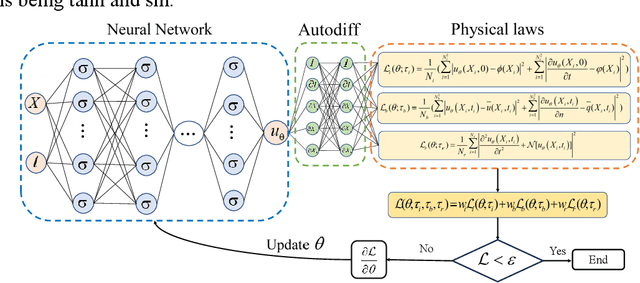
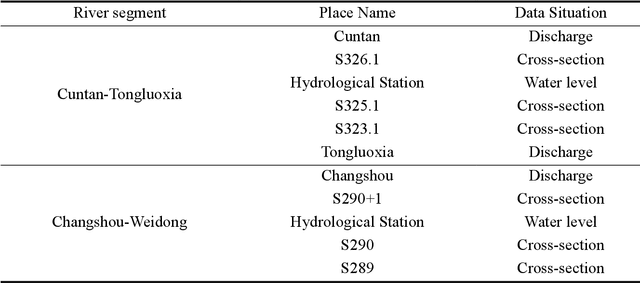
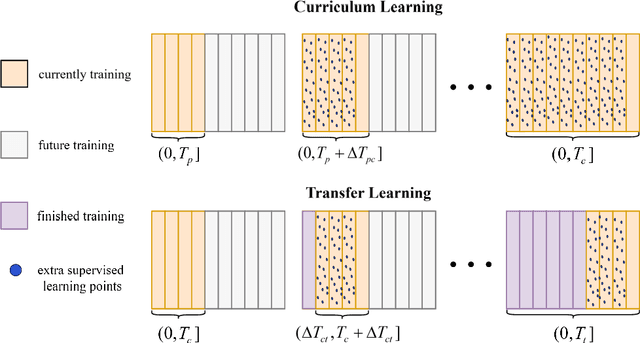

This paper proposes a Curriculum-Transfer-Learning based physics-informed neural network (CTL-PINN) for long-term simulation of physical and mechanical behaviors. The main innovation of CTL-PINN lies in decomposing long-term problems into a sequence of short-term subproblems. Initially, the standard PINN is employed to solve the first sub-problem. As the simulation progresses, subsequent time-domain problems are addressed using a curriculum learning approach that integrates information from previous steps. Furthermore, transfer learning techniques are incorporated, allowing the model to effectively utilize prior training data and solve sequential time domain transfer problems. CTL-PINN combines the strengths of curriculum learning and transfer learning, overcoming the limitations of standard PINNs, such as local optimization issues, and addressing the inaccuracies over extended time domains encountered in CL-PINN and the low computational efficiency of TL-PINN. The efficacy and robustness of CTL-PINN are demonstrated through applications to nonlinear wave propagation, Kirchhoff plate dynamic response, and the hydrodynamic model of the Three Gorges Reservoir Area, showcasing its superior capability in addressing long-term computational challenges.
Transfer Learning in Physics-Informed Neural Networks: Full Fine-Tuning, Lightweight Fine-Tuning, and Low-Rank Adaptation
Feb 02, 2025AI for PDEs has garnered significant attention, particularly Physics-Informed Neural Networks (PINNs). However, PINNs are typically limited to solving specific problems, and any changes in problem conditions necessitate retraining. Therefore, we explore the generalization capability of transfer learning in the strong and energy form of PINNs across different boundary conditions, materials, and geometries. The transfer learning methods we employ include full finetuning, lightweight finetuning, and Low-Rank Adaptation (LoRA). The results demonstrate that full finetuning and LoRA can significantly improve convergence speed while providing a slight enhancement in accuracy.
DeepNetBeam: A Framework for the Analysis of Functionally Graded Porous Beams
Aug 04, 2024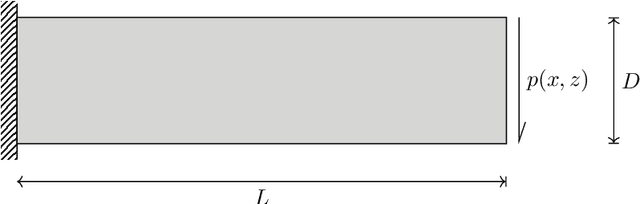
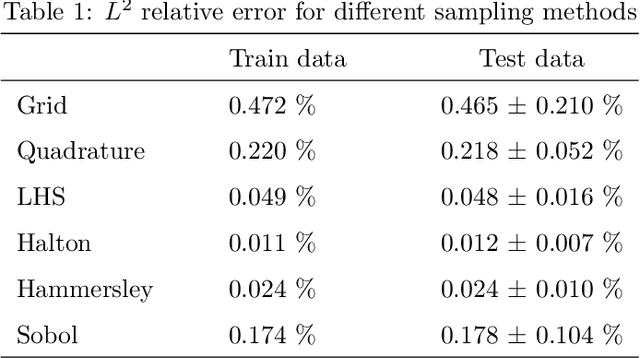
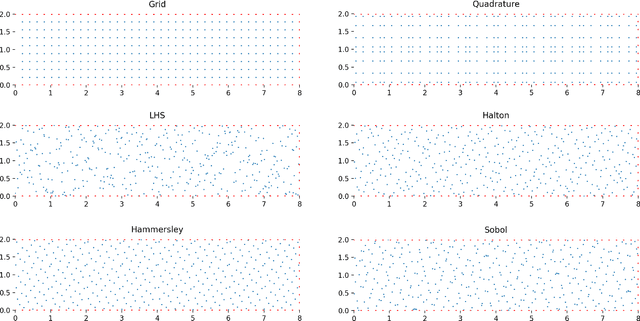
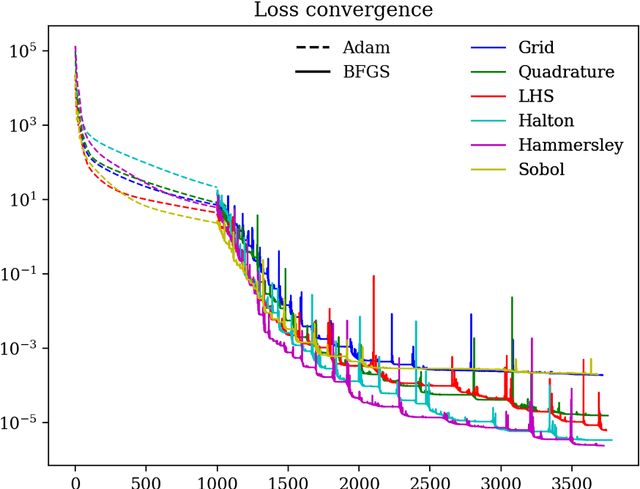
This study investigates different Scientific Machine Learning (SciML) approaches for the analysis of functionally graded (FG) porous beams and compares them under a new framework. The beam material properties are assumed to vary as an arbitrary continuous function. The methods consider the output of a neural network/operator as an approximation to the displacement fields and derive the equations governing beam behavior based on the continuum formulation. The methods are implemented in the framework and formulated by three approaches: (a) the vector approach leads to a Physics-Informed Neural Network (PINN), (b) the energy approach brings about the Deep Energy Method (DEM), and (c) the data-driven approach, which results in a class of Neural Operator methods. Finally, a neural operator has been trained to predict the response of the porous beam with functionally graded material under any porosity distribution pattern and any arbitrary traction condition. The results are validated with analytical and numerical reference solutions. The data and code accompanying this manuscript will be publicly available at https://github.com/eshaghi-ms/DeepNetBeam.
Kolmogorov Arnold Informed neural network: A physics-informed deep learning framework for solving PDEs based on Kolmogorov Arnold Networks
Jun 16, 2024


AI for partial differential equations (PDEs) has garnered significant attention, particularly with the emergence of Physics-informed neural networks (PINNs). The recent advent of Kolmogorov-Arnold Network (KAN) indicates that there is potential to revisit and enhance the previously MLP-based PINNs. Compared to MLPs, KANs offer interpretability and require fewer parameters. PDEs can be described in various forms, such as strong form, energy form, and inverse form. While mathematically equivalent, these forms are not computationally equivalent, making the exploration of different PDE formulations significant in computational physics. Thus, we propose different PDE forms based on KAN instead of MLP, termed Kolmogorov-Arnold-Informed Neural Network (KINN). We systematically compare MLP and KAN in various numerical examples of PDEs, including multi-scale, singularity, stress concentration, nonlinear hyperelasticity, heterogeneous, and complex geometry problems. Our results demonstrate that KINN significantly outperforms MLP in terms of accuracy and convergence speed for numerous PDEs in computational solid mechanics, except for the complex geometry problem. This highlights KINN's potential for more efficient and accurate PDE solutions in AI for PDEs.
Multigoal-oriented dual-weighted-residual error estimation using deep neural networks
Dec 22, 2021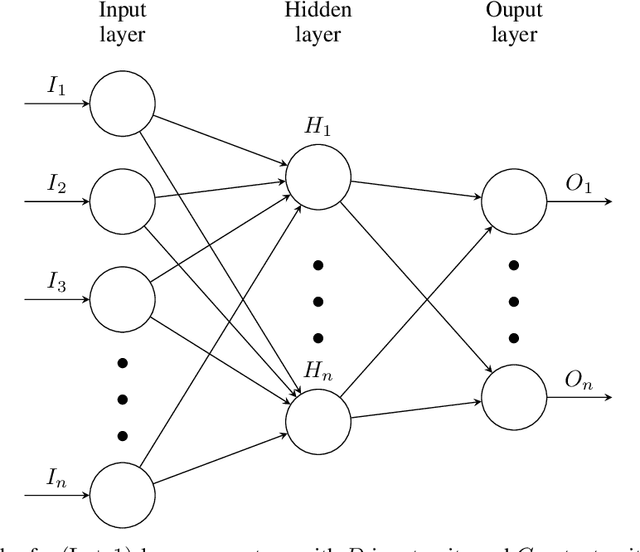
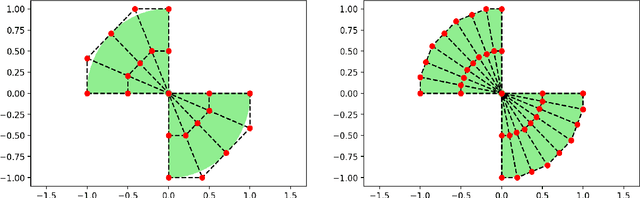
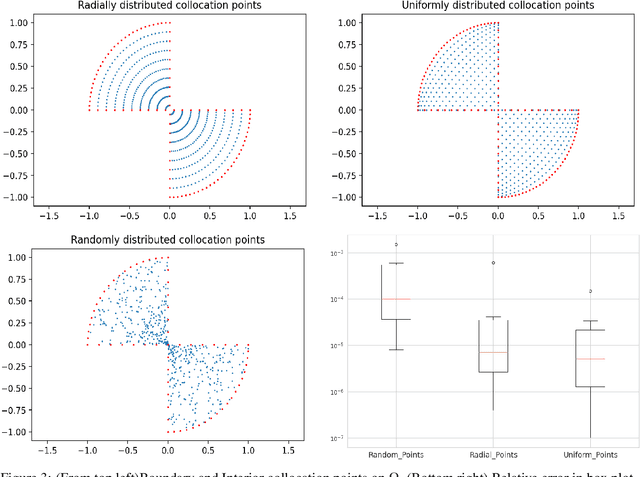
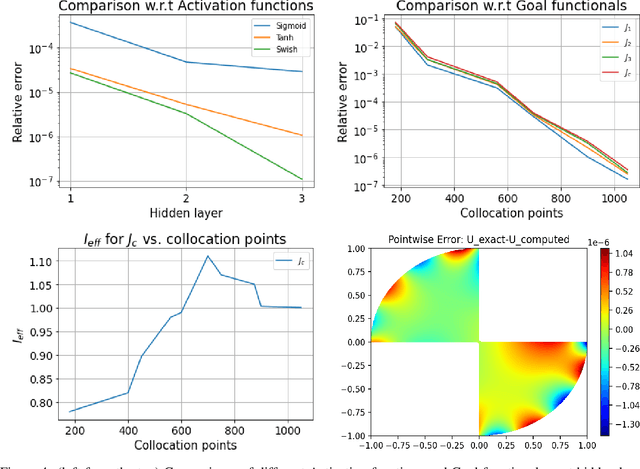
Deep learning has shown successful application in visual recognition and certain artificial intelligence tasks. Deep learning is also considered as a powerful tool with high flexibility to approximate functions. In the present work, functions with desired properties are devised to approximate the solutions of PDEs. Our approach is based on a posteriori error estimation in which the adjoint problem is solved for the error localization to formulate an error estimator within the framework of neural network. An efficient and easy to implement algorithm is developed to obtain a posteriori error estimate for multiple goal functionals by employing the dual-weighted residual approach, which is followed by the computation of both primal and adjoint solutions using the neural network. The present study shows that such a data-driven model based learning has superior approximation of quantities of interest even with relatively less training data. The novel algorithmic developments are substantiated with numerical test examples. The advantages of using deep neural network over the shallow neural network are demonstrated and the convergence enhancing techniques are also presented
A Deep Collocation Method for the Bending Analysis of Kirchhoff Plate
Feb 04, 2021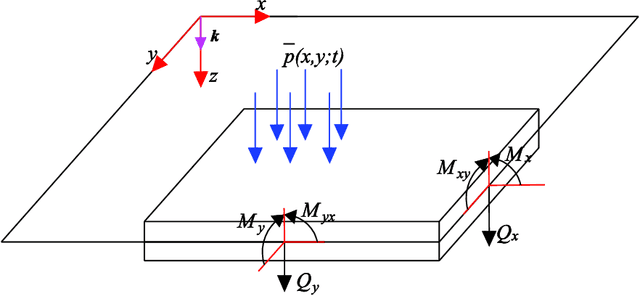
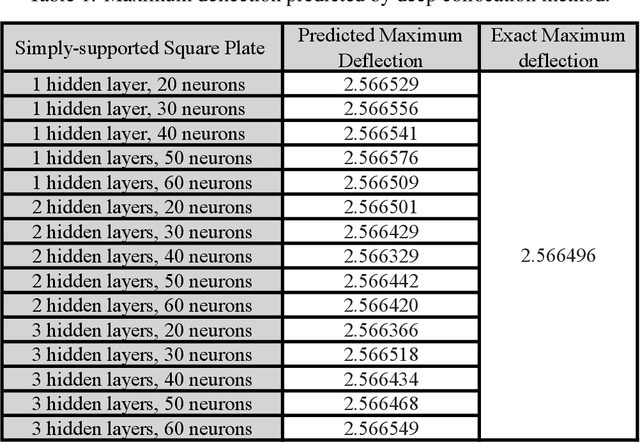
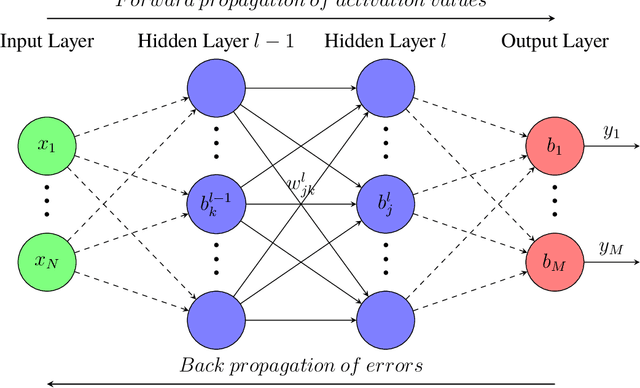
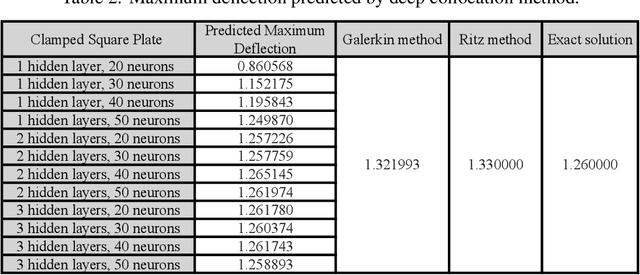
In this paper, a deep collocation method (DCM) for thin plate bending problems is proposed. This method takes advantage of computational graphs and backpropagation algorithms involved in deep learning. Besides, the proposed DCM is based on a feedforward deep neural network (DNN) and differs from most previous applications of deep learning for mechanical problems. First, batches of randomly distributed collocation points are initially generated inside the domain and along the boundaries. A loss function is built with the aim that the governing partial differential equations (PDEs) of Kirchhoff plate bending problems, and the boundary/initial conditions are minimised at those collocation points. A combination of optimizers is adopted in the backpropagation process to minimize the loss function so as to obtain the optimal hyperparameters. In Kirchhoff plate bending problems, the C1 continuity requirement poses significant difficulties in traditional mesh-based methods. This can be solved by the proposed DCM, which uses a deep neural network to approximate the continuous transversal deflection, and is proved to be suitable to the bending analysis of Kirchhoff plate of various geometries.
Deep Autoencoder based Energy Method for the Bending, Vibration, and Buckling Analysis of Kirchhoff Plates
Oct 09, 2020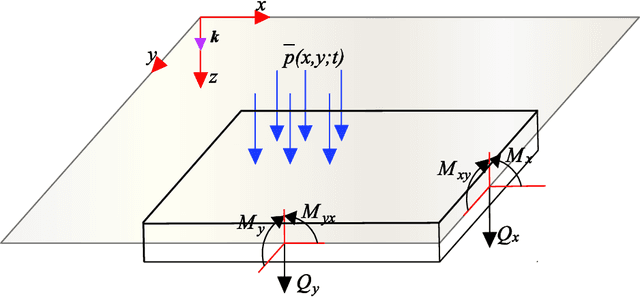
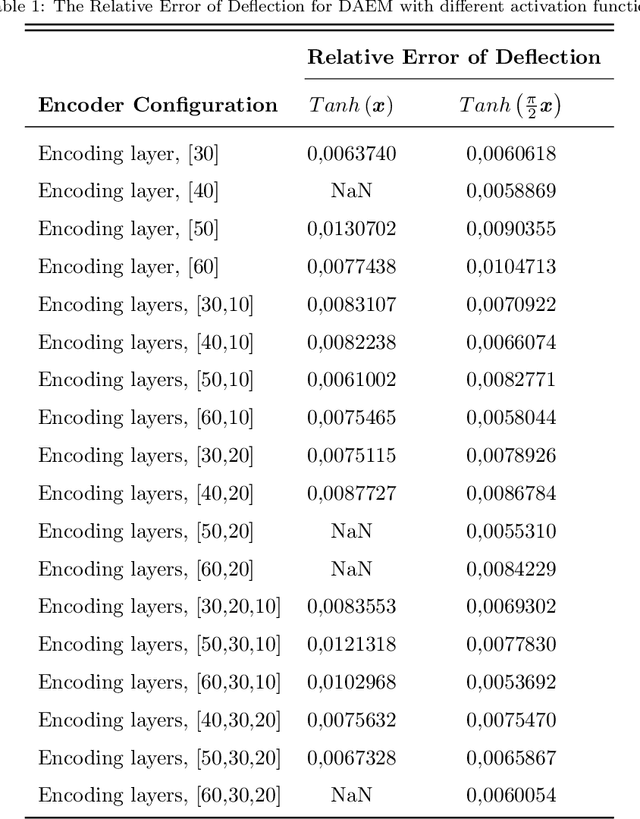
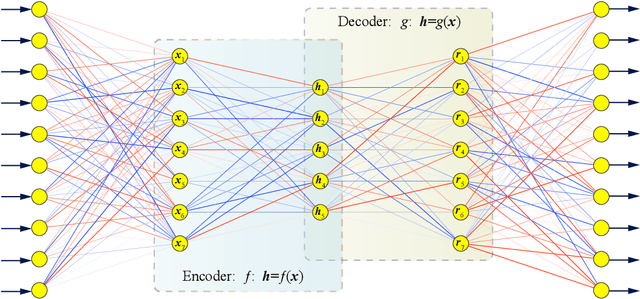
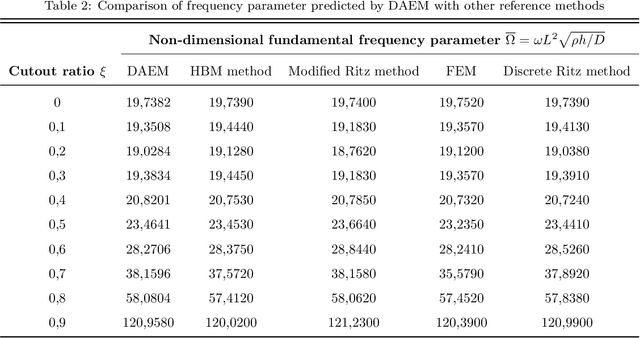
In this paper, we present a deep autoencoder based energy method (DAEM) for the bending, vibration and buckling analysis of Kirchhoff plates. The DAEM exploits the higher order continuity of the DAEM and integrates a deep autoencoder and the minimum total potential principle in one framework yielding an unsupervised feature learning method. The DAEM is a specific type of feedforward deep neural network (DNN) and can also serve as function approximator. With robust feature extraction capacity, the DAEM can more efficiently identify patterns behind the whole energy system, such as the field variables, natural frequency and critical buckling load factor studied in this paper. The objective function is to minimize the total potential energy. The DAEM performs unsupervised learning based on random generated points inside the physical domain so that the total potential energy is minimized at all points. For vibration and buckling analysis, the loss function is constructed based on Rayleigh's principle and the fundamental frequency and the critical buckling load is extracted. A scaled hyperbolic tangent activation function for the underlying mechanical model is presented which meets the continuity requirement and alleviates the gradient vanishing/explosive problems under bending analysis. The DAEM can be easily implemented and we employed the Pytorch library and the LBFGS optimizer. A comprehensive study of the DAEM configuration is performed for several numerical examples with various geometries, load conditions, and boundary conditions.
Analysis of three dimensional potential problems in non-homogeneous media with deep learning based collocation method
Oct 03, 2020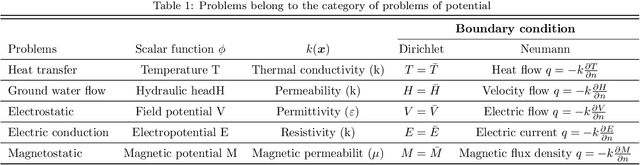
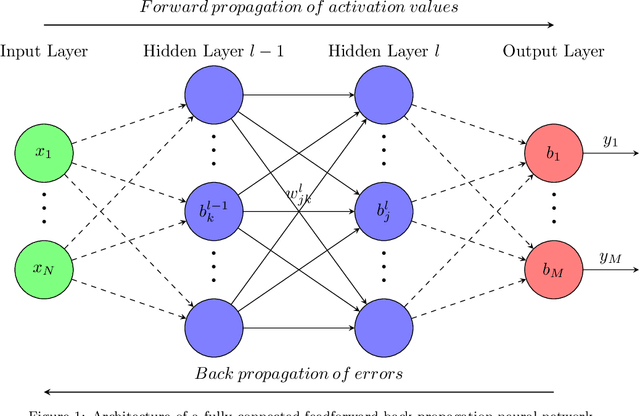

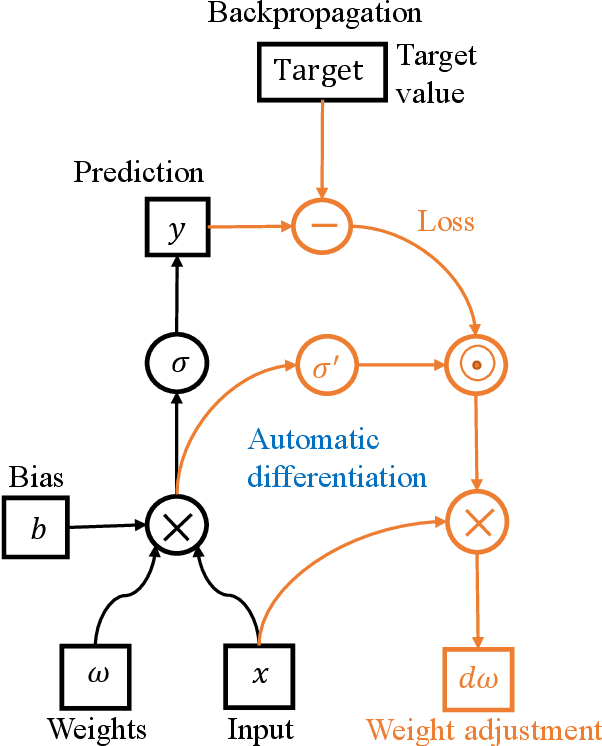
A deep learning based collocation method is presented in this paper to solve the three dimensional potential problems in non-homogeneous media. Based on the universal approximation theorem, the neural network can be utilized to approximate solutions for different PDEs in different geometries. The performance of deep learning based method depends on the configurations of the network and other hyper-parameter settings. This makes the choice of neural network configurations extremely important. The configuration of this deep collocation method is setup by comparing different schemes of smooth activation functions, sampling methods for collocation points generation, combined optimizers. Besides, a convergence proof of this deep collocation method in solving non-homogeneous potential problems is performed. Then the deep collocation method is applied to the analysis of different material variations, and it can be concluded that the deep collocation method predicts the temperature and flux accurately for different material variations, especially the exponential material variations. As a result, the deep learning based collocation method shows a great potential in approximating solutions to PDEs.