 Add to Chrome
 Add to Firefox
 Add to Edge
HAMNO: A Hierarchical Adaptive Multi-scale Neural Operator with Physics-Informed Learning for Dynamical Systems
Jun 10, 2026
Neural operators provide a powerful framework for learning solution mappings of partial differential equations directly in function space. However, many existing architectures still struggle to represent nonlinear time-dependent systems that involve multi-scale structures, long-range interactions, and stable long-time evolution. In this work, we introduce the Hierarchical Adaptive Multi-scale Neural Operator (HAMNO), a neural-operator architecture that combines local convolutional representations, global spectral operators, and hierarchical encoder-decoder processing. The central component of HAMNO is a data-dependent gating mechanism that adaptively balances local and global information at each spatial location, allowing the model to resolve fine-scale features while preserving long-range dependencies. We further develop a physics-informed extension, PI-HAMNO, based on a multi-objective loss strategy that combines data fitting with strong- and weak-form physics constraints. The strong-form term penalizes the domain-integrated squared PDE residual in physical coordinates, while the weak-form term is constructed by multiplying the governing residual by finite-element test functions and evaluating the resulting element integrals using centroid-based tetrahedral quadrature. The framework is evaluated on non-periodic Allen-Cahn (AC), Cahn-Hilliard (CH), and Swift-Hohenberg (SH) equations defined on cubic domains. Across long-horizon rollout, data-limited training, out-of-distribution initial-condition shifts, and random-seed variations, HAMNO improves predictive accuracy over standard neural-operator baselines, while PI-HAMNO further enhances stability, physical consistency, and data efficiency. The implementation is publicly available at https://github.com/MBamdad/HAMNO .

DeepNetBeam: A Framework for the Analysis of Functionally Graded Porous Beams
Aug 04, 2024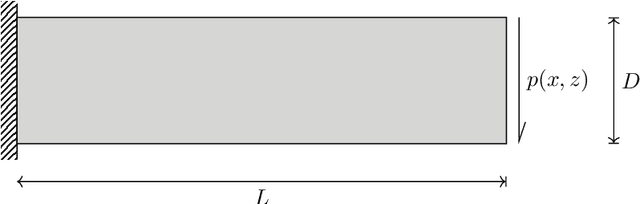
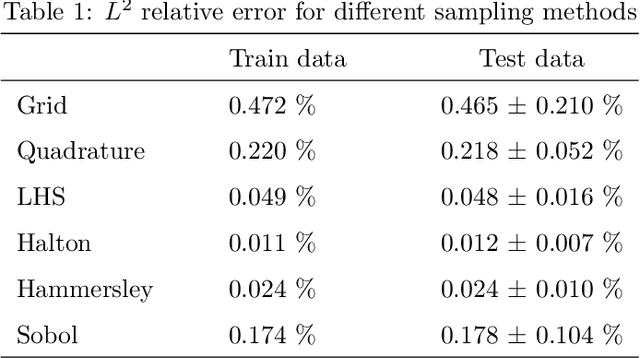
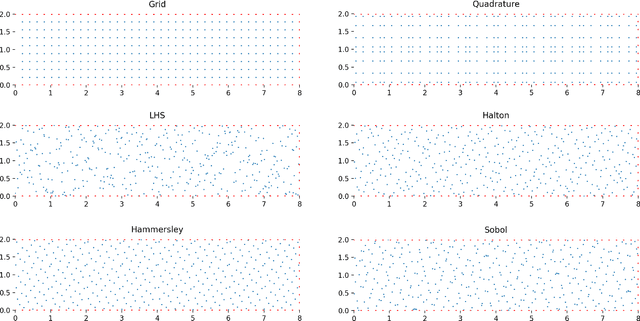
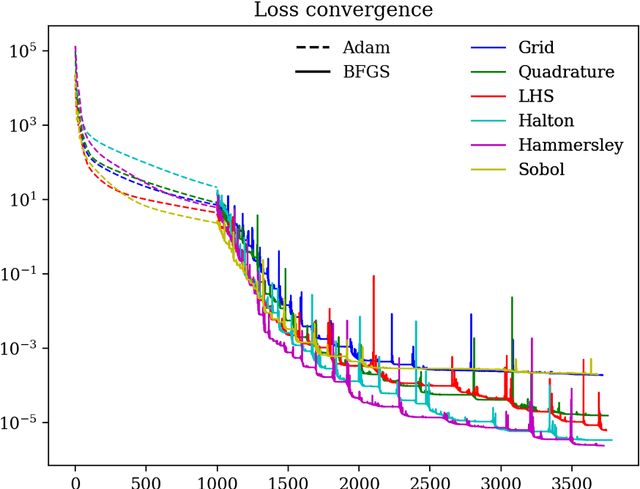
This study investigates different Scientific Machine Learning (SciML) approaches for the analysis of functionally graded (FG) porous beams and compares them under a new framework. The beam material properties are assumed to vary as an arbitrary continuous function. The methods consider the output of a neural network/operator as an approximation to the displacement fields and derive the equations governing beam behavior based on the continuum formulation. The methods are implemented in the framework and formulated by three approaches: (a) the vector approach leads to a Physics-Informed Neural Network (PINN), (b) the energy approach brings about the Deep Energy Method (DEM), and (c) the data-driven approach, which results in a class of Neural Operator methods. Finally, a neural operator has been trained to predict the response of the porous beam with functionally graded material under any porosity distribution pattern and any arbitrary traction condition. The results are validated with analytical and numerical reference solutions. The data and code accompanying this manuscript will be publicly available at https://github.com/eshaghi-ms/DeepNetBeam.