 Add to Chrome
 Add to Firefox
 Add to Edge
DualPrim: Compact 3D Reconstruction with Positive and Negative Primitives
Mar 17, 2026
Neural reconstructions often trade structure for fidelity, yielding dense and unstructured meshes with irregular topology and weak part boundaries that hinder editing, animation, and downstream asset reuse. We present DualPrim, a compact and structured 3D reconstruction framework. Unlike additive-only implicit or primitive methods, DualPrim represents shapes with positive and negative superquadrics: the former builds the bases while the latter carves local volumes through a differentiable operator, enabling topology-aware modeling of holes and concavities. This additive-subtractive design increases the representational power without sacrificing compactness or differentiability. We embed DualPrim in a volumetric differentiable renderer, enabling end-to-end learning from multi-view images and seamless mesh export via closed-form boolean difference. Empirically, DualPrim delivers state-of-the-art accuracy and produces compact, structured, and interpretable outputs that better satisfy downstream needs than additive-only alternatives.

NeUDF: Leaning Neural Unsigned Distance Fields with Volume Rendering
Apr 20, 2023Multi-view shape reconstruction has achieved impressive progresses thanks to the latest advances in neural implicit surface rendering. However, existing methods based on signed distance function (SDF) are limited to closed surfaces, failing to reconstruct a wide range of real-world objects that contain open-surface structures. In this work, we introduce a new neural rendering framework, coded NeUDF, that can reconstruct surfaces with arbitrary topologies solely from multi-view supervision. To gain the flexibility of representing arbitrary surfaces, NeUDF leverages the unsigned distance function (UDF) as surface representation. While a naive extension of an SDF-based neural renderer cannot scale to UDF, we propose two new formulations of weight function specially tailored for UDF-based volume rendering. Furthermore, to cope with open surface rendering, where the in/out test is no longer valid, we present a dedicated normal regularization strategy to resolve the surface orientation ambiguity. We extensively evaluate our method over a number of challenging datasets, including DTU}, MGN, and Deep Fashion 3D. Experimental results demonstrate that nEudf can significantly outperform the state-of-the-art method in the task of multi-view surface reconstruction, especially for complex shapes with open boundaries.
NeAT: Learning Neural Implicit Surfaces with Arbitrary Topologies from Multi-view Images
Mar 21, 2023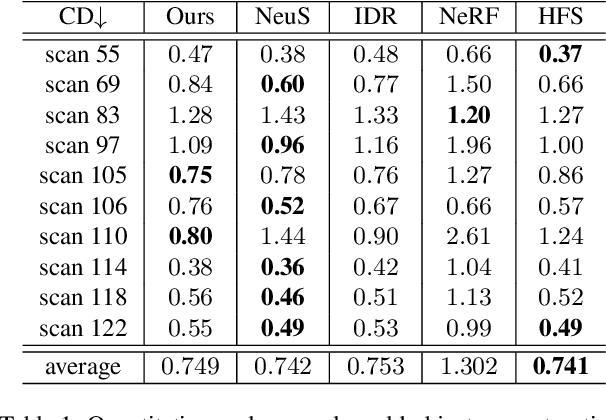
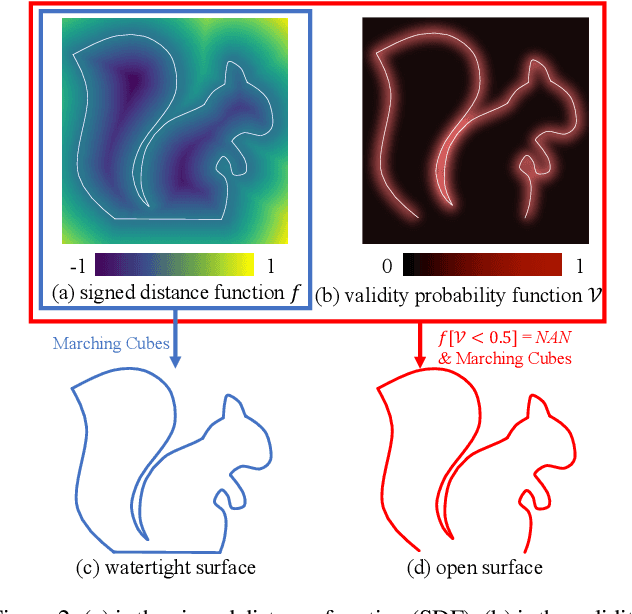
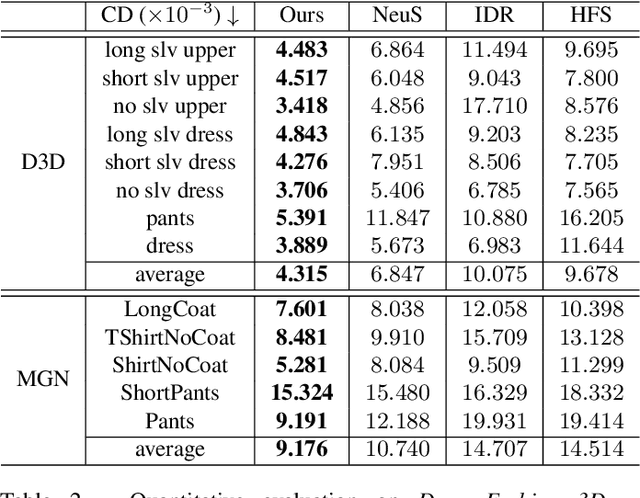
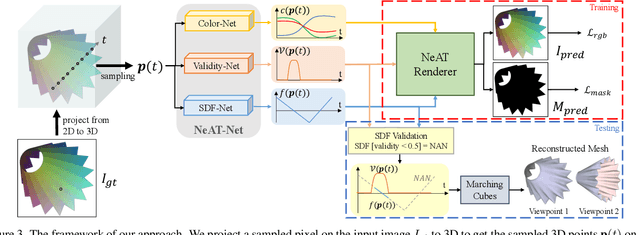
Recent progress in neural implicit functions has set new state-of-the-art in reconstructing high-fidelity 3D shapes from a collection of images. However, these approaches are limited to closed surfaces as they require the surface to be represented by a signed distance field. In this paper, we propose NeAT, a new neural rendering framework that can learn implicit surfaces with arbitrary topologies from multi-view images. In particular, NeAT represents the 3D surface as a level set of a signed distance function (SDF) with a validity branch for estimating the surface existence probability at the query positions. We also develop a novel neural volume rendering method, which uses SDF and validity to calculate the volume opacity and avoids rendering points with low validity. NeAT supports easy field-to-mesh conversion using the classic Marching Cubes algorithm. Extensive experiments on DTU, MGN, and Deep Fashion 3D datasets indicate that our approach is able to faithfully reconstruct both watertight and non-watertight surfaces. In particular, NeAT significantly outperforms the state-of-the-art methods in the task of open surface reconstruction both quantitatively and qualitatively.