 Add to Chrome
 Add to Firefox
 Add to Edge
TopoIntent: Compiling Security Intent into Executable, Compliance-Checked Network Topologies
Aug 13, 2026
Enterprise security topology design requires translating business intent, regulatory requirements, and risk assumptions into zones, boundary devices, inter-zone paths, and access-control policies. Existing NetOps automation tools mainly operate after this design is fixed, providing limited support for generating structured security topologies from underspecified natural-language requirements. We present TopoIntent, a system that compiles security intent into executable, compliance-checked network topologies. It uses a schema contract to constrain generation, retrieves reference architectures from a curated template library via dense-vector search, and applies staged fusion for intent-template alignment and security completion. The generated topology is checked against CIS Controls v8.1.2 safeguards visible at the topology layer, while unresolved cases are marked for manual review. Structural gaps are repaired through additive schema-preserving edits. The final topology is exported to Mininet scripts with kernel-level iptables ACLs, enabling executable reachability and allow/deny tests. Because no public benchmark exists for this requirement-to-topology task, we construct an evaluation set from reference security architecture diagrams. The retrieval set contains 22 templates and 44 synthetic intents across five scenarios, while the held-out set contains 7 templates and 14 intents from finance and government scenarios excluded from retrieval. On the held-out set, additive repair improves topology-visible CIS satisfaction from 0.78 to 1.00 in fewer than 1.5 rounds on average, and one feedback round raises the post-ACL policy pass rate from 0.78 to 0.88.

HexEval: An Evidence-Driven Hexagonal Framework for Multidimensional Scholar Assessment
Aug 12, 2026Scholar assessment plays a fundamental role in faculty recruitment, funding allocation, academic promotion, and talent discovery. Existing scholar assessment methods predominantly rely on bibliometric indicators and reputation proxies, while recent large language model (LLM)-based approaches mainly focus on evaluating individual research papers rather than comprehensively assessing scholars. We argue that scholar assessment should be formulated as an evidence-driven reasoning problem that jointly considers intrinsic research quality and externally verifiable scholarly behavior. To this end, we propose HexEval, an evidence-driven hexagonal framework for multidimensional scholar assessment. HexEval explicitly organizes scholar assessment into two complementary evidence layers. The intrinsic layer evaluates anonymized representative works along three dimensions, namely research rigor, methodological innovation, and scientific contribution, whereas the external layer characterizes scholars through knowledge translation, research coherence, and academic impact using heterogeneous evidence collected from GitHub, Lens, OpenAlex, and other publicly verifiable sources. Instead of producing opaque aggregate scores, HexEval preserves intermediate evidence, dimension-specific rationales, and verification signals throughout the evaluation process, enabling interpretable and auditable scholar profiles. Experiments across all six dimensions show dimension-dependent agreement with human or external reference criteria: structured calibration improves absolute agreement for intrinsic quality, while the external modules recover broad trajectory and ordinal impact signals. These results support evidence-driven reasoning over heterogeneous scholarly evidence as a promising paradigm for auditable AI-assisted scholar assessment, while exposing the coverage and attribution limitations of public scholarly data.
RS-RAG: Bridging Remote Sensing Imagery and Comprehensive Knowledge with a Multi-Modal Dataset and Retrieval-Augmented Generation Model
Apr 07, 2025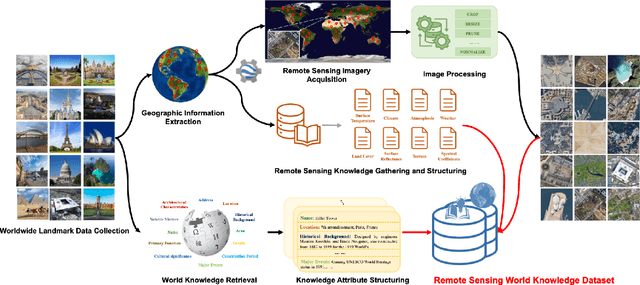
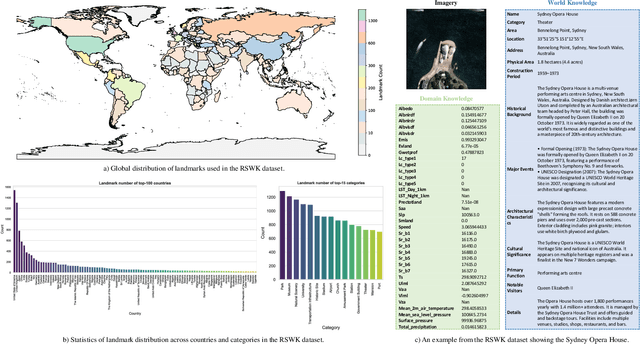
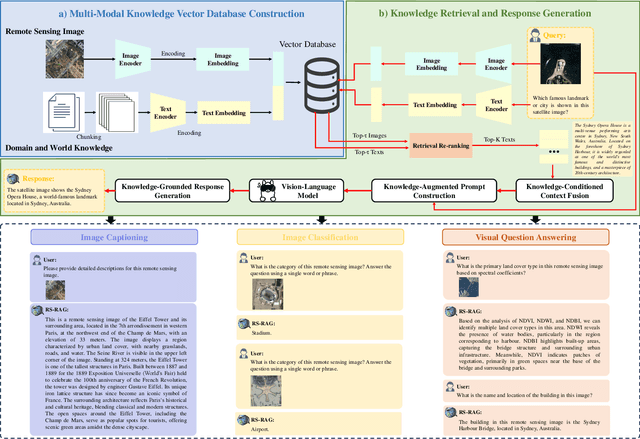
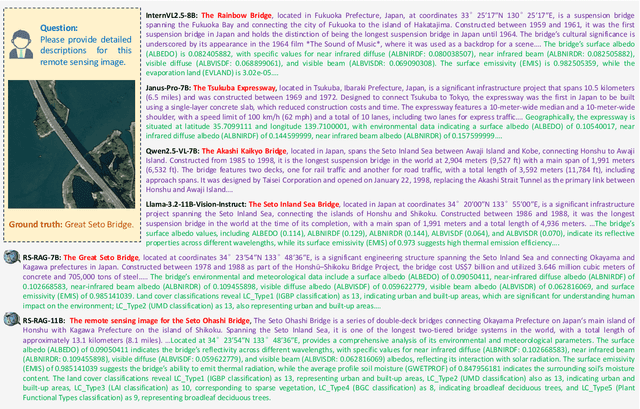
Recent progress in VLMs has demonstrated impressive capabilities across a variety of tasks in the natural image domain. Motivated by these advancements, the remote sensing community has begun to adopt VLMs for remote sensing vision-language tasks, including scene understanding, image captioning, and visual question answering. However, existing remote sensing VLMs typically rely on closed-set scene understanding and focus on generic scene descriptions, yet lack the ability to incorporate external knowledge. This limitation hinders their capacity for semantic reasoning over complex or context-dependent queries that involve domain-specific or world knowledge. To address these challenges, we first introduced a multimodal Remote Sensing World Knowledge (RSWK) dataset, which comprises high-resolution satellite imagery and detailed textual descriptions for 14,141 well-known landmarks from 175 countries, integrating both remote sensing domain knowledge and broader world knowledge. Building upon this dataset, we proposed a novel Remote Sensing Retrieval-Augmented Generation (RS-RAG) framework, which consists of two key components. The Multi-Modal Knowledge Vector Database Construction module encodes remote sensing imagery and associated textual knowledge into a unified vector space. The Knowledge Retrieval and Response Generation module retrieves and re-ranks relevant knowledge based on image and/or text queries, and incorporates the retrieved content into a knowledge-augmented prompt to guide the VLM in producing contextually grounded responses. We validated the effectiveness of our approach on three representative vision-language tasks, including image captioning, image classification, and visual question answering, where RS-RAG significantly outperformed state-of-the-art baselines.