 Add to Chrome
 Add to Firefox
 Add to Edge
GRACE: Boosting Video MLLMs with Grounded Action-Centric Evidence for Viewer Sentiment Prediction
Jun 15, 2026
Viewer sentiment prediction in video advertisements aims to infer the latent affective response evoked in the audience. To bridge the gap between what is shown and what is felt, models must deduce hidden viewer emotions from explicit visual narratives, concrete character-object interactions, and visible textual cues. However, standard Multimodal Large Language Models (MLLMs) typically rely on holistic frame representations, which leave these fine-grained, affect-relevant events implicit and complicate precise emotional reasoning. To address this, we propose a grounded action-centric evidence augmentation framework that enhances video MLLMs' clue extraction and comprehension by introducing explicit event structure and localized visual evidence. Our method extracts temporally ordered subject-verb-object (SVO) triplets and auxiliary visible textual cues from action-centric video descriptions, grounds subject and object entities as visual entity crops, and then enables the MLLM to perform clue-enhanced emotional reasoning based on these extracted structured clues. In this way, action triplets specify "what happens", while grounded visual entity crops anchor "who or what participates in each event" to concrete visual evidence. Experiments on the Pitts dataset show consistent improvements over Qwen2.5-VL and Qwen3-VL baselines. Ablation studies, cross-dataset evaluation on AdsQA, and transfer experiments on an emotion-focused TVQA subset further support the effectiveness and generalization of our approach.

Towards End-to-End Network Intent Management with Large Language Models
Apr 18, 2025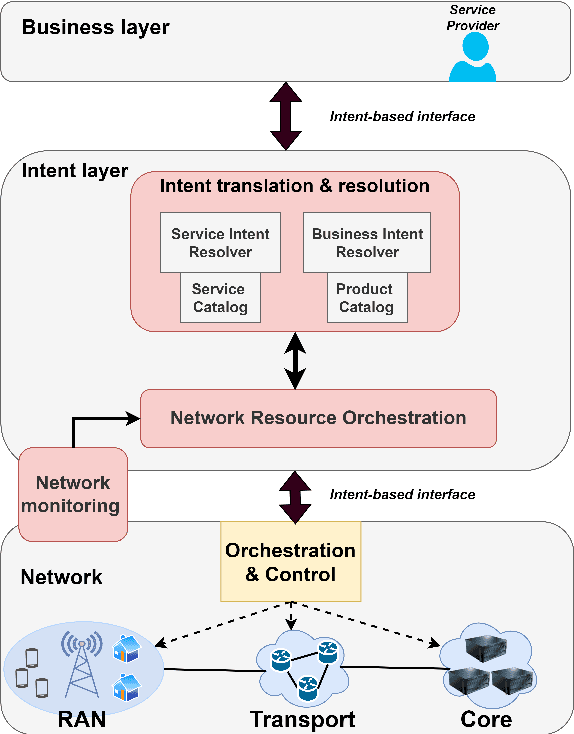
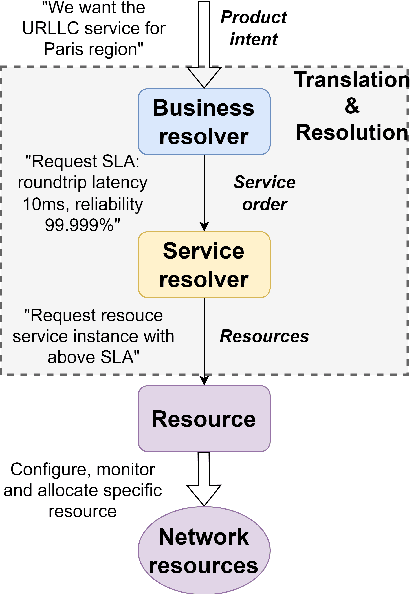
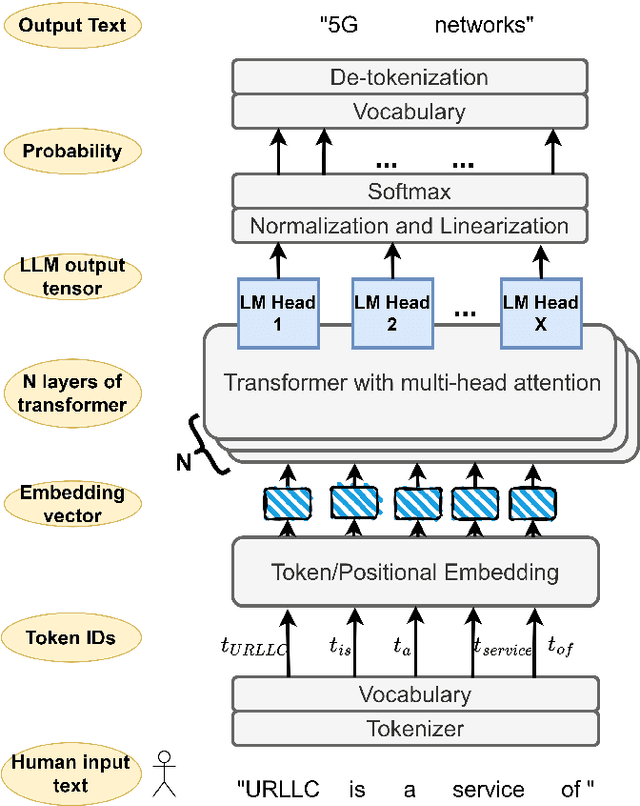
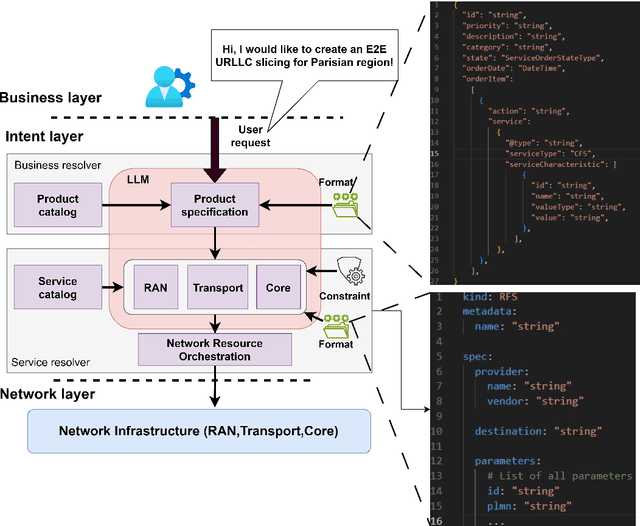
Large Language Models (LLMs) are likely to play a key role in Intent-Based Networking (IBN) as they show remarkable performance in interpreting human language as well as code generation, enabling the translation of high-level intents expressed by humans into low-level network configurations. In this paper, we leverage closed-source language models (i.e., Google Gemini 1.5 pro, ChatGPT-4) and open-source models (i.e., LLama, Mistral) to investigate their capacity to generate E2E network configurations for radio access networks (RANs) and core networks in 5G/6G mobile networks. We introduce a novel performance metrics, known as FEACI, to quantitatively assess the format (F), explainability (E), accuracy (A), cost (C), and inference time (I) of the generated answer; existing general metrics are unable to capture these features. The results of our study demonstrate that open-source models can achieve comparable or even superior translation performance compared with the closed-source models requiring costly hardware setup and not accessible to all users.
Point Cloud-Assisted Neural Image Compression
Dec 16, 2024High-efficient image compression is a critical requirement. In several scenarios where multiple modalities of data are captured by different sensors, the auxiliary information from other modalities are not fully leveraged by existing image-only codecs, leading to suboptimal compression efficiency. In this paper, we increase image compression performance with the assistance of point cloud, which is widely adopted in the area of autonomous driving. We first unify the data representation for both modalities to facilitate data processing. Then, we propose the point cloud-assisted neural image codec (PCA-NIC) to enhance the preservation of image texture and structure by utilizing the high-dimensional point cloud information. We further introduce a multi-modal feature fusion transform module (MMFFT) to capture more representative image features, remove redundant information between channels and modalities that are not relevant to the image content. Our work is the first to improve image compression performance using point cloud and achieves state-of-the-art performance.