 Add to Chrome
 Add to Firefox
 Add to Edge
SIGMark: Scalable In-Generation Watermark with Blind Extraction for Video Diffusion
Mar 03, 2026
Artificial Intelligence Generated Content (AIGC), particularly video generation with diffusion models, has been advanced rapidly. Invisible watermarking is a key technology for protecting AI-generated videos and tracing harmful content, and thus plays a crucial role in AI safety. Beyond post-processing watermarks which inevitably degrade video quality, recent studies have proposed distortion-free in-generation watermarking for video diffusion models. However, existing in-generation approaches are non-blind: they require maintaining all the message-key pairs and performing template-based matching during extraction, which incurs prohibitive computational costs at scale. Moreover, when applied to modern video diffusion models with causal 3D Variational Autoencoders (VAEs), their robustness against temporal disturbance becomes extremely weak. To overcome these challenges, we propose SIGMark, a Scalable In-Generation watermarking framework with blind extraction for video diffusion. To achieve blind-extraction, we propose to generate watermarked initial noise using a Global set of Frame-wise PseudoRandom Coding keys (GF-PRC), reducing the cost of storing large-scale information while preserving noise distribution and diversity for distortion-free watermarking. To enhance robustness, we further design a Segment Group-Ordering module (SGO) tailored to causal 3D VAEs, ensuring robust watermark inversion during extraction under temporal disturbance. Comprehensive experiments on modern diffusion models show that SIGMark achieves very high bit-accuracy during extraction under both temporal and spatial disturbances with minimal overhead, demonstrating its scalability and robustness. Our project is available at https://jeremyzhao1998.github.io/SIGMark-release/.

Defending Against Data Reconstruction Attacks in Federated Learning: An Information Theory Approach
Mar 02, 2024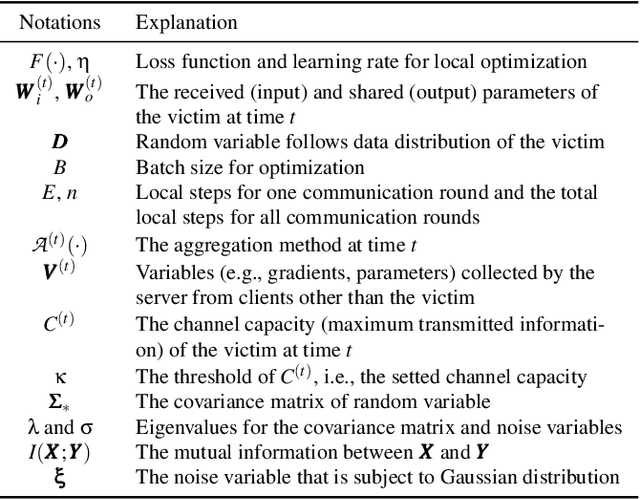
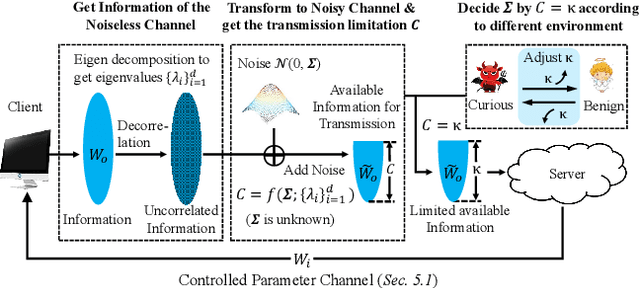
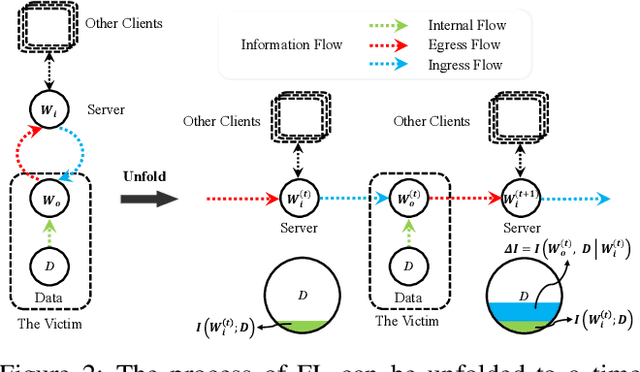
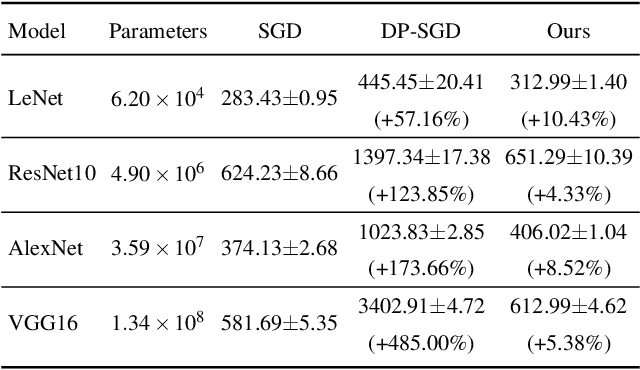
Federated Learning (FL) trains a black-box and high-dimensional model among different clients by exchanging parameters instead of direct data sharing, which mitigates the privacy leak incurred by machine learning. However, FL still suffers from membership inference attacks (MIA) or data reconstruction attacks (DRA). In particular, an attacker can extract the information from local datasets by constructing DRA, which cannot be effectively throttled by existing techniques, e.g., Differential Privacy (DP). In this paper, we aim to ensure a strong privacy guarantee for FL under DRA. We prove that reconstruction errors under DRA are constrained by the information acquired by an attacker, which means that constraining the transmitted information can effectively throttle DRA. To quantify the information leakage incurred by FL, we establish a channel model, which depends on the upper bound of joint mutual information between the local dataset and multiple transmitted parameters. Moreover, the channel model indicates that the transmitted information can be constrained through data space operation, which can improve training efficiency and the model accuracy under constrained information. According to the channel model, we propose algorithms to constrain the information transmitted in a single round of local training. With a limited number of training rounds, the algorithms ensure that the total amount of transmitted information is limited. Furthermore, our channel model can be applied to various privacy-enhancing techniques (such as DP) to enhance privacy guarantees against DRA. Extensive experiments with real-world datasets validate the effectiveness of our methods.