 Add to Chrome
 Add to Firefox
 Add to Edge
Lagged backward-compatible physics-informed neural networks for unsaturated soil consolidation analysis
Feb 03, 2026
This study develops a Lagged Backward-Compatible Physics-Informed Neural Network (LBC-PINN) for simulating and inverting one-dimensional unsaturated soil consolidation under long-term loading. To address the challenges of coupled air and water pressure dissipation across multi-scale time domains, the framework integrates logarithmic time segmentation, lagged compatibility loss enforcement, and segment-wise transfer learning. In forward analysis, the LBC-PINN with recommended segmentation schemes accurately predicts pore air and pore water pressure evolution. Model predictions are validated against finite element method (FEM) results, with mean absolute errors below 1e-2 for time durations up to 1e10 seconds. A simplified segmentation strategy based on the characteristic air-phase dissipation time improves computational efficiency while preserving predictive accuracy. Sensitivity analyses confirm the robustness of the framework across air-to-water permeability ratios ranging from 1e-3 to 1e3.

Semantics-Driven Unsupervised Learning for Monocular Depth and Ego-Motion Estimation
Jun 08, 2020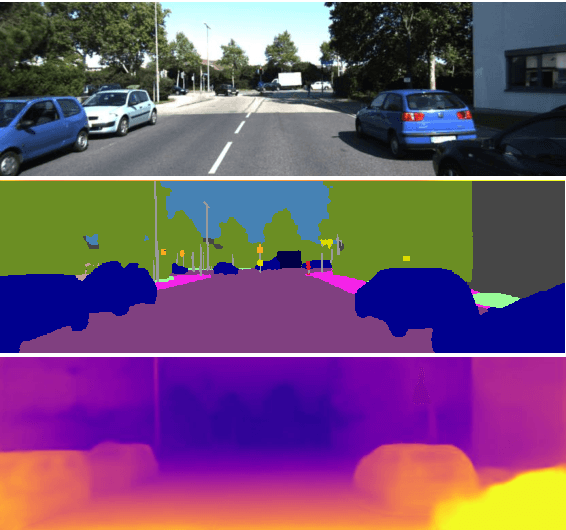
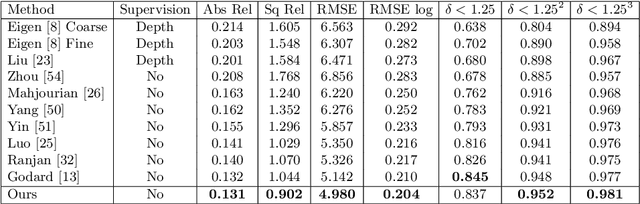
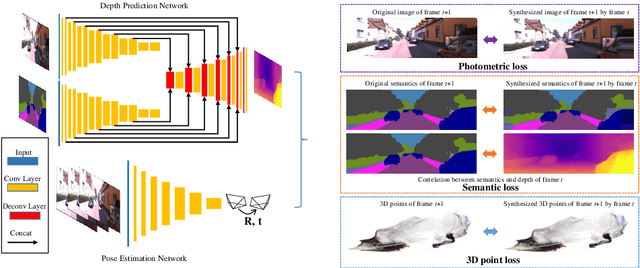
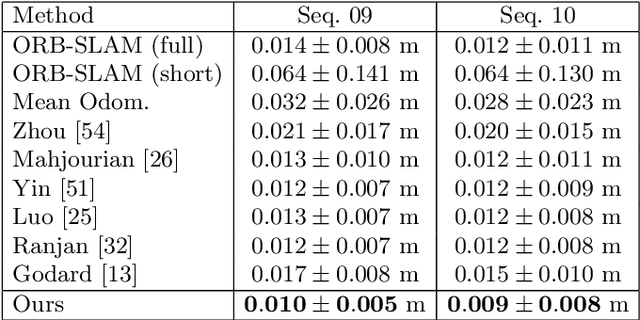
We propose a semantics-driven unsupervised learning approach for monocular depth and ego-motion estimation from videos in this paper. Recent unsupervised learning methods employ photometric errors between synthetic view and actual image as a supervision signal for training. In our method, we exploit semantic segmentation information to mitigate the effects of dynamic objects and occlusions in the scene, and to improve depth prediction performance by considering the correlation between depth and semantics. To avoid costly labeling process, we use noisy semantic segmentation results obtained by a pre-trained semantic segmentation network. In addition, we minimize the position error between the corresponding points of adjacent frames to utilize 3D spatial information. Experimental results on the KITTI dataset show that our method achieves good performance in both depth and ego-motion estimation tasks.