 Add to Chrome
 Add to Firefox
 Add to Edge
From Manipulation to Mistrust: Explaining Diverse Micro-Video Misinformation for Robust Debunking in the Wild
Mar 26, 2026
The rise of micro-videos has reshaped how misinformation spreads, amplifying its speed, reach, and impact on public trust. Existing benchmarks typically focus on a single deception type, overlooking the diversity of real-world cases that involve multimodal manipulation, AI-generated content, cognitive bias, and out-of-context reuse. Meanwhile, most detection models lack fine-grained attribution, limiting interpretability and practical utility. To address these gaps, we introduce WildFakeBench, a large-scale benchmark of over 10,000 real-world micro-videos covering diverse misinformation types and sources, each annotated with expert-defined attribution labels. Building on this foundation, we develop FakeAgent, a Delphi-inspired multi-agent reasoning framework that integrates multimodal understanding with external evidence for attribution-grounded analysis. FakeAgent jointly analyzes content and retrieved evidence to identify manipulation, recognize cognitive and AI-generated patterns, and detect out-of-context misinformation. Extensive experiments show that FakeAgent consistently outperforms existing MLLMs across all misinformation types, while WildFakeBench provides a realistic and challenging testbed for advancing explainable micro-video misinformation detection. Data and code are available at: https://github.com/Aiyistan/FakeAgent.

DiFaR: Enhancing Multimodal Misinformation Detection with Diverse, Factual, and Relevant Rationales
Aug 14, 2025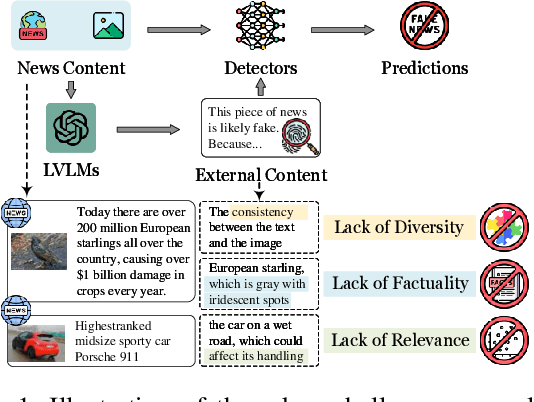
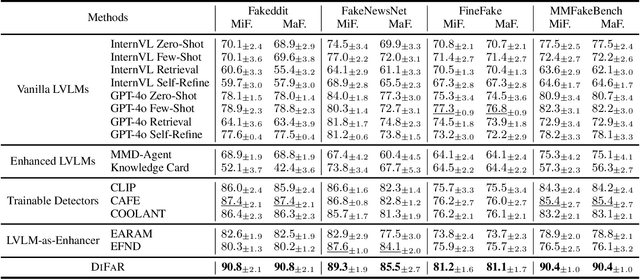
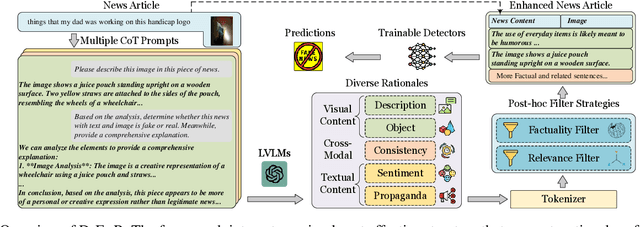
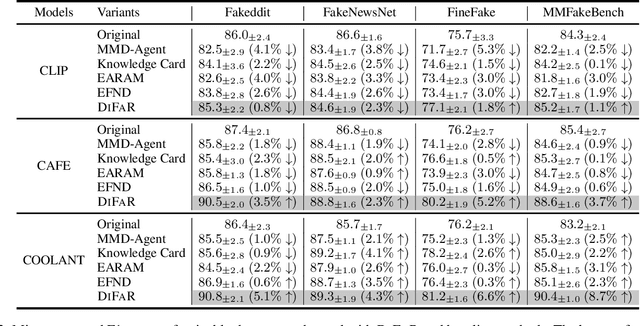
Generating textual rationales from large vision-language models (LVLMs) to support trainable multimodal misinformation detectors has emerged as a promising paradigm. However, its effectiveness is fundamentally limited by three core challenges: (i) insufficient diversity in generated rationales, (ii) factual inaccuracies due to hallucinations, and (iii) irrelevant or conflicting content that introduces noise. We introduce DiFaR, a detector-agnostic framework that produces diverse, factual, and relevant rationales to enhance misinformation detection. DiFaR employs five chain-of-thought prompts to elicit varied reasoning traces from LVLMs and incorporates a lightweight post-hoc filtering module to select rationale sentences based on sentence-level factuality and relevance scores. Extensive experiments on four popular benchmarks demonstrate that DiFaR outperforms four baseline categories by up to 5.9% and boosts existing detectors by as much as 8.7%. Both automatic metrics and human evaluations confirm that DiFaR significantly improves rationale quality across all three dimensions.