 Add to Chrome
 Add to Firefox
 Add to Edge
VLN-AVP: Zero-Shot Vision-Language Navigation with Hybrid Long-Short-Term Memory for Autonomous Valet Parking
Jul 20, 2026
Existing methods in Autonomous Valet Parking (AVP) typically rely on pre-built maps, which severely restricts their scalability to unseen environments and open-vocabulary targets. Inspired by the application of Vision-Language Models (VLMs) in Vision-Language Navigation (VLN) tasks, we propose VLN-AVP, a zero-shot navigation framework for AVP tasks. By combining the precise spatial perception of a Bird's-Eye-View (BEV) model with the general intelligence of VLMs, our framework 1) eliminates the dependency on pre-built maps, 2) interprets semantic environmental contexts in parking scenarios, and 3) enables intuitive navigation following natural language instructions. Specifically, we introduce a hybrid memory system: a short-term perception memory tracks semantic visual cues to address the limitations of VLM's single-frame reasoning in existing methods, while a long-term topological memory facilitates stable policy learning from past experiences. To bridge the gap in existing benchmarks, we also present the VLN-AVP dataset and benchmark. Featuring 10 high-fidelity parking scenes and over 1,000 navigation episodes, it has the largest number of garage scenes to date and is the first VLN benchmark for underground parking. Extensive experiments demonstrate that in simulation, our method achieves an over 25% improvement in success rate compared to VLN methods and an over 15% improvement compared to other autonomous driving methods. Furthermore, it attains a leading success rate in real-world vehicle experiments, proving its practical feasibility.

MapLocNet: Coarse-to-Fine Feature Registration for Visual Re-Localization in Navigation Maps
Jul 11, 2024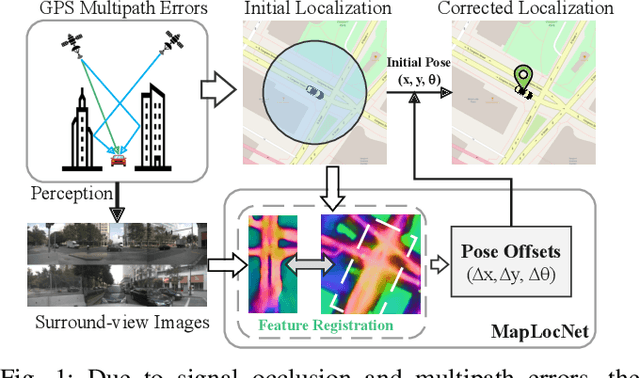
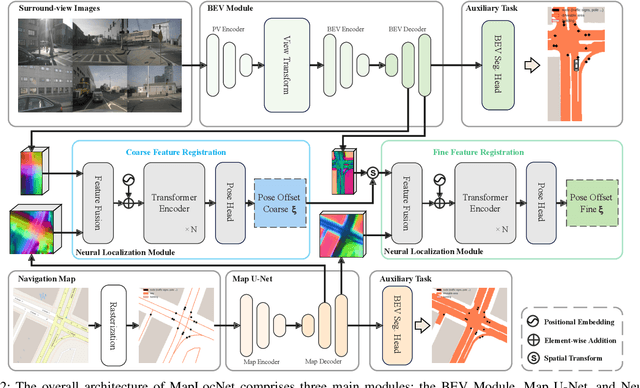
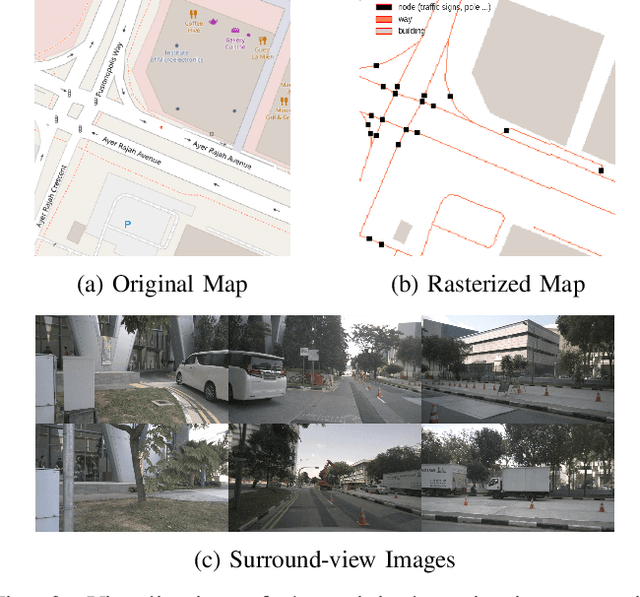
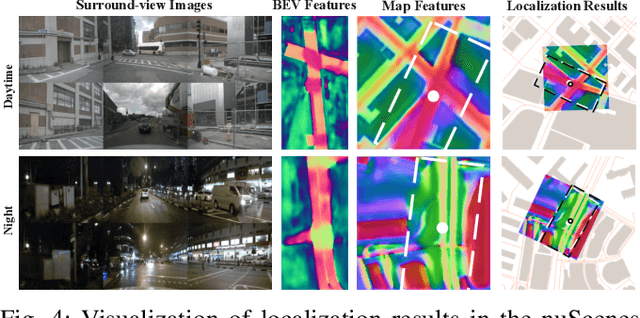
Robust localization is the cornerstone of autonomous driving, especially in challenging urban environments where GPS signals suffer from multipath errors. Traditional localization approaches rely on high-definition (HD) maps, which consist of precisely annotated landmarks. However, building HD map is expensive and challenging to scale up. Given these limitations, leveraging navigation maps has emerged as a promising low-cost alternative for localization. Current approaches based on navigation maps can achieve highly accurate localization, but their complex matching strategies lead to unacceptable inference latency that fails to meet the real-time demands. To address these limitations, we propose a novel transformer-based neural re-localization method. Inspired by image registration, our approach performs a coarse-to-fine neural feature registration between navigation map and visual bird's-eye view features. Our method significantly outperforms the current state-of-the-art OrienterNet on both the nuScenes and Argoverse datasets, which is nearly 10%/20% localization accuracy and 30/16 FPS improvement on single-view and surround-view input settings, separately. We highlight that our research presents an HD-map-free localization method for autonomous driving, offering cost-effective, reliable, and scalable performance in challenging driving environments.