 Add to Chrome
 Add to Firefox
 Add to Edge
HAPI-EP: Towards Hybrid, Adaptive, and Predictive Digital Twins of Cardiac Electrophysiology
Jun 14, 2026
A digital twin (DT) of a patient-specific heart offers significant potential in personalized medicine. However, its rapid and dynamic adaptation to an individual's live data and its predictive capability after adaptation remains central challenges. We examine this challenge from its two building blocks: DT formulation where mechanistic and data-driven models show competing merits and limitations, and DT optimization strategies that are largely driven by a reconstruction objective leading to un-identifiable models. We address both bottlenecks via HAPI -- an AI framework for building hybrid, adaptive, and predictive DTs with three key enablers. First, HAPI constructs a physics-integrated gray-box model in which an interpretable mechanistic backbone is augmented by a neural component that models its residual to the observed data. Second, rather than attempting to pre-encode all possible variations in a static hybrid model, HAPI enables rapid on-the-fly adaptation of the hybrid model to few-shot live data, achieved by feedforward meta-learners realizing amortized inference of both mechanistic and neural parameters of the hybrid model trained with predictive objectives. Finally, we show that this adaptivity corresponds to the construction of a conditional generative model (i.e., the hybrid DT) that endows it with theoretical identifiability and thus strong performance in predictive scenarios. We demonstrate the proof-of-concept of HAPI in cardiac electrophysiology using a hybrid monodomain model with mechanistic reaction kinetics and neural graph diffusion. Across synthetic and real-data studies, we show that HAPI's mechanistic-neural hybridization and predictive adaptation are critical for obtaining identifiable DTs with strong predictive and out-of-distribution capabilities.

CoMetaPNS: Continually Meta-learning Personalized Neural Surrogates for Cardiac Electrophysiology Simulations
Jun 05, 2026Personalized virtual heart simulations face challenges in model personalization and computational cost. While neural surrogates offer state-of-the-art solutions, they typically address either efficient personalization or training generalizable models. Recent work reframes this by learning the process of personalizing a surrogate using limited subject-specific context data, through few-shot generative modeling with set-conditioned surrogates and meta-learned amortized inference. These methods, however, assume a static and diverse training distribution with known task identifiers. When new data becomes available, they require costly retraining with all prior data to avoid catastrophic forgetting - a phenomena where the model forgets earlier tasks when trained on new ones. This is a major limitation in clinical settings where often unlabeled data arrives sequentially and full retraining is infeasible. This paper presents a new continual meta-learning framework to achieve personalized neural surrogates able to not only continually integrate information but also identify whether incoming data stems from a known or unknown dynamics source. By leveraging a continual Bayesian Gaussian Mixture Model over a memory buffer, our framework can infer the identifiers and relationships of data over time - required for effective meta-learning. Empirical results on synthetic cardiac data demonstrate superior simulation forecasting, computational scalability, and resilience to catastrophic forgetting compared to existing baselines.
Federated Foundation Model for GI Endoscopy Images
May 30, 2025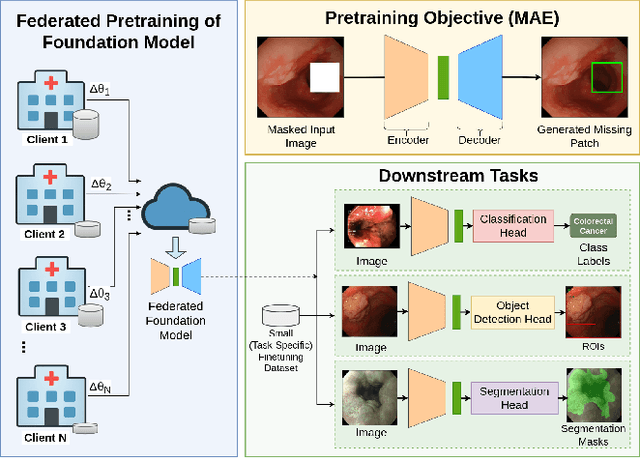
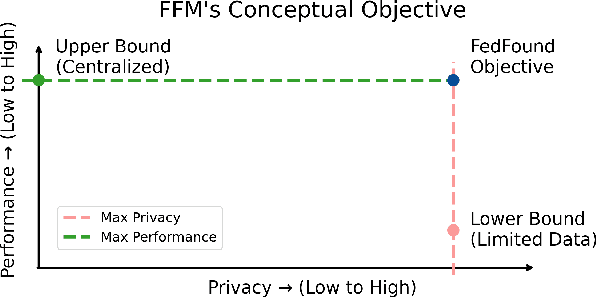
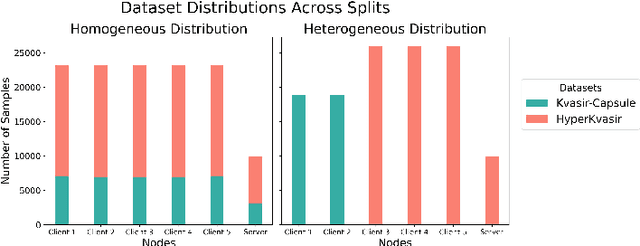
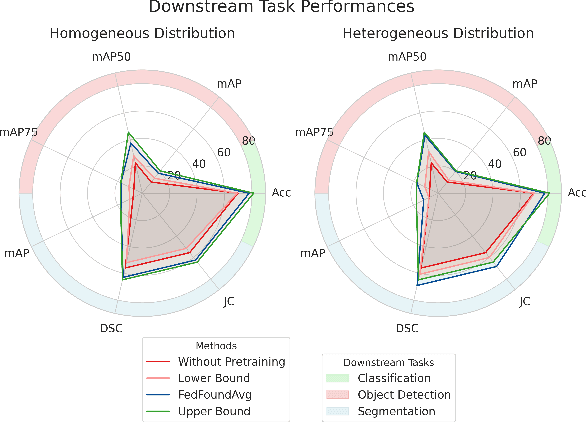
Gastrointestinal (GI) endoscopy is essential in identifying GI tract abnormalities in order to detect diseases in their early stages and improve patient outcomes. Although deep learning has shown success in supporting GI diagnostics and decision-making, these models require curated datasets with labels that are expensive to acquire. Foundation models offer a promising solution by learning general-purpose representations, which can be finetuned for specific tasks, overcoming data scarcity. Developing foundation models for medical imaging holds significant potential, but the sensitive and protected nature of medical data presents unique challenges. Foundation model training typically requires extensive datasets, and while hospitals generate large volumes of data, privacy restrictions prevent direct data sharing, making foundation model training infeasible in most scenarios. In this work, we propose a FL framework for training foundation models for gastroendoscopy imaging, enabling data to remain within local hospital environments while contributing to a shared model. We explore several established FL algorithms, assessing their suitability for training foundation models without relying on task-specific labels, conducting experiments in both homogeneous and heterogeneous settings. We evaluate the trained foundation model on three critical downstream tasks--classification, detection, and segmentation--and demonstrate that it achieves improved performance across all tasks, highlighting the effectiveness of our approach in a federated, privacy-preserving setting.
HyPer-EP: Meta-Learning Hybrid Personalized Models for Cardiac Electrophysiology
Mar 15, 2024


Personalized virtual heart models have demonstrated increasing potential for clinical use, although the estimation of their parameters given patient-specific data remain a challenge. Traditional physics-based modeling approaches are computationally costly and often neglect the inherent structural errors in these models due to model simplifications and assumptions. Modern deep learning approaches, on the other hand, rely heavily on data supervision and lacks interpretability. In this paper, we present a novel hybrid modeling framework to describe a personalized cardiac digital twin as a combination of a physics-based known expression augmented by neural network modeling of its unknown gap to reality. We then present a novel meta-learning framework to enable the separate identification of both the physics-based and neural components in the hybrid model. We demonstrate the feasibility and generality of this hybrid modeling framework with two examples of instantiations and their proof-of-concept in synthetic experiments.
Unsupervised Learning of Hybrid Latent Dynamics: A Learn-to-Identify Framework
Mar 13, 2024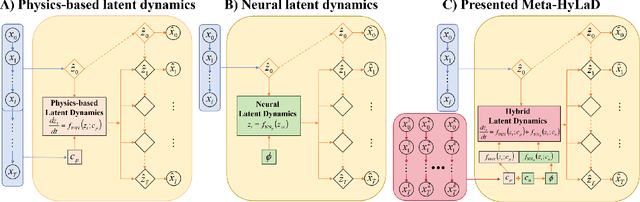
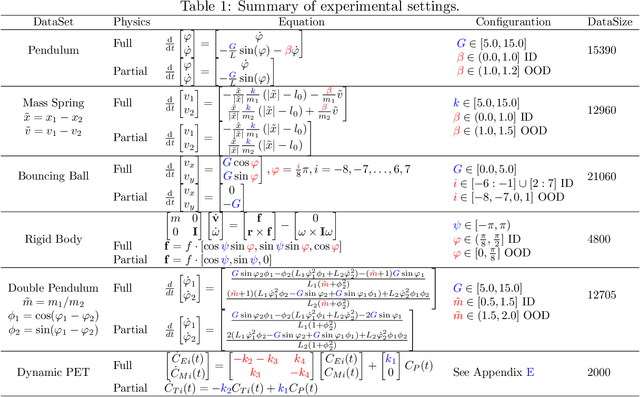
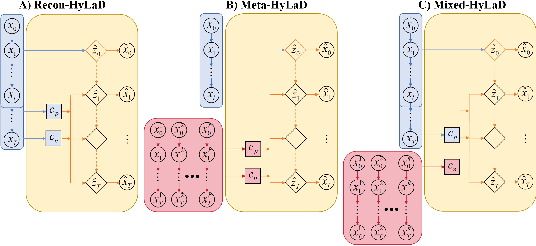

Modern applications increasingly require unsupervised learning of latent dynamics from high-dimensional time-series. This presents a significant challenge of identifiability: many abstract latent representations may reconstruct observations, yet do they guarantee an adequate identification of the governing dynamics? This paper investigates this challenge from two angles: the use of physics inductive bias specific to the data being modeled, and a learn-to-identify strategy that separates forecasting objectives from the data used for the identification. We combine these two strategies in a novel framework for unsupervised meta-learning of hybrid latent dynamics (Meta-HyLaD) with: 1) a latent dynamic function that hybridize known mathematical expressions of prior physics with neural functions describing its unknown errors, and 2) a meta-learning formulation to learn to separately identify both components of the hybrid dynamics. Through extensive experiments on five physics and one biomedical systems, we provide strong evidence for the benefits of Meta-HyLaD to integrate rich prior knowledge while identifying their gap to observed data.
LIBR+: Improving Intraoperative Liver Registration by Learning the Residual of Biomechanics-Based Deformable Registration
Mar 11, 2024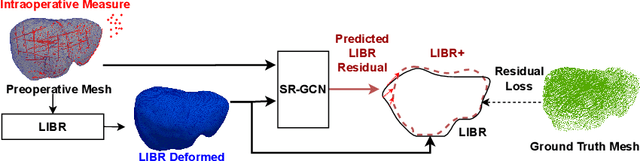
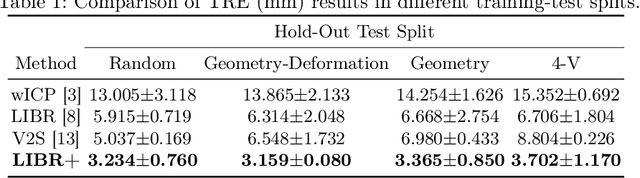
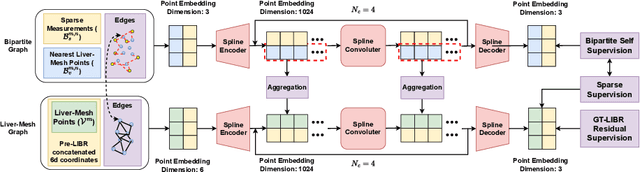
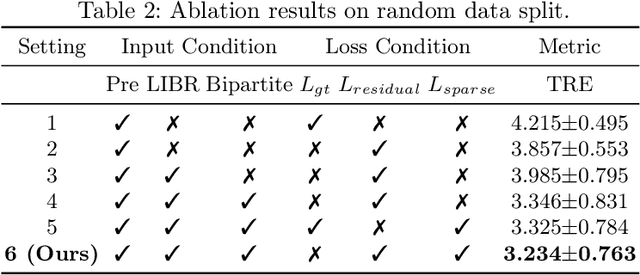
The surgical environment imposes unique challenges to the intraoperative registration of organ shapes to their preoperatively-imaged geometry. Biomechanical model-based registration remains popular, while deep learning solutions remain limited due to the sparsity and variability of intraoperative measurements and the limited ground-truth deformation of an organ that can be obtained during the surgery. In this paper, we propose a novel \textit{hybrid} registration approach that leverage a linearized iterative boundary reconstruction (LIBR) method based on linear elastic biomechanics, and use deep neural networks to learn its residual to the ground-truth deformation (LIBR+). We further formulate a dual-branch spline-residual graph convolutional neural network (SR-GCN) to assimilate information from sparse and variable intraoperative measurements and effectively propagate it through the geometry of the 3D organ. Experiments on a large intraoperative liver registration dataset demonstrated the consistent improvements achieved by LIBR+ in comparison to existing rigid, biomechnical model-based non-rigid, and deep-learning based non-rigid approaches to intraoperative liver registration.
Few-shot Generation of Personalized Neural Surrogates for Cardiac Simulation via Bayesian Meta-Learning
Oct 06, 2022Clinical adoption of personalized virtual heart simulations faces challenges in model personalization and expensive computation. While an ideal solution is an efficient neural surrogate that at the same time is personalized to an individual subject, the state-of-the-art is either concerned with personalizing an expensive simulation model, or learning an efficient yet generic surrogate. This paper presents a completely new concept to achieve personalized neural surrogates in a single coherent framework of meta-learning (metaPNS). Instead of learning a single neural surrogate, we pursue the process of learning a personalized neural surrogate using a small amount of context data from a subject, in a novel formulation of few-shot generative modeling underpinned by: 1) a set-conditioned neural surrogate for cardiac simulation that, conditioned on subject-specific context data, learns to generate query simulations not included in the context set, and 2) a meta-model of amortized variational inference that learns to condition the neural surrogate via simple feed-forward embedding of context data. As test time, metaPNS delivers a personalized neural surrogate by fast feed-forward embedding of a small and flexible number of data available from an individual, achieving -- for the first time -- personalization and surrogate construction for expensive simulations in one end-to-end learning framework. Synthetic and real-data experiments demonstrated that metaPNS was able to improve personalization and predictive accuracy in comparison to conventionally-optimized cardiac simulation models, at a fraction of computation.
Neural State-Space Modeling with Latent Causal-Effect Disentanglement
Sep 26, 2022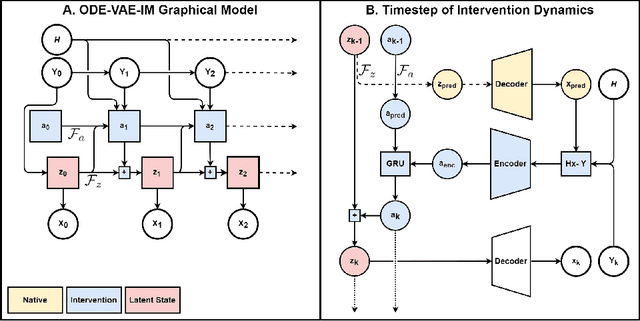
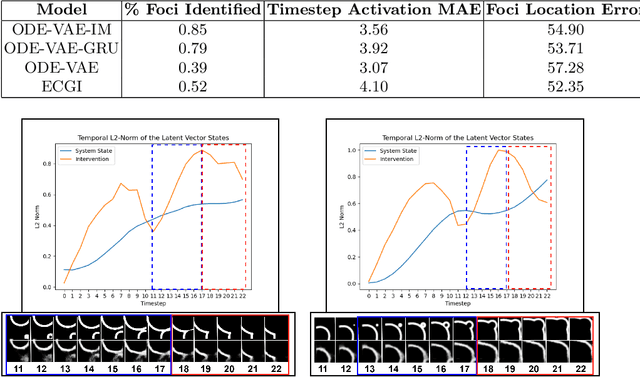

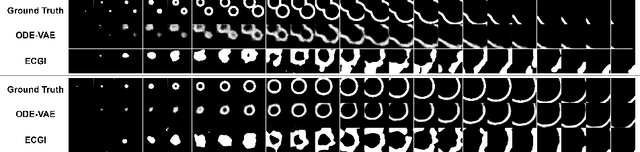
Despite substantial progress in deep learning approaches to time-series reconstruction, no existing methods are designed to uncover local activities with minute signal strength due to their negligible contribution to the optimization loss. Such local activities however can signify important abnormal events in physiological systems, such as an extra foci triggering an abnormal propagation of electrical waves in the heart. We discuss a novel technique for reconstructing such local activity that, while small in signal strength, is the cause of subsequent global activities that have larger signal strength. Our central innovation is to approach this by explicitly modeling and disentangling how the latent state of a system is influenced by potential hidden internal interventions. In a novel neural formulation of state-space models (SSMs), we first introduce causal-effect modeling of the latent dynamics via a system of interacting neural ODEs that separately describes 1) the continuous-time dynamics of the internal intervention, and 2) its effect on the trajectory of the system's native state. Because the intervention can not be directly observed but have to be disentangled from the observed subsequent effect, we integrate knowledge of the native intervention-free dynamics of a system, and infer the hidden intervention by assuming it to be responsible for differences observed between the actual and hypothetical intervention-free dynamics. We demonstrated a proof-of-concept of the presented framework on reconstructing ectopic foci disrupting the course of normal cardiac electrical propagation from remote observations.
Learning Geometry-Dependent and Physics-Based Inverse Image Reconstruction
Jul 18, 2020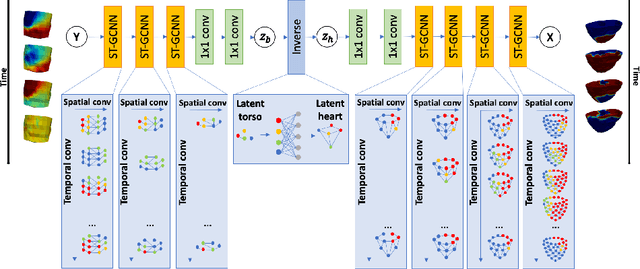
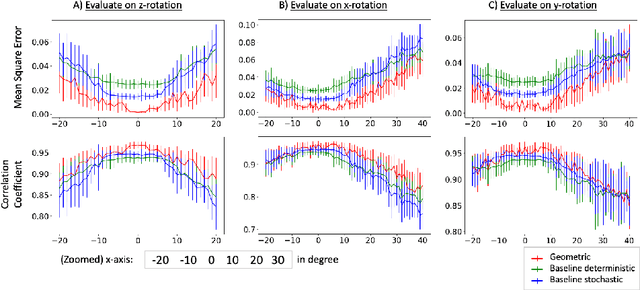
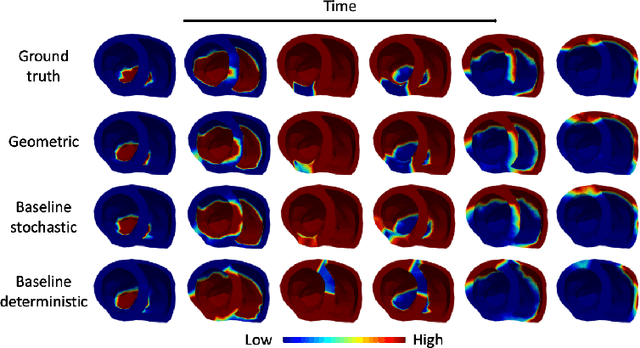
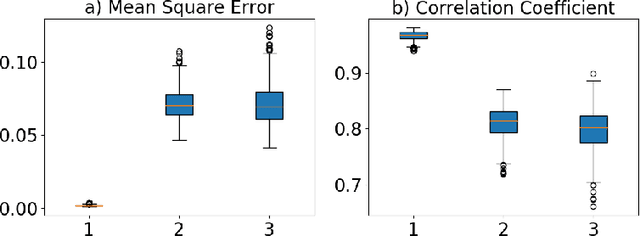
Deep neural networks have shown great potential in image reconstruction problems in Euclidean space. However, many reconstruction problems involve imaging physics that are dependent on the underlying non-Euclidean geometry. In this paper, we present a new approach to learn inverse imaging that exploit the underlying geometry and physics. We first introduce a non-Euclidean encoding-decoding network that allows us to describe the unknown and measurement variables over their respective geometrical domains. We then learn the geometry-dependent physics in between the two domains by explicitly modeling it via a bipartite graph over the graphical embedding of the two geometry. We applied the presented network to reconstructing electrical activity on the heart surface from body-surface potential. In a series of generalization tasks with increasing difficulty, we demonstrated the improved ability of the presented network to generalize across geometrical changes underlying the data in comparison to its Euclidean alternatives.