 Add to Chrome
 Add to Firefox
 Add to Edge
HAPI-EP: Towards Hybrid, Adaptive, and Predictive Digital Twins of Cardiac Electrophysiology
Jun 14, 2026
A digital twin (DT) of a patient-specific heart offers significant potential in personalized medicine. However, its rapid and dynamic adaptation to an individual's live data and its predictive capability after adaptation remains central challenges. We examine this challenge from its two building blocks: DT formulation where mechanistic and data-driven models show competing merits and limitations, and DT optimization strategies that are largely driven by a reconstruction objective leading to un-identifiable models. We address both bottlenecks via HAPI -- an AI framework for building hybrid, adaptive, and predictive DTs with three key enablers. First, HAPI constructs a physics-integrated gray-box model in which an interpretable mechanistic backbone is augmented by a neural component that models its residual to the observed data. Second, rather than attempting to pre-encode all possible variations in a static hybrid model, HAPI enables rapid on-the-fly adaptation of the hybrid model to few-shot live data, achieved by feedforward meta-learners realizing amortized inference of both mechanistic and neural parameters of the hybrid model trained with predictive objectives. Finally, we show that this adaptivity corresponds to the construction of a conditional generative model (i.e., the hybrid DT) that endows it with theoretical identifiability and thus strong performance in predictive scenarios. We demonstrate the proof-of-concept of HAPI in cardiac electrophysiology using a hybrid monodomain model with mechanistic reaction kinetics and neural graph diffusion. Across synthetic and real-data studies, we show that HAPI's mechanistic-neural hybridization and predictive adaptation are critical for obtaining identifiable DTs with strong predictive and out-of-distribution capabilities.

HyPer-EP: Meta-Learning Hybrid Personalized Models for Cardiac Electrophysiology
Mar 15, 2024


Personalized virtual heart models have demonstrated increasing potential for clinical use, although the estimation of their parameters given patient-specific data remain a challenge. Traditional physics-based modeling approaches are computationally costly and often neglect the inherent structural errors in these models due to model simplifications and assumptions. Modern deep learning approaches, on the other hand, rely heavily on data supervision and lacks interpretability. In this paper, we present a novel hybrid modeling framework to describe a personalized cardiac digital twin as a combination of a physics-based known expression augmented by neural network modeling of its unknown gap to reality. We then present a novel meta-learning framework to enable the separate identification of both the physics-based and neural components in the hybrid model. We demonstrate the feasibility and generality of this hybrid modeling framework with two examples of instantiations and their proof-of-concept in synthetic experiments.
Unsupervised Learning of Hybrid Latent Dynamics: A Learn-to-Identify Framework
Mar 13, 2024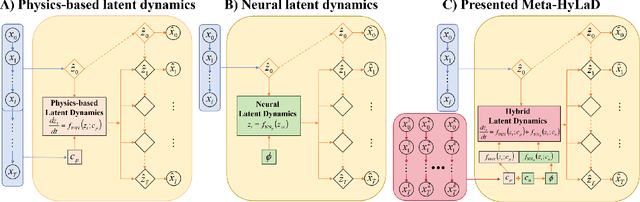
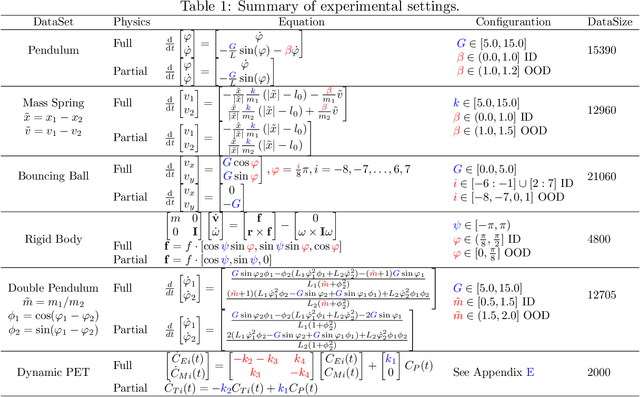
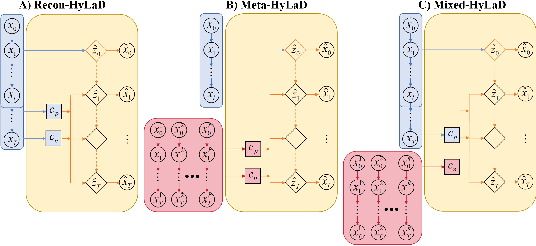

Modern applications increasingly require unsupervised learning of latent dynamics from high-dimensional time-series. This presents a significant challenge of identifiability: many abstract latent representations may reconstruct observations, yet do they guarantee an adequate identification of the governing dynamics? This paper investigates this challenge from two angles: the use of physics inductive bias specific to the data being modeled, and a learn-to-identify strategy that separates forecasting objectives from the data used for the identification. We combine these two strategies in a novel framework for unsupervised meta-learning of hybrid latent dynamics (Meta-HyLaD) with: 1) a latent dynamic function that hybridize known mathematical expressions of prior physics with neural functions describing its unknown errors, and 2) a meta-learning formulation to learn to separately identify both components of the hybrid dynamics. Through extensive experiments on five physics and one biomedical systems, we provide strong evidence for the benefits of Meta-HyLaD to integrate rich prior knowledge while identifying their gap to observed data.