 Add to Chrome
 Add to Firefox
 Add to Edge
A Specialized Large Language Model for Clinical Reasoning and Diagnosis in Rare Diseases
Nov 18, 2025
Rare diseases affect hundreds of millions worldwide, yet diagnosis often spans years. Convectional pipelines decouple noisy evidence extraction from downstream inferential diagnosis, and general/medical large language models (LLMs) face scarce real world electronic health records (EHRs), stale domain knowledge, and hallucinations. We assemble a large, domain specialized clinical corpus and a clinician validated reasoning set, and develop RareSeek R1 via staged instruction tuning, chain of thought learning, and graph grounded retrieval. Across multicenter EHR narratives and public benchmarks, RareSeek R1 attains state of the art accuracy, robust generalization, and stability under noisy or overlapping phenotypes. Augmented retrieval yields the largest gains when narratives pair with prioritized variants by resolving ambiguity and aligning candidates to mechanisms. Human studies show performance on par with experienced physicians and consistent gains in assistive use. Notably, transparent reasoning highlights decisive non phenotypic evidence (median 23.1%, such as imaging, interventions, functional tests) underpinning many correct diagnoses. This work advances a narrative first, knowledge integrated reasoning paradigm that shortens the diagnostic odyssey and enables auditable, clinically translatable decision support.

Electroencephalogram-based Multi-class Decoding of Attended Speakers' Direction with Audio Spatial Spectrum
Nov 11, 2024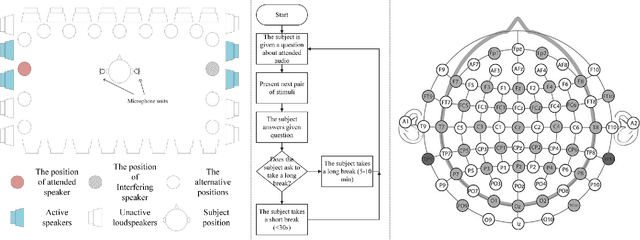
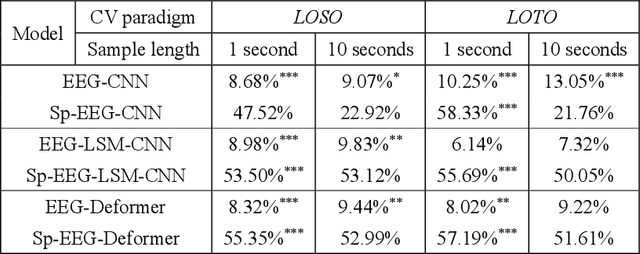
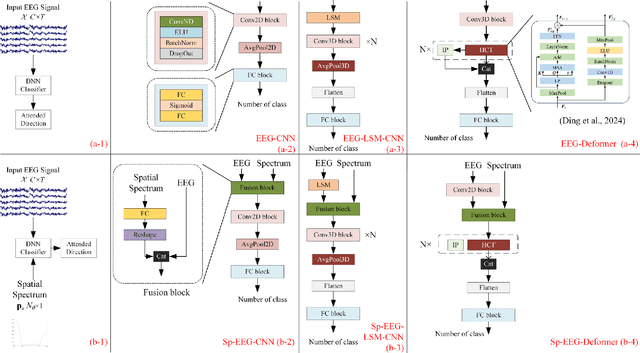
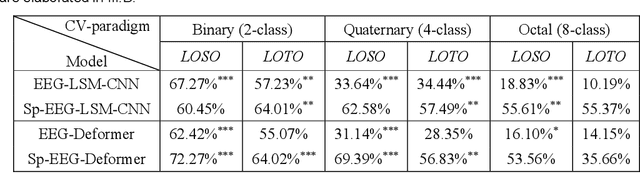
Decoding the directional focus of an attended speaker from listeners' electroencephalogram (EEG) signals is essential for developing brain-computer interfaces to improve the quality of life for individuals with hearing impairment. Previous works have concentrated on binary directional focus decoding, i.e., determining whether the attended speaker is on the left or right side of the listener. However, a more precise decoding of the exact direction of the attended speaker is necessary for effective speech processing. Additionally, audio spatial information has not been effectively leveraged, resulting in suboptimal decoding results. In this paper, we observe that, on our recently presented dataset with 15-class directional focus, models relying exclusively on EEG inputs exhibits significantly lower accuracy when decoding the directional focus in both leave-one-subject-out and leave-one-trial-out scenarios. By integrating audio spatial spectra with EEG features, the decoding accuracy can be effectively improved. We employ the CNN, LSM-CNN, and EEG-Deformer models to decode the directional focus from listeners' EEG signals with the auxiliary audio spatial spectra. The proposed Sp-Aux-Deformer model achieves notable 15-class decoding accuracies of 57.48% and 61.83% in leave-one-subject-out and leave-one-trial-out scenarios, respectively.