 Add to Chrome
 Add to Firefox
 Add to Edge
RADAR: Relative Angular Divergence Across Representations
May 21, 2026
Machine learning methods rely on data. However, gathering suitable data can be challenging due to availability constraints, cost, or the need for domain expertise. Expanding datasets with additional sources is a common response to limited data, yet this practice does not always improve downstream performance and can sometimes lead to a loss of performance, known as negative transfer. We propose RADAR, a simple, geometrically grounded metric for estimating cross-domain transferability in foundation models. RADAR analyzes the layer-wise evolution of representations by measuring angular alignments and relative changes in distance along layer-to-layer displacement trajectories, and by comparing empirical distributions of within-domain and cross-domain dynamics. We hypothesize that domain transferability is related to the divergence between these trajectory distributions. We evaluate the metric across multiple modalities, including cross-lingual sentiment classification with text embedding models and cross-domain image classification with foundation vision models. Across several settings, RADAR provides competitive predictive performance relative to existing transferability metrics on several vision and text benchmarks, with particularly strong results when domain transitions are smooth or cleanly separated. Our ablations further suggest that the effectiveness of transferability estimation depends on the geometry of the model's internal representation space, with different modalities favoring different topological formulations.

Retrieval-Augmented LLMs for Security Incident Analysis
Mar 18, 2026Investigating cybersecurity incidents requires collecting and analyzing evidence from multiple log sources, including intrusion detection alerts, network traffic records, and authentication events. This process is labor-intensive: analysts must sift through large volumes of data to identify relevant indicators and piece together what happened. We present a RAG-based system that performs security incident analysis through targeted query-based filtering and LLM semantic reasoning. The system uses a query library with associated MITRE ATT\&CK techniques to extract indicators from raw logs, then retrieves relevant context to answer forensic questions and reconstruct attack sequences. We evaluate the system with five LLM providers on malware traffic incidents and multi-stage Active Directory attacks. We find that LLM models have different performance and tradeoffs, with Claude Sonnet~4 and DeepSeek~V3 achieving 100\% recall across all four malware scenarios, while DeepSeek costs 15$\times$ less (\$0.008 vs.\ \$0.12 per analysis). Attack step detection on Active Directory scenarios reaches 100\% precision and 82\% recall. Ablation studies confirm that a RAG architecture is essential: LLM baselines without RAG-enhanced context correctly identify victim hosts but miss all attack infrastructure including malicious domains and command-and-control servers. These results demonstrate that combining targeted query-based filtering with RAG-based retrieval enables accurate, cost-effective security analysis within LLM context limits.
ABCD: All Biases Come Disguised
Feb 19, 2026Multiple-choice question (MCQ) benchmarks have been a standard evaluation practice for measuring LLMs' ability to reason and answer knowledge-based questions. Through a synthetic NonsenseQA benchmark, we observe that different LLMs exhibit varying degrees of label-position-few-shot-prompt bias, where the model either uses the answer position, the label in front of the answer, the distributions of correct answers present in the few-shot prompt, or a combination of all to answer each MCQ question. We propose a simple bias-reduced evaluation protocol that replaces the labels of each question with uniform, unordered labels and prompts the LLM to use the whole answer presented. With a simple sentence similarity model, we demonstrate improved robustness and lower standard deviation between different permutations of answers with a minimal drop in LLM's performance, exposing the LLM's capabilities under reduced evaluation artifacts, without any help from the prompt examples or the option labels. Across multiple benchmarks and models, this protocol substantially improves the robustness to answer permutations, reducing mean accuracy variance $3\times$ with only a minimal decrease in the mean model's performance. Through ablation studies on various embedding models and similarity functions, we show that the method is more robust than the standard ones.
PoolFlip: A Multi-Agent Reinforcement Learning Security Environment for Cyber Defense
Aug 27, 2025Cyber defense requires automating defensive decision-making under stealthy, deceptive, and continuously evolving adversarial strategies. The FlipIt game provides a foundational framework for modeling interactions between a defender and an advanced adversary that compromises a system without being immediately detected. In FlipIt, the attacker and defender compete to control a shared resource by performing a Flip action and paying a cost. However, the existing FlipIt frameworks rely on a small number of heuristics or specialized learning techniques, which can lead to brittleness and the inability to adapt to new attacks. To address these limitations, we introduce PoolFlip, a multi-agent gym environment that extends the FlipIt game to allow efficient learning for attackers and defenders. Furthermore, we propose Flip-PSRO, a multi-agent reinforcement learning (MARL) approach that leverages population-based training to train defender agents equipped to generalize against a range of unknown, potentially adaptive opponents. Our empirical results suggest that Flip-PSRO defenders are $2\times$ more effective than baselines to generalize to a heuristic attack not exposed in training. In addition, our newly designed ownership-based utility functions ensure that Flip-PSRO defenders maintain a high level of control while optimizing performance.
Quantitative Resilience Modeling for Autonomous Cyber Defense
Mar 04, 2025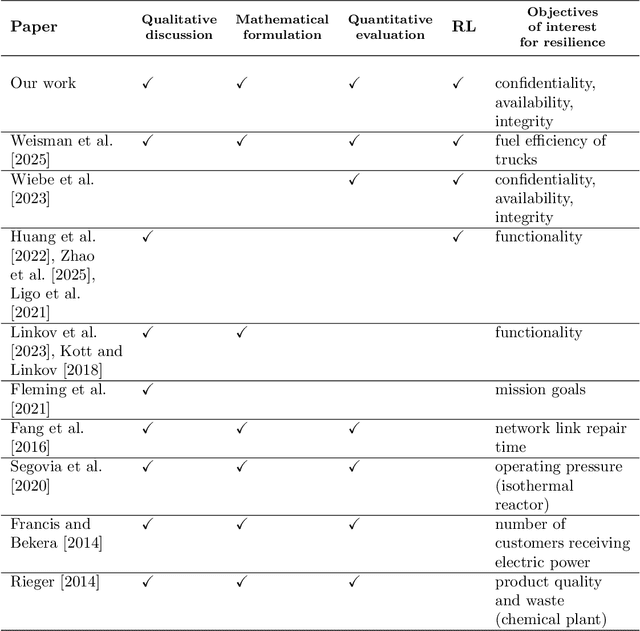
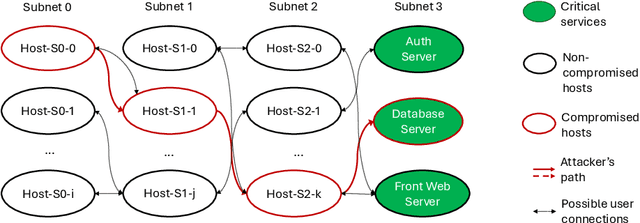
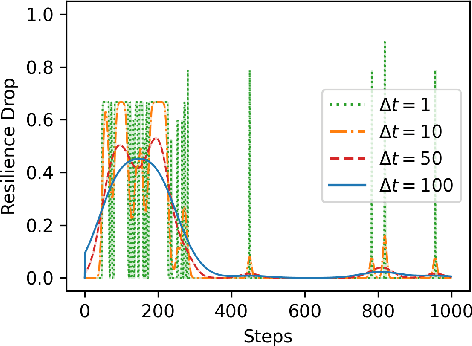
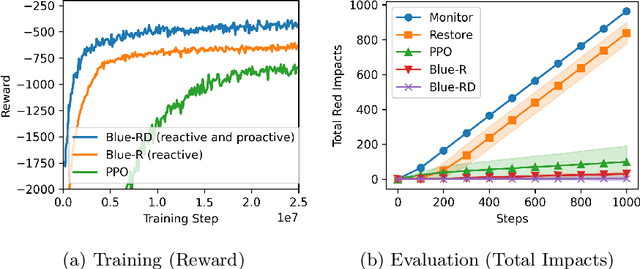
Cyber resilience is the ability of a system to recover from an attack with minimal impact on system operations. However, characterizing a network's resilience under a cyber attack is challenging, as there are no formal definitions of resilience applicable to diverse network topologies and attack patterns. In this work, we propose a quantifiable formulation of resilience that considers multiple defender operational goals, the criticality of various network resources for daily operations, and provides interpretability to security operators about their system's resilience under attack. We evaluate our approach within the CybORG environment, a reinforcement learning (RL) framework for autonomous cyber defense, analyzing trade-offs between resilience, costs, and prioritization of operational goals. Furthermore, we introduce methods to aggregate resilience metrics across time-variable attack patterns and multiple network topologies, comprehensively characterizing system resilience. Using insights gained from our resilience metrics, we design RL autonomous defensive agents and compare them against several heuristic baselines, showing that proactive network hardening techniques and prompt recovery of compromised machines are critical for effective cyber defenses.
MicroT: Low-Energy and Adaptive Models for MCUs
Mar 12, 2024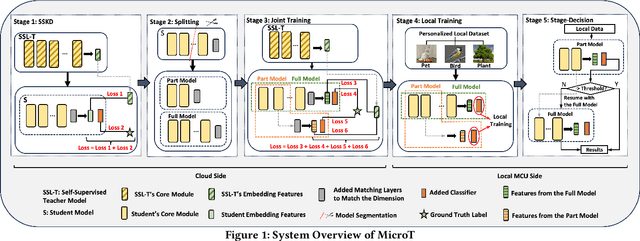


We propose MicroT, a low-energy, multi-task adaptive model framework for resource-constrained MCUs. We divide the original model into a feature extractor and a classifier. The feature extractor is obtained through self-supervised knowledge distillation and further optimized into part and full models through model splitting and joint training. These models are then deployed on MCUs, with classifiers added and trained on local tasks, ultimately performing stage-decision for joint inference. In this process, the part model initially processes the sample, and if the confidence score falls below the set threshold, the full model will resume and continue the inference. We evaluate MicroT on two models, three datasets, and two MCU boards. Our experimental evaluation shows that MicroT effectively improves model performance and reduces energy consumption when dealing with multiple local tasks. Compared to the unoptimized feature extractor, MicroT can improve accuracy by up to 9.87%. On MCUs, compared to the standard full model inference, MicroT can save up to about 29.13% in energy consumption. MicroT also allows users to adaptively adjust the stage-decision ratio as needed, better balancing model performance and energy consumption. Under the standard stage-decision ratio configuration, MicroT can increase accuracy by 5.91% and save about 14.47% of energy consumption.