 Add to Chrome
 Add to Firefox
 Add to Edge
DNQ: Deep Nash Q-Network for Partially Observable n-Player Games
Jun 04, 2026
Many real-world competitive systems require multiple decision-makers to act simultaneously under shared constraints, limited information, and repeated interaction, as in auctions, resource allocation, and security competition. We study multi-turn simultaneous bidding as a controlled testbed for such problems and propose DNQ, a solver-in-the-loop equilibrium supervision framework for training bidding agents. DNQ alternates between trajectory collection, critic-based payoff estimation, equilibrium computation, and policy imitation. At each visited state, a shared critic predicts either pairwise payoff matrices or an exact N-player payoff tensor, an external solver computes equilibrium strategies, and the agents are trained by minimizing the KL divergence between their masked policies and the solver-derived equilibrium targets. We focus on a scalable pairwise formulation that greatly reduces equilibrium-solving cost and training time compared with the exact formulation, while the shared critic amortizes payoff learning across agents and states. Experiments compare the pairwise and exact variants using critic loss, policy entropy, bidding resource usage, and training cost, showing that the pairwise method scales to larger numbers of agents, whereas the exact method becomes computationally impractical as the joint game grows. These results illustrate the trade-off between strategic fidelity and scalability in repeated competitive environments.

Retrieval-Augmented LLMs for Security Incident Analysis
Mar 18, 2026Investigating cybersecurity incidents requires collecting and analyzing evidence from multiple log sources, including intrusion detection alerts, network traffic records, and authentication events. This process is labor-intensive: analysts must sift through large volumes of data to identify relevant indicators and piece together what happened. We present a RAG-based system that performs security incident analysis through targeted query-based filtering and LLM semantic reasoning. The system uses a query library with associated MITRE ATT\&CK techniques to extract indicators from raw logs, then retrieves relevant context to answer forensic questions and reconstruct attack sequences. We evaluate the system with five LLM providers on malware traffic incidents and multi-stage Active Directory attacks. We find that LLM models have different performance and tradeoffs, with Claude Sonnet~4 and DeepSeek~V3 achieving 100\% recall across all four malware scenarios, while DeepSeek costs 15$\times$ less (\$0.008 vs.\ \$0.12 per analysis). Attack step detection on Active Directory scenarios reaches 100\% precision and 82\% recall. Ablation studies confirm that a RAG architecture is essential: LLM baselines without RAG-enhanced context correctly identify victim hosts but miss all attack infrastructure including malicious domains and command-and-control servers. These results demonstrate that combining targeted query-based filtering with RAG-based retrieval enables accurate, cost-effective security analysis within LLM context limits.
Quantitative Resilience Modeling for Autonomous Cyber Defense
Mar 04, 2025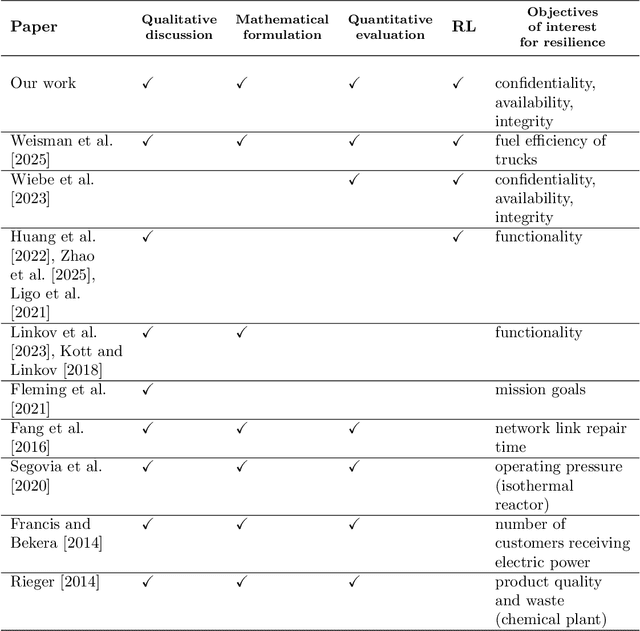
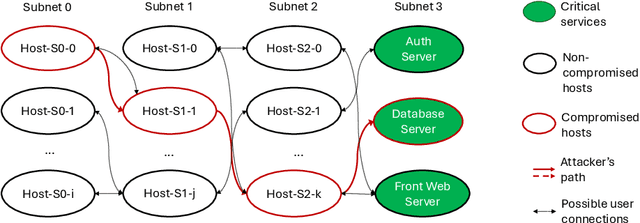
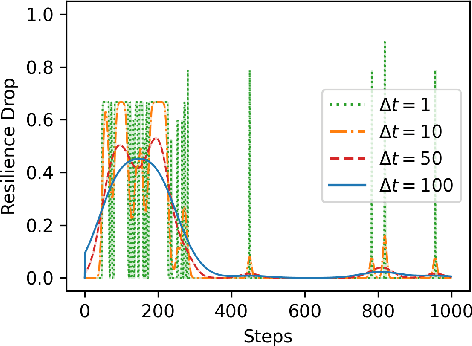
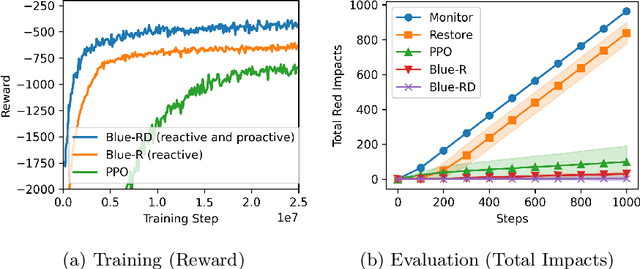
Cyber resilience is the ability of a system to recover from an attack with minimal impact on system operations. However, characterizing a network's resilience under a cyber attack is challenging, as there are no formal definitions of resilience applicable to diverse network topologies and attack patterns. In this work, we propose a quantifiable formulation of resilience that considers multiple defender operational goals, the criticality of various network resources for daily operations, and provides interpretability to security operators about their system's resilience under attack. We evaluate our approach within the CybORG environment, a reinforcement learning (RL) framework for autonomous cyber defense, analyzing trade-offs between resilience, costs, and prioritization of operational goals. Furthermore, we introduce methods to aggregate resilience metrics across time-variable attack patterns and multiple network topologies, comprehensively characterizing system resilience. Using insights gained from our resilience metrics, we design RL autonomous defensive agents and compare them against several heuristic baselines, showing that proactive network hardening techniques and prompt recovery of compromised machines are critical for effective cyber defenses.