 Add to Chrome
 Add to Firefox
 Add to Edge
Unsupervised Susceptibility Distortion Correction of EPI without Calibration Scans via Image Translation-Based Registration
Jun 19, 2026
Functional magnetic resonance imaging (fMRI) utilizes echo-planar imaging (EPI) to capture blood-oxygen-level-dependent (BOLD) signals with high temporal resolution. However, EPI is inherently sensitive to magnetic field inhomogeneities, resulting in susceptibility-induced geometric distortions along the phase-encoding (PE) direction. To correct these distortions, conventional approaches rely on additional calibration scans, such as field maps or reverse PE acquisitions, which are not always available in practice. To overcome this limitation, we propose SACRED, a calibration scan-free susceptibility distortion correction framework that corrects geometric distortions via image translation-based registration using only a routinely acquired anatomical T1-weighted (T1w) image and a unidirectional PE BOLD image. SACRED employs an invertible neural network as the image translation backbone to bridge the contrast gap between BOLD and T1w images while enforcing structural consistency through a modality independent neighborhood descriptor. This design enables the use of a mono-contrast similarity objective to train the registration network in an unsupervised manner without requiring distortion-corrected BOLD images. In addition, we incorporate test-time adaptation (TTA) to further enhance performance on out-of-distribution (OOD) data at inference time. SACRED was evaluated on one in-distribution (ID) dataset and two OOD datasets, and was compared with representative fMRI distortion correction methods. The results demonstrate that SACRED significantly outperforms competing methods on both ID and OOD datasets, exhibiting robustness to scanner and population shifts, partly enabled by TTA. The code will be made publicly available upon acceptance.

Standardized Evaluation of Automatic Methods for Perivascular Spaces Segmentation in MRI -- MICCAI 2024 Challenge Results
Dec 20, 2025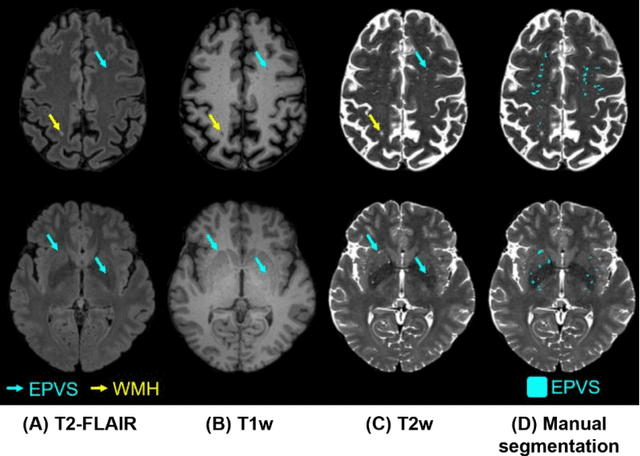
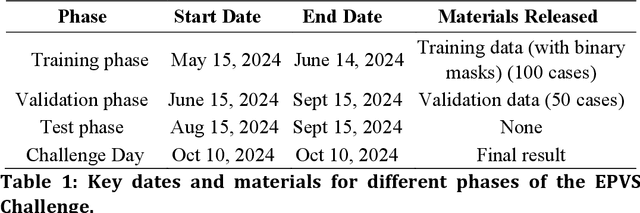
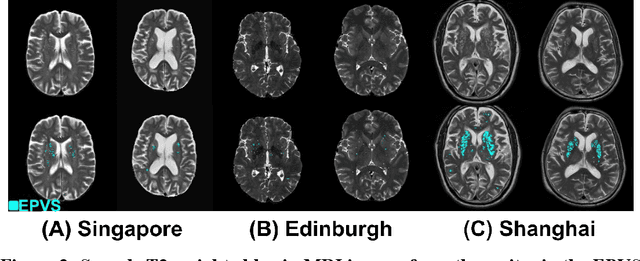
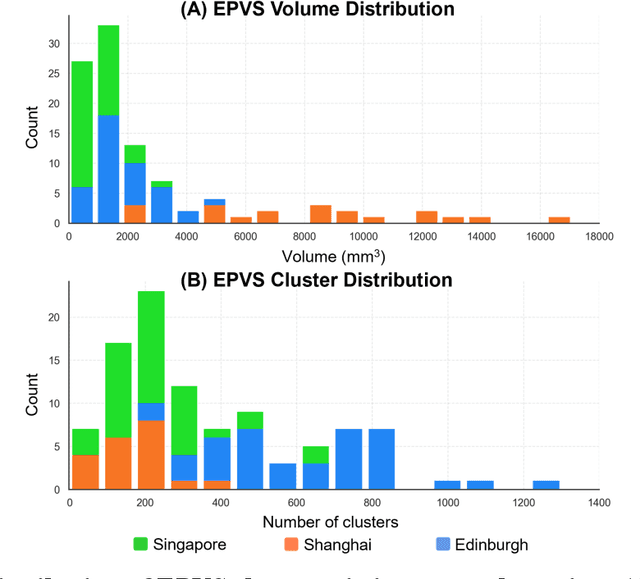
Perivascular spaces (PVS), when abnormally enlarged and visible in magnetic resonance imaging (MRI) structural sequences, are important imaging markers of cerebral small vessel disease and potential indicators of neurodegenerative conditions. Despite their clinical significance, automatic enlarged PVS (EPVS) segmentation remains challenging due to their small size, variable morphology, similarity with other pathological features, and limited annotated datasets. This paper presents the EPVS Challenge organized at MICCAI 2024, which aims to advance the development of automated algorithms for EPVS segmentation across multi-site data. We provided a diverse dataset comprising 100 training, 50 validation, and 50 testing scans collected from multiple international sites (UK, Singapore, and China) with varying MRI protocols and demographics. All annotations followed the STRIVE protocol to ensure standardized ground truth and covered the full brain parenchyma. Seven teams completed the full challenge, implementing various deep learning approaches primarily based on U-Net architectures with innovations in multi-modal processing, ensemble strategies, and transformer-based components. Performance was evaluated using dice similarity coefficient, absolute volume difference, recall, and precision metrics. The winning method employed MedNeXt architecture with a dual 2D/3D strategy for handling varying slice thicknesses. The top solutions showed relatively good performance on test data from seen datasets, but significant degradation of performance was observed on the previously unseen Shanghai cohort, highlighting cross-site generalization challenges due to domain shift. This challenge establishes an important benchmark for EPVS segmentation methods and underscores the need for the continued development of robust algorithms that can generalize in diverse clinical settings.