 Add to Chrome
 Add to Firefox
 Add to Edge
PGMem: Tightly Coupled Persona-Memory Graph for Lifelong Personalized Agents
Aug 03, 2026
Long-term personalized dialogue agents must track user preferences as their personas evolve. Existing memory systems organize past events well, but store personas as flat profiles detached from the events that justify them. This loose coupling leads to the memory-persona validity gap and the persona-aware retrieval gap. We propose PGMem, a heterogeneous persona-memory graph that connects event and persona nodes through typed provenance and evidence edges, keeping each persona signal traceable to the events that support or revise it. At retrieval time, PGMem expands from query-relevant seeds and ranks signals by evidential validity. Across three benchmarks with small language model backbones, PGMem consistently outperforms summary-based, persona-aware, graph-structured, and agentic memory baselines, and improves performance as the context grows. The source code of PGMem is available at https://github.com/wonjunchoi23/pgmem/

Ptychographic lensless coherent endomicroscopy through a flexible fiber bundle
Jan 31, 2024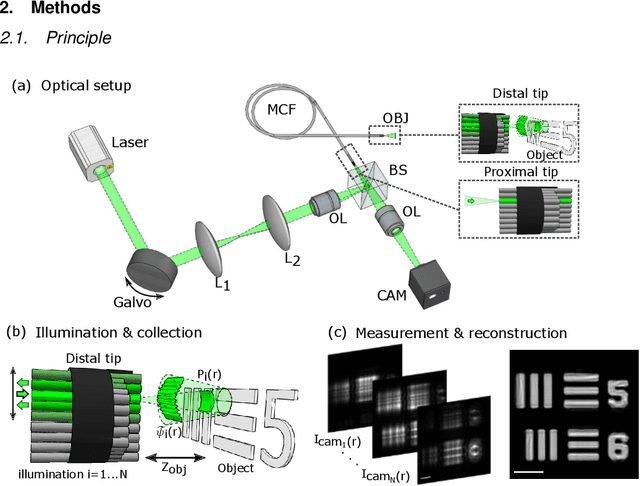
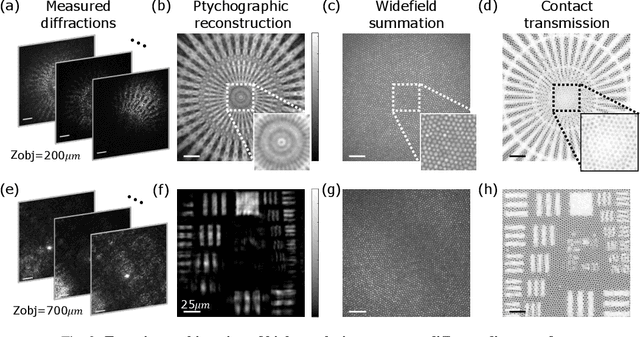
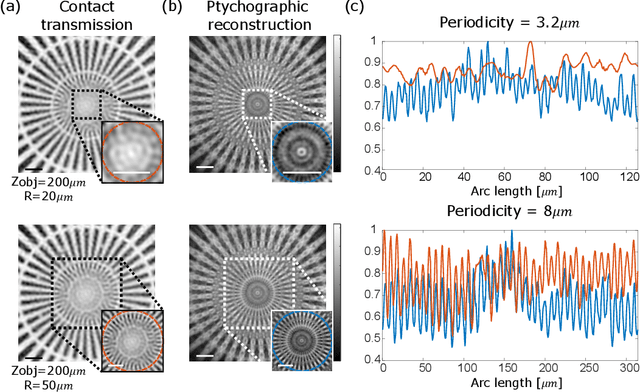
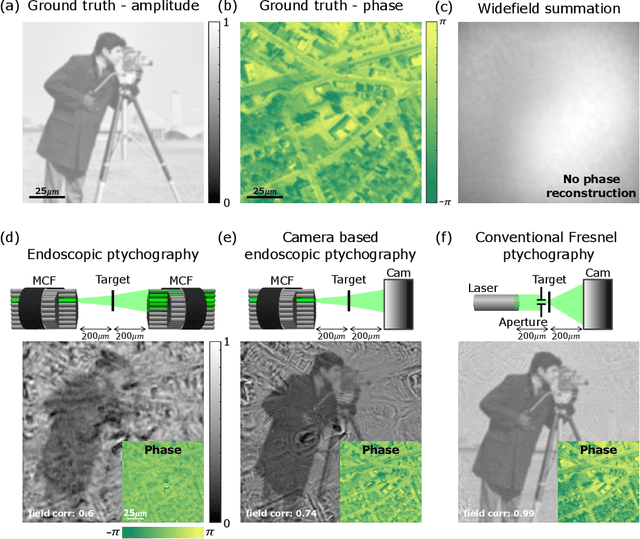
Conventional fiber-bundle-based endoscopes allow minimally invasive imaging through flexible multi-core fiber (MCF) bundles by placing a miniature lens at the distal tip and using each core as an imaging pixel. In recent years, lensless imaging through MCFs was made possible by correcting the core-to-core phase distortions pre-measured in a calibration procedure. However, temporally varying wavefront distortions, for instance, due to dynamic fiber bending, pose a challenge for such approaches. Here, we demonstrate a coherent lensless imaging technique based on intensity-only measurements insensitive to core-to-core phase distortions. We leverage a ptychographic reconstruction algorithm to retrieve the phase and amplitude profiles of reflective objects placed at a distance from the fiber tip, using as input a set of diffracted intensity patterns reflected from the object when the illumination is scanned over the MCF cores. Our approach thus utilizes an acquisition process equivalent to confocal microendoscopy, only replacing the single detector with a camera.
BackTrack: Robust template update via Backward Tracking of candidate template
Aug 21, 2023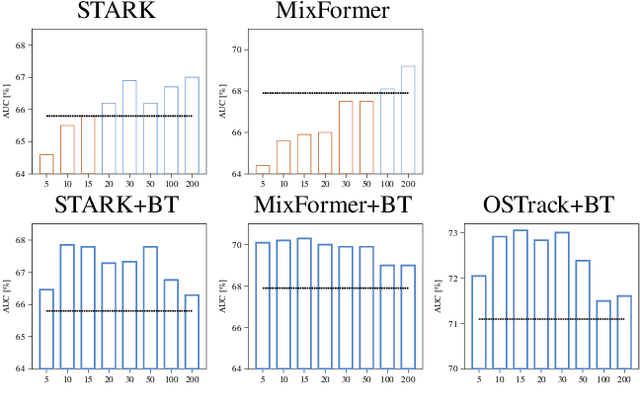

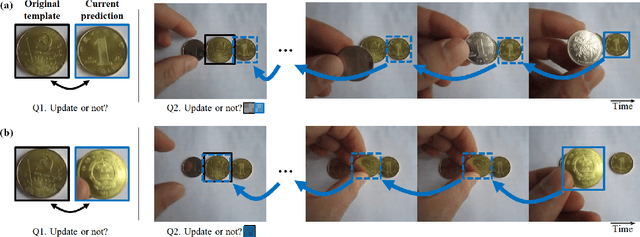
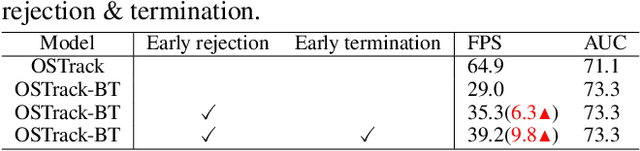
Variations of target appearance such as deformations, illumination variance, occlusion, etc., are the major challenges of visual object tracking that negatively impact the performance of a tracker. An effective method to tackle these challenges is template update, which updates the template to reflect the change of appearance in the target object during tracking. However, with template updates, inadequate quality of new templates or inappropriate timing of updates may induce a model drift problem, which severely degrades the tracking performance. Here, we propose BackTrack, a robust and reliable method to quantify the confidence of the candidate template by backward tracking it on the past frames. Based on the confidence score of candidates from BackTrack, we can update the template with a reliable candidate at the right time while rejecting unreliable candidates. BackTrack is a generic template update scheme and is applicable to any template-based trackers. Extensive experiments on various tracking benchmarks verify the effectiveness of BackTrack over existing template update algorithms, as it achieves SOTA performance on various tracking benchmarks.