 Add to Chrome
 Add to Firefox
 Add to Edge
MoRel: Long-Range Flicker-Free 4D Motion Modeling via Anchor Relay-based Bidirectional Blending with Hierarchical Densification
Dec 10, 2025

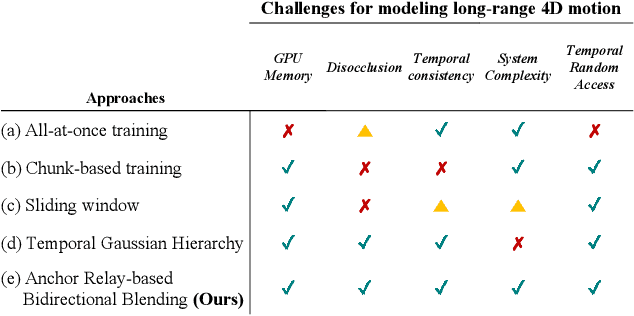
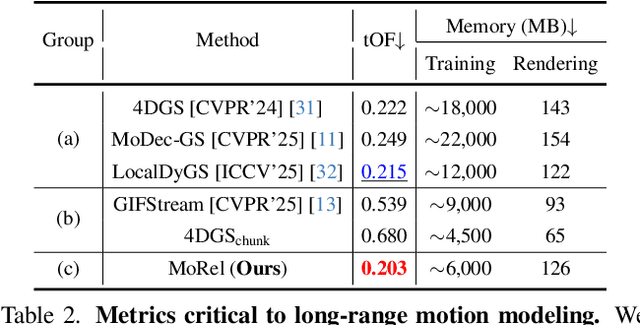
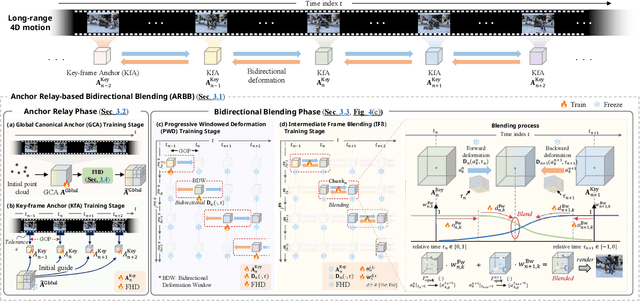
Recent advances in 4D Gaussian Splatting (4DGS) have extended the high-speed rendering capability of 3D Gaussian Splatting (3DGS) into the temporal domain, enabling real-time rendering of dynamic scenes. However, one of the major remaining challenges lies in modeling long-range motion-contained dynamic videos, where a naive extension of existing methods leads to severe memory explosion, temporal flickering, and failure to handle appearing or disappearing occlusions over time. To address these challenges, we propose a novel 4DGS framework characterized by an Anchor Relay-based Bidirectional Blending (ARBB) mechanism, named MoRel, which enables temporally consistent and memory-efficient modeling of long-range dynamic scenes. Our method progressively constructs locally canonical anchor spaces at key-frame time index and models inter-frame deformations at the anchor level, enhancing temporal coherence. By learning bidirectional deformations between KfA and adaptively blending them through learnable opacity control, our approach mitigates temporal discontinuities and flickering artifacts. We further introduce a Feature-variance-guided Hierarchical Densification (FHD) scheme that effectively densifies KfA's while keeping rendering quality, based on an assigned level of feature-variance. To effectively evaluate our model's capability to handle real-world long-range 4D motion, we newly compose long-range 4D motion-contained dataset, called SelfCap$_{\text{LR}}$. It has larger average dynamic motion magnitude, captured at spatially wider spaces, compared to previous dynamic video datasets. Overall, our MoRel achieves temporally coherent and flicker-free long-range 4D reconstruction while maintaining bounded memory usage, demonstrating both scalability and efficiency in dynamic Gaussian-based representations.

MoDec-GS: Global-to-Local Motion Decomposition and Temporal Interval Adjustment for Compact Dynamic 3D Gaussian Splatting
Jan 07, 2025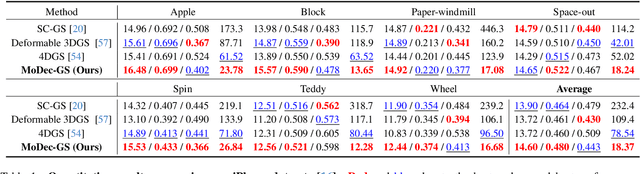
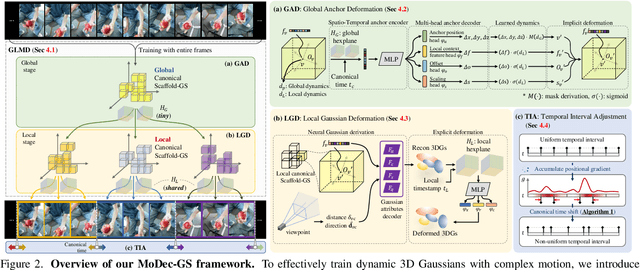
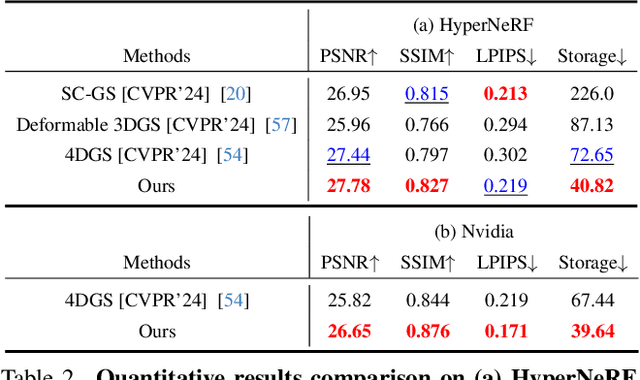
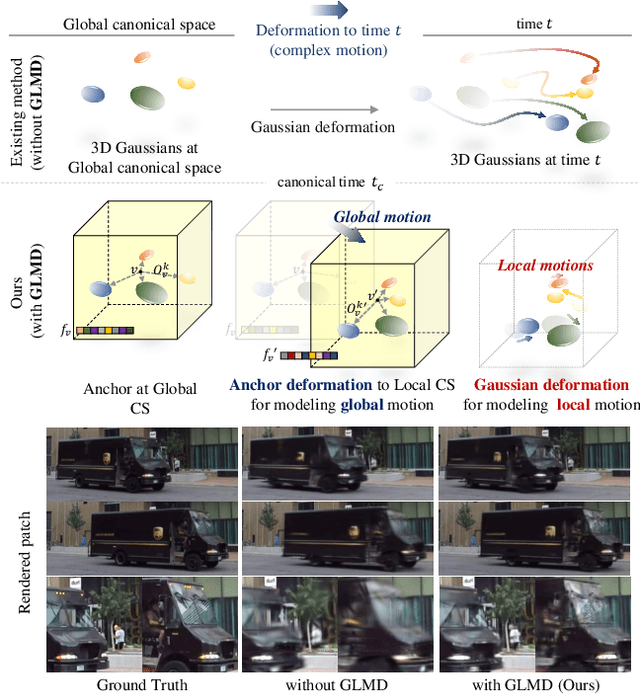
3D Gaussian Splatting (3DGS) has made significant strides in scene representation and neural rendering, with intense efforts focused on adapting it for dynamic scenes. Despite delivering remarkable rendering quality and speed, existing methods struggle with storage demands and representing complex real-world motions. To tackle these issues, we propose MoDecGS, a memory-efficient Gaussian splatting framework designed for reconstructing novel views in challenging scenarios with complex motions. We introduce GlobaltoLocal Motion Decomposition (GLMD) to effectively capture dynamic motions in a coarsetofine manner. This approach leverages Global Canonical Scaffolds (Global CS) and Local Canonical Scaffolds (Local CS), extending static Scaffold representation to dynamic video reconstruction. For Global CS, we propose Global Anchor Deformation (GAD) to efficiently represent global dynamics along complex motions, by directly deforming the implicit Scaffold attributes which are anchor position, offset, and local context features. Next, we finely adjust local motions via the Local Gaussian Deformation (LGD) of Local CS explicitly. Additionally, we introduce Temporal Interval Adjustment (TIA) to automatically control the temporal coverage of each Local CS during training, allowing MoDecGS to find optimal interval assignments based on the specified number of temporal segments. Extensive evaluations demonstrate that MoDecGS achieves an average 70% reduction in model size over stateoftheart methods for dynamic 3D Gaussians from realworld dynamic videos while maintaining or even improving rendering quality.