 Add to Chrome
 Add to Firefox
 Add to Edge
MoRel: Long-Range Flicker-Free 4D Motion Modeling via Anchor Relay-based Bidirectional Blending with Hierarchical Densification
Dec 10, 2025

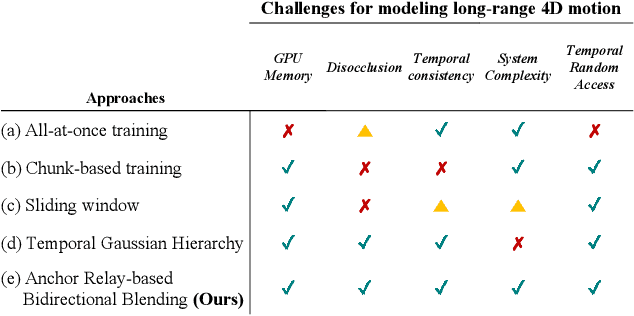
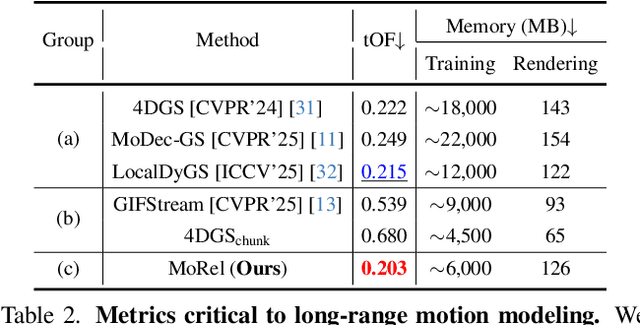
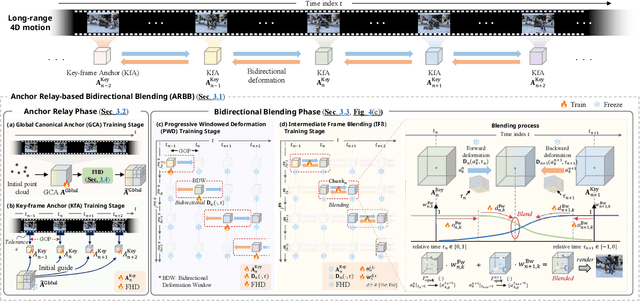
Recent advances in 4D Gaussian Splatting (4DGS) have extended the high-speed rendering capability of 3D Gaussian Splatting (3DGS) into the temporal domain, enabling real-time rendering of dynamic scenes. However, one of the major remaining challenges lies in modeling long-range motion-contained dynamic videos, where a naive extension of existing methods leads to severe memory explosion, temporal flickering, and failure to handle appearing or disappearing occlusions over time. To address these challenges, we propose a novel 4DGS framework characterized by an Anchor Relay-based Bidirectional Blending (ARBB) mechanism, named MoRel, which enables temporally consistent and memory-efficient modeling of long-range dynamic scenes. Our method progressively constructs locally canonical anchor spaces at key-frame time index and models inter-frame deformations at the anchor level, enhancing temporal coherence. By learning bidirectional deformations between KfA and adaptively blending them through learnable opacity control, our approach mitigates temporal discontinuities and flickering artifacts. We further introduce a Feature-variance-guided Hierarchical Densification (FHD) scheme that effectively densifies KfA's while keeping rendering quality, based on an assigned level of feature-variance. To effectively evaluate our model's capability to handle real-world long-range 4D motion, we newly compose long-range 4D motion-contained dataset, called SelfCap$_{\text{LR}}$. It has larger average dynamic motion magnitude, captured at spatially wider spaces, compared to previous dynamic video datasets. Overall, our MoRel achieves temporally coherent and flicker-free long-range 4D reconstruction while maintaining bounded memory usage, demonstrating both scalability and efficiency in dynamic Gaussian-based representations.

SUCCESS-GS: Survey of Compactness and Compression for Efficient Static and Dynamic Gaussian Splatting
Dec 08, 2025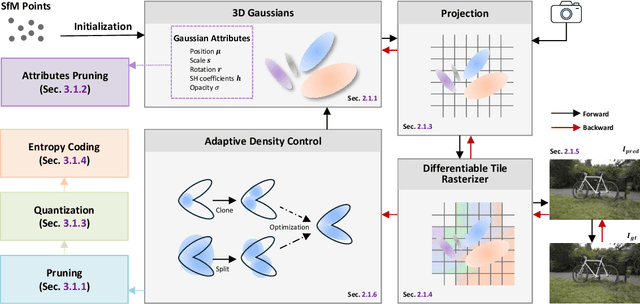
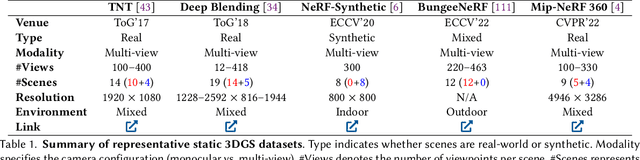
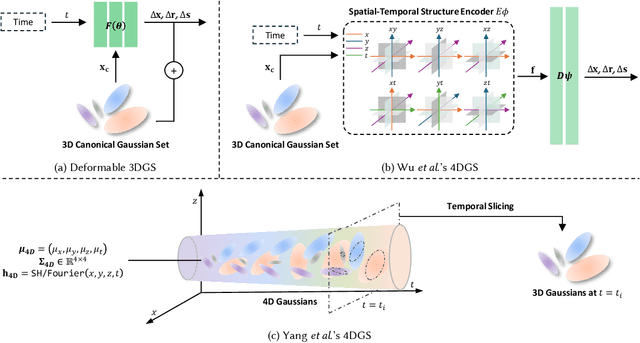
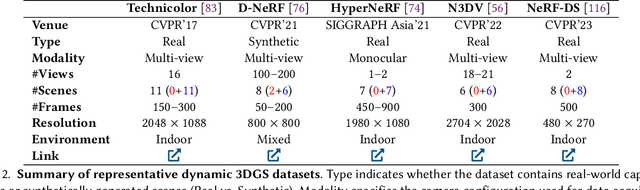
3D Gaussian Splatting (3DGS) has emerged as a powerful explicit representation enabling real-time, high-fidelity 3D reconstruction and novel view synthesis. However, its practical use is hindered by the massive memory and computational demands required to store and render millions of Gaussians. These challenges become even more severe in 4D dynamic scenes. To address these issues, the field of Efficient Gaussian Splatting has rapidly evolved, proposing methods that reduce redundancy while preserving reconstruction quality. This survey provides the first unified overview of efficient 3D and 4D Gaussian Splatting techniques. For both 3D and 4D settings, we systematically categorize existing methods into two major directions, Parameter Compression and Restructuring Compression, and comprehensively summarize the core ideas and methodological trends within each category. We further cover widely used datasets, evaluation metrics, and representative benchmark comparisons. Finally, we discuss current limitations and outline promising research directions toward scalable, compact, and real-time Gaussian Splatting for both static and dynamic 3D scene representation.