 Add to Chrome
 Add to Firefox
 Add to Edge
An Intent of Collaboration: On Agencies between Designers and Emerging (Intelligent) Technologies
Mar 12, 2026
Amidst the emergence of powerful intelligent technologies such as LLMs and text-to-image AIs that promise to enhance creative processes, designers face the challenges of remaining empowered and creative while working with these foreign digital partners. While generative AIs offer versatile, informative, and occasionally poetic outcomes, their lack of embodied knowledge presents an even greater challenge to designers in gaining fruitful outcomes, such as in the field of Digital Craftsmanship. In this project, three designers embarked on a three-month experimental journey with an intention to co-create with Google's LLM as a potential intelligent partner to investigate how it will influence the designers' creativity. We found that a power dynamic of agencies exists between the LLM and the designer, in which the designer can easily lose their creative agency. Regaining the designer's creative agency involves introspection into their own creative process, a structural understanding of the specific emerging technology involved, and deliberate adjustments to the dynamics of the human-technology relationship. We propose paying attention to the designer's inner world and parties of agencies when engaging with emerging intelligent technologies through three aspects: the sensitivity towards a creative process as cognitive activities; the active investigation into specific technology's capability; and the adjustment towards an appropriate working relationship between the designer and the emerging technology.
* Accepted by IASDR Conference 2025, Taipei, Taiwan 16 pages excluding references, 8 figures

Social Robots for People with Dementia: A Literature Review on Deception from Design to Perception
Jul 01, 2025As social robots increasingly enter dementia care, concerns about deception, intentional or not, are gaining attention. Yet, how robotic design cues might elicit misleading perceptions in people with dementia, and how these perceptions arise, remains insufficiently understood. In this scoping review, we examined 26 empirical studies on interactions between people with dementia and physical social robots. We identify four key design cue categories that may influence deceptive impressions: cues resembling physiological signs (e.g., simulated breathing), social intentions (e.g., playful movement), familiar beings (e.g., animal-like form and sound), and, to a lesser extent, cues that reveal artificiality. Thematic analysis of user responses reveals that people with dementia often attribute biological, social, and mental capacities to robots, dynamically shifting between awareness and illusion. These findings underscore the fluctuating nature of ontological perception in dementia contexts. Existing definitions of robotic deception often rest on philosophical or behaviorist premises, but rarely engage with the cognitive mechanisms involved. We propose an empirically grounded definition: robotic deception occurs when Type 1 (automatic, heuristic) processing dominates over Type 2 (deliberative, analytic) reasoning, leading to misinterpretation of a robot's artificial nature. This dual-process perspective highlights the ethical complexity of social robots in dementia care and calls for design approaches that are not only engaging, but also epistemically respectful.
A Bayesian framework for active object recognition, pose estimation and shape transfer learning through touch
Sep 10, 2024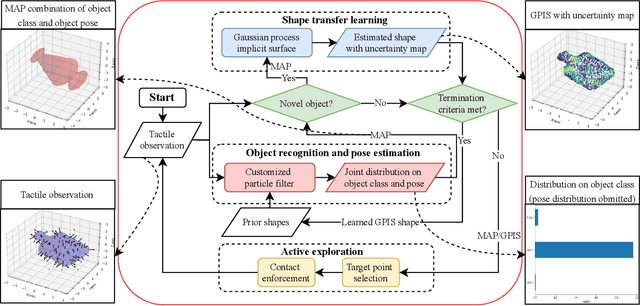
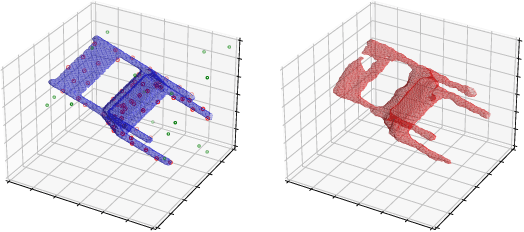
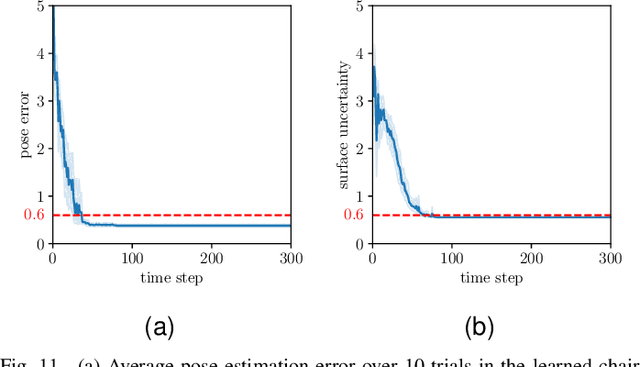
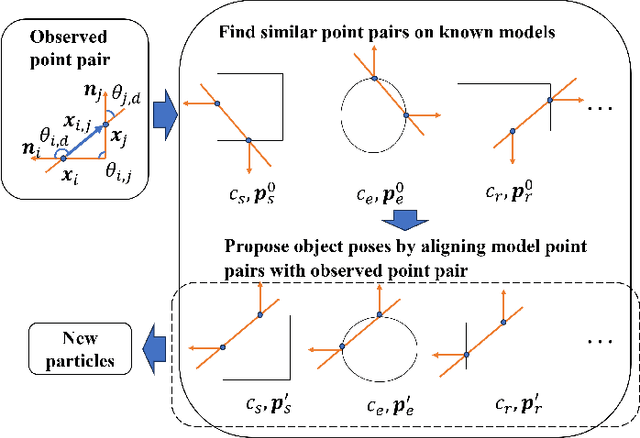
As humans can explore and understand the world through the sense of touch, tactile sensing is also an important aspect of robotic perception. In unstructured environments, robots can encounter both known and novel objects, this calls for a method to address both known and novel objects. In this study, we combine a particle filter (PF) and Gaussian process implicit surface (GPIS) in a unified Bayesian framework. The framework can differentiate between known and novel objects, perform object recognition, estimate pose for known objects, and reconstruct shapes for unknown objects, in an active learning fashion. By grounding the selection of the GPIS prior with the maximum-likelihood-estimation (MLE) shape from the PF, the knowledge about known objects' shapes can be transferred to learn novel shapes. An exploration procedure with global shape estimation is proposed to guide active data acquisition and conclude the exploration when sufficient information is obtained. The performance of the proposed Bayesian framework is evaluated through simulations on known and novel objects, initialized with random poses and is compared with a rapidly explore random tree (RRT).The results show that the proposed exploration procedure, utilizing global shape estimation, achieves faster exploration than the RRT-based local exploration procedure. Overall, results indicate that the proposed framework is effective and efficient in object recognition, pose estimation and shape reconstruction. Moreover, we show that a learned shape can be included as a new prior and used effectively for future object recognition and pose estimation of novel objects.