 Add to Chrome
 Add to Firefox
 Add to Edge
STaR-KV: Spatio-Temporal Adaptive Re-weighting for KV Cache Compression in GUI Vision-Language Models
Jun 01, 2026
Vision-language-model-based graphical user interface (GUI) agents have shown broad automation capabilities, yet deployment is bottlenecked by a key-value (KV) cache that grows linearly with interaction steps. For instance, UI-TARS-1.5-7B consumes 76 GB of GPU memory on merely five screenshots, approaching the capacity of mainstream 80 GB accelerators. Existing KV compression methods share two structural assumptions: aggregating visual-token importance into a single shared saliency map, and applying a fixed top-B cutoff to the fused score distribution. Pilot measurements refute both: spatial specialization lives at the attention-subspace level and migrates across layers, while the score distribution drifts in shape along a trajectory. We propose STaR-KV (Spatio-Temporal Adaptive Re-weighting), a training-free KV cache compression framework that calibrates token importance along three axes: (i) subspace-aware scoring driven by online spatial mutual information; (ii) a temporal stability discount that suppresses redundant cache entries from persistently attended subspaces; and (iii) an entropy-derived temperature that adaptively reshapes the score distribution. Across four GUI benchmarks, STaR-KV achieves the strongest average accuracy among state-of-the-art KV compression methods (e.g., GUIKV, SnapKV) at matched budgets, with no compression-stage FLOPs overhead (-0.07%) and cutting peak GPU memory by nearly 40% at a 20% KV-cache budget. Code is available at https://github.com/kawhiiiileo/STaR-KV.

Robust Adaptive Beamforming Maximizing the Worst-Case SINR over Distributional Uncertainty Sets for Random INC Matrix and Signal Steering Vector
Oct 16, 2021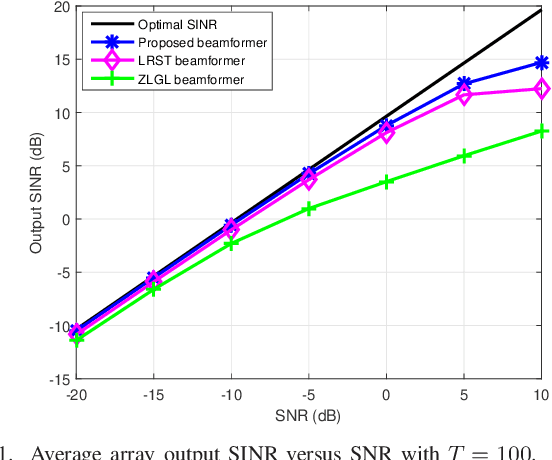
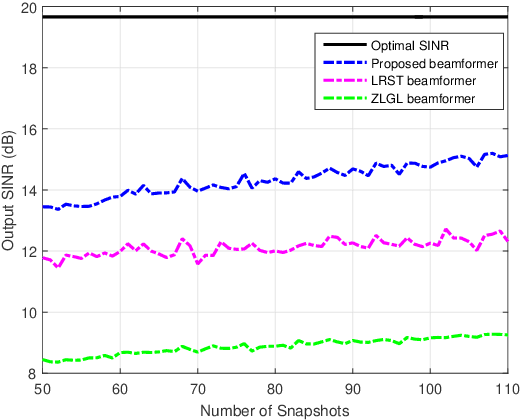
The robust adaptive beamforming (RAB) problem is considered via the worst-case signal-to-interference-plus-noise ratio (SINR) maximization over distributional uncertainty sets for the random interference-plus-noise covariance (INC) matrix and desired signal steering vector. The distributional uncertainty set of the INC matrix accounts for the support and the positive semidefinite (PSD) mean of the distribution, and a similarity constraint on the mean. The distributional uncertainty set for the steering vector consists of the constraints on the known first- and second-order moments. The RAB problem is formulated as a minimization of the worst-case expected value of the SINR denominator achieved by any distribution, subject to the expected value of the numerator being greater than or equal to one for each distribution. Resorting to the strong duality of linear conic programming, such a RAB problem is rewritten as a quadratic matrix inequality problem. It is then tackled by iteratively solving a sequence of linear matrix inequality relaxation problems with the penalty term on the rank-one PSD matrix constraint. To validate the results, simulation examples are presented, and they demonstrate the improved performance of the proposed robust beamformer in terms of the array output SINR.