 Add to Chrome
 Add to Firefox
 Add to Edge
Trading Utility for Dynamic Fairness in Multiple Resource Division with Sequential Demand
Jun 09, 2026
Dynamic multi-resource allocation is a central problem in shared computing environments, where users' demands arrive sequentially and resources must be distributed fairly without knowledge of future demands. Existing methods emphasize fairness guarantees such as Sharing Incentive, Envy Freeness, and Dynamic Pareto Optimality, but often overlook system utility. Moreover, these fairness criteria are mutually incompatible, preventing strict enforcement of them at the same time. We propose a neural allocation mechanism that reconciles fairness with utility through multi-objective optimization during sequential rollout. We first formalize fairness in the dynamic setting via stepwise loss functions for Sharing Incentive, Envy Freeness, and Dynamic Pareto Optimality, enabling differentiable training. Leveraging non-wastefulness, we parameterized the solutions by constraining allocations to the subspace of demand while allowing elastic over-allocation when resources remain available. Empirical results demonstrate that our learned allocator achieves substantially higher utility at comparable levels of fairness, uncovering clear Pareto-frontier-like tradeoffs across metrics.

When Users Change Their Mind: Evaluating Interruptible Agents in Long-Horizon Web Navigation
Apr 01, 2026As LLM agents transition from short, static problem solving to executing complex, long-horizon tasks in dynamic environments, the ability to handle user interruptions, such as adding requirement or revising goals, during mid-task execution is becoming a core requirement for realistic deployment. However, existing benchmarks largely assume uninterrupted agent behavior or study interruptions only in short, unconstrained language tasks. In this paper, we present the first systematic study of interruptible agents in long-horizon, environmentally grounded web navigation tasks, where actions induce persistent state changes. We formalize three realistic interruption types, including addition, revision, and retraction, and introduce InterruptBench, a benchmark derived from WebArena-Lite that synthesizes high-quality interruption scenarios under strict semantic constraints. Using a unified interruption simulation framework, we evaluate six strong LLM backbones across single- and multi-turn interruption settings, analyzing both their effectiveness in adapting to updated intents and their efficiency in recovering from mid-task changes. Our results show that handling user interruptions effectively and efficiently during long-horizon agentic tasks remains challenging for powerful large-scale LLMs. Code and dataset are available at https://github.com/HenryPengZou/InterruptBench.
TodyComm: Task-Oriented Dynamic Communication for Multi-Round LLM-based Multi-Agent System
Feb 03, 2026Multi-round LLM-based multi-agent systems rely on effective communication structures to support collaboration across rounds. However, most existing methods employ a fixed communication topology during inference, which falls short in many realistic applications where the agents' roles may change \textit{across rounds} due to dynamic adversary, task progression, or time-varying constraints such as communication bandwidth. In this paper, we propose addressing this issue through TodyComm, a \textbf{t}ask-\textbf{o}riented \textbf{dy}namic \textbf{comm}unication algorithm. It produces behavior-driven collaboration topologies that adapt to the dynamics at each round, optimizing the utility for the task through policy gradient. Experiments on five benchmarks demonstrate that under both dynamic adversary and communications budgets, TodyComm delivers superior task effectiveness while retaining token efficiency and scalability.
Fairness Risks for Group-conditionally Missing Demographics
Feb 20, 2024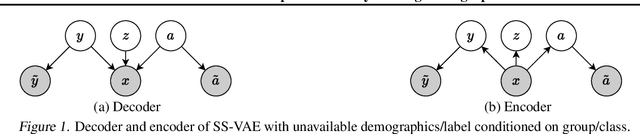
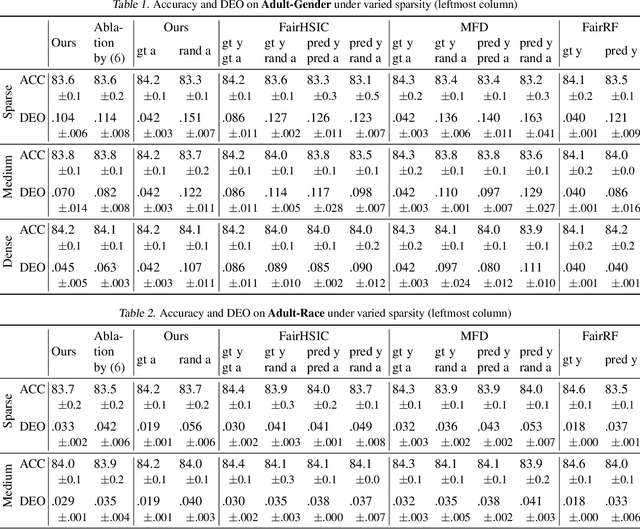
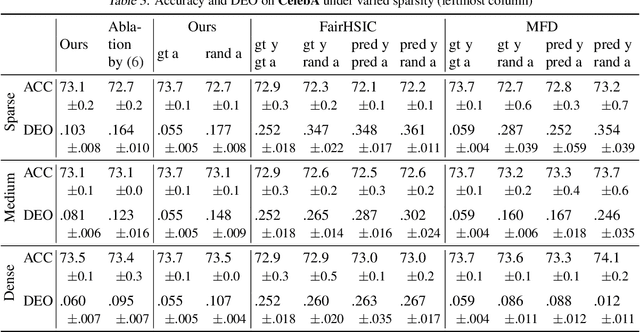
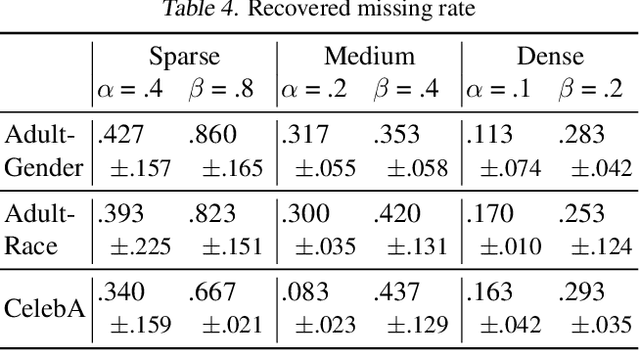
Fairness-aware classification models have gained increasing attention in recent years as concerns grow on discrimination against some demographic groups. Most existing models require full knowledge of the sensitive features, which can be impractical due to privacy, legal issues, and an individual's fear of discrimination. The key challenge we will address is the group dependency of the unavailability, e.g., people of some age range may be more reluctant to reveal their age. Our solution augments general fairness risks with probabilistic imputations of the sensitive features, while jointly learning the group-conditionally missing probabilities in a variational auto-encoder. Our model is demonstrated effective on both image and tabular datasets, achieving an improved balance between accuracy and fairness.
Fast Direct Localization for Millimeter Wave MIMO Systems via Deep ADMM Unfolding
Feb 06, 2023
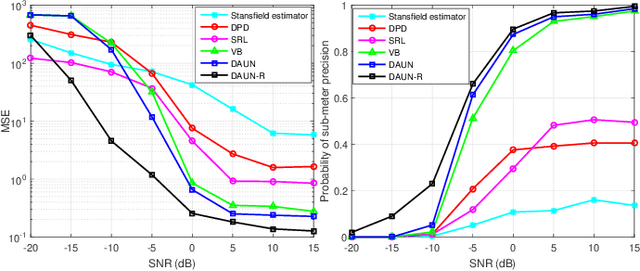
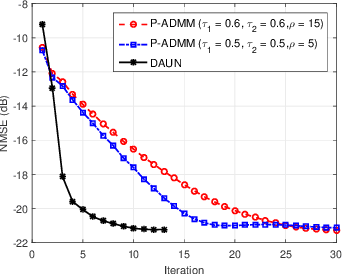
Massive arrays deployed in millimeter-wave systems enable high angular resolution performance, which in turn facilitates sub-meter localization services. Albeit suboptimal, up to now the most popular localization approach has been based on a so-called two-step procedure, where triangulation is applied upon aggregation of the angle-of-arrival (AoA) measurements from the collaborative base stations. This is mainly due to the prohibitive computational cost of the existing direct localization approaches in large-scale systems. To address this issue, we propose a deep unfolding based fast direct localization solver. First, the direct localization is formulated as a joint $l_1$-$l_{2,1}$ norm sparse recovery problem, which is then solved by using alternating direction method of multipliers (ADMM). Next, we develop a deep ADMM unfolding network (DAUN) to learn the ADMM parameter settings from the training data and a position refinement algorithm is proposed for DAUN. Finally, simulation results showcase the superiority of the proposed DAUN over the baseline solvers in terms of better localization accuracy, faster convergence and significantly lower computational complexity.