 Add to Chrome
 Add to Firefox
 Add to Edge
Overview and Comparison of AVS Point Cloud Compression Standard
Feb 09, 2026
Point cloud is a prevalent 3D data representation format with significant application values in immersive media, autonomous driving, digital heritage protection, etc. However, the large data size of point clouds poses challenges to transmission and storage, which influences the wide deployments. Therefore, point cloud compression plays a crucial role in practical applications for both human and machine perception optimization. To this end, the Moving Picture Experts Group (MPEG) has established two standards for point cloud compression, including Geometry-based Point Cloud Compression (G-PCC) and Video-based Point Cloud Compression (V-PCC). In the meantime, the Audio Video coding Standard (AVS) Workgroup of China also have launched and completed the development for its first generation point cloud compression standard, namely AVS PCC. This new standardization effort has adopted many new coding tools and techniques, which are different from the other counterpart standards. This paper reviews the AVS PCC standard from two perspectives, i.e., the related technologies and performance comparisons.
* 3 figures, 3 tables

E-Bench: Subjective-Aligned Benchmark Suite for Text-Driven Video Editing Quality Assessment
Aug 21, 2024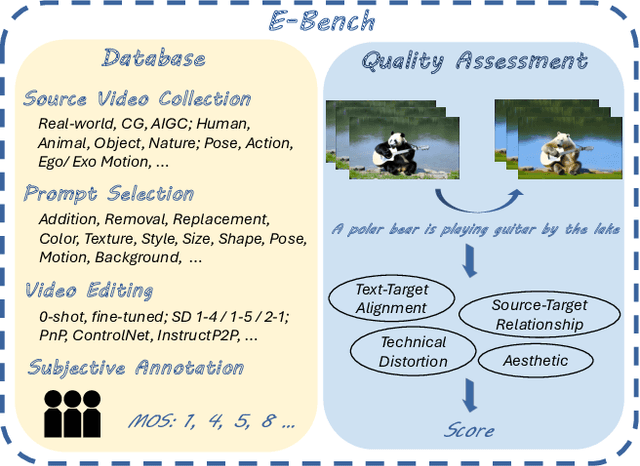
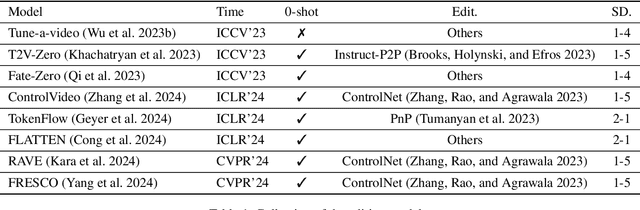

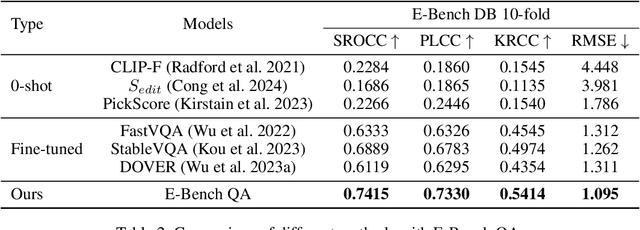
Text-driven video editing has recently experienced rapid development. Despite this, evaluating edited videos remains a considerable challenge. Current metrics tend to fail to align with human perceptions, and effective quantitative metrics for video editing are still notably absent. To address this, we introduce E-Bench, a benchmark suite tailored to the assessment of text-driven video editing. This suite includes E-Bench DB, a video quality assessment (VQA) database for video editing. E-Bench DB encompasses a diverse set of source videos featuring various motions and subjects, along with multiple distinct editing prompts, editing results from 8 different models, and the corresponding Mean Opinion Scores (MOS) from 24 human annotators. Based on E-Bench DB, we further propose E-Bench QA, a quantitative human-aligned measurement for the text-driven video editing task. In addition to the aesthetic, distortion, and other visual quality indicators that traditional VQA methods emphasize, E-Bench QA focuses on the text-video alignment and the relevance modeling between source and edited videos. It proposes a new assessment network for video editing that attains superior performance in alignment with human preferences. To the best of our knowledge, E-Bench introduces the first quality assessment dataset for video editing and an effective subjective-aligned quantitative metric for this domain. All data and code will be publicly available at https://github.com/littlespray/E-Bench.