 Add to Chrome
 Add to Firefox
 Add to Edge
ASDA: Automated Skill Distillation and Adaptation for Financial Reasoning
Mar 17, 2026
Adapting large language models (LLMs) to specialized financial reasoning typically requires expensive fine-tuning that produces model-locked expertise. Training-free alternatives have emerged, yet our experiments show that leading methods (GEPA and ACE) achieve only marginal gains on the FAMMA financial reasoning benchmark, exposing the limits of unstructured text optimization for complex, multi-step domain reasoning. We introduce Automated Skill Distillation and Adaptation (ASDA), a framework that automatically generates structured skill artifacts through iterative error-corrective learning without modifying model weights. A teacher model analyzes a student model's failures on financial reasoning tasks, clusters errors by subfield and error type, and synthesizes skill files containing reasoning procedures, code templates, and worked examples, which are dynamically injected during inference. Evaluated on FAMMA, ASDA achieves up to +17.33% improvement on arithmetic reasoning and +5.95% on non-arithmetic reasoning, substantially outperforming all training-free baselines. The resulting skill artifacts are human-readable, version-controlled, and compatible with the Agent Skills open standard, offering any organization with a labeled domain dataset a practical and auditable path to domain adaptation without weight access or retraining.

An Even Faster and More Unifying Algorithm for Comparing Trees via Unbalanced Bipartite Matchings
Jan 18, 2001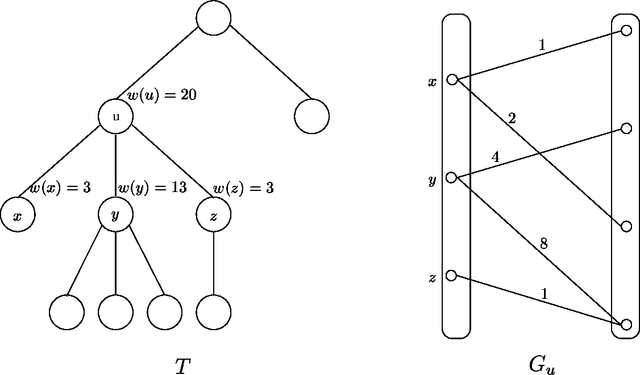
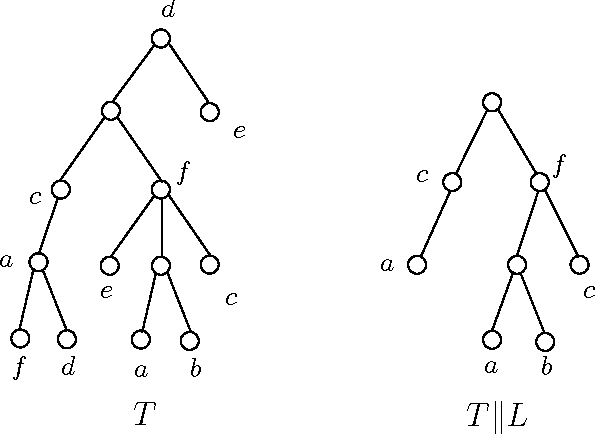
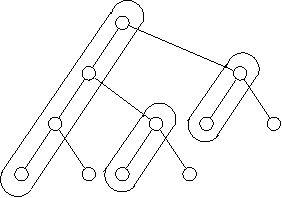
A widely used method for determining the similarity of two labeled trees is to compute a maximum agreement subtree of the two trees. Previous work on this similarity measure is only concerned with the comparison of labeled trees of two special kinds, namely, uniformly labeled trees (i.e., trees with all their nodes labeled by the same symbol) and evolutionary trees (i.e., leaf-labeled trees with distinct symbols for distinct leaves). This paper presents an algorithm for comparing trees that are labeled in an arbitrary manner. In addition to this generality, this algorithm is faster than the previous algorithms. Another contribution of this paper is on maximum weight bipartite matchings. We show how to speed up the best known matching algorithms when the input graphs are node-unbalanced or weight-unbalanced. Based on these enhancements, we obtain an efficient algorithm for a new matching problem called the hierarchical bipartite matching problem, which is at the core of our maximum agreement subtree algorithm.