 Add to Chrome
 Add to Firefox
 Add to Edge
ROSE: An Intent-Centered Evaluation Metric for NL2SQL
Apr 14, 2026
Execution Accuracy (EX), the widely used metric for evaluating the effectiveness of Natural Language to SQL (NL2SQL) solutions, is becoming increasingly unreliable. It is sensitive to syntactic variation, ignores that questions may admit multiple interpretations, and is easily misled by erroneous ground-truth SQL. To address this, we introduce ROSE, an intent-centered metric that focuses on whether the predicted SQL answers the question, rather than consistency with the ground-truth SQL under the reference-dependent paradigm. ROSE employs an adversarial Prover-Refuter cascade: SQL Prover assesses the semantic correctness of a predicted SQL against the user's intent independently, while Adversarial Refuter uses the ground-truth SQL as evidence to challenge and refine this judgment. On our expert-aligned validation set ROSE-VEC, ROSE achieves the best agreement with human experts, outperforming the next-best metric by nearly 24% in Cohen's Kappa. We also conduct a largescale re-evaluation of 19 NL2SQL methods, revealing four valuable insights. We release ROSE and ROSE-VEC to facilitate more reliable NL2SQL research.

InterFeedback: Unveiling Interactive Intelligence of Large Multimodal Models via Human Feedback
Feb 20, 2025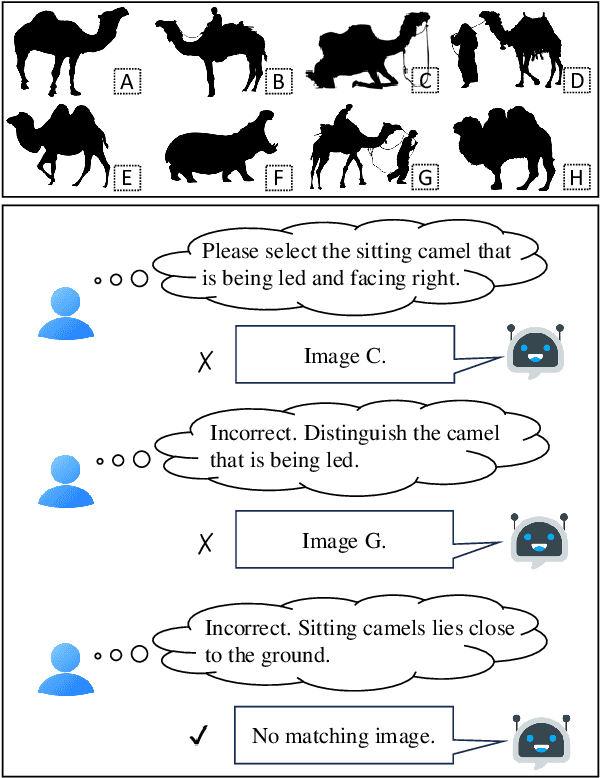
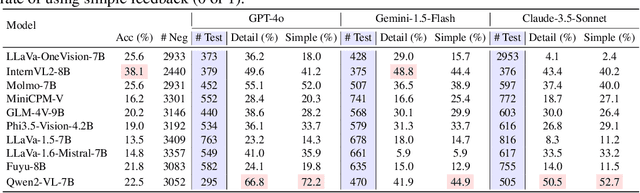
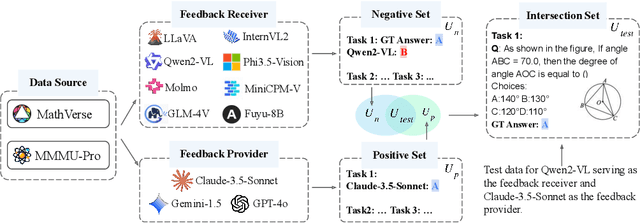
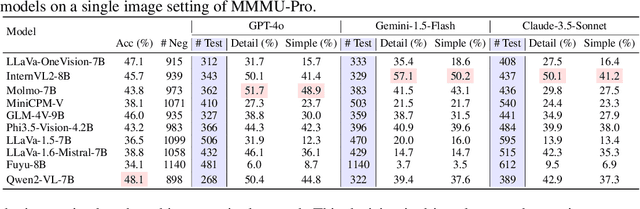
Existing benchmarks do not test Large Multimodal Models (LMMs) on their interactive intelligence with human users which is vital for developing general-purpose AI assistants. We design InterFeedback, an interactive framework, which can be applied to any LMM and dataset to assess this ability autonomously. On top of this, we introduce InterFeedback-Bench which evaluates interactive intelligence using two representative datasets, MMMU-Pro and MathVerse, to test 10 different open-source LMMs. Additionally, we present InterFeedback-Human, a newly collected dataset of 120 cases designed for manually testing interactive performance in leading models such as OpenAI-o1 and Claude-3.5-Sonnet. Our evaluation results show that even state-of-the-art LMM (like OpenAI-o1) can correct their results through human feedback less than 50%. Our findings point to the need for methods that can enhance the LMMs' capability to interpret and benefit from feedback.