 Add to Chrome
 Add to Firefox
 Add to Edge
Fine-grained Verification via Diagnostic Reasoning Supervision for Aspect Sentiment Triplet Extraction
May 29, 2026
Aspect Sentiment Triplet Extraction (ASTE) aims to identify aspect terms, opinion terms, and sentiment polarities as structured triplets, providing essential inputs for downstream information system applications such as opinion mining, explainable recommendations, and review summarization. Prior work mainly focuses on end-to-end extraction, while post hoc verification of extracted triplets remains comparatively underexplored. This gap limits the reliability of ASTE systems, since predicted triplets may be locally plausible while being globally invalid. Moreover, candidate invalidity is multi-faceted and candidate usability is inherently graded, motivating a fine-grained verification mechanism that can filter or re-rank outputs from diverse extractors. In this paper, we propose FiVeD, a framework for Fine-grained Verification with Diagnostic reasoning supervision. Specifically, the verifier is trained with multiple complementary objectives, including validity classification and quality score estimation as primary tasks, with error type classification and rationale generation as auxiliary tasks. We define hierarchical error categories and construct plausible incorrect triplets under semantic and syntactic constraints, and leverage an off-the-shelf LLM with task-specific rubrics to produce quality scores and diagnostic rationales. During inference, the resulting quality scores are used to filter candidate outputs, supporting adjustable precision-recall tradeoffs. Experiments across multiple ASTE baselines demonstrate that FiVeD consistently improves extraction performance by up to 3.53 F1 points as a plug-and-play verification module.

STAR: Stepwise Task Augmentation and Relation Learning for Aspect Sentiment Quad Prediction
Jan 27, 2025
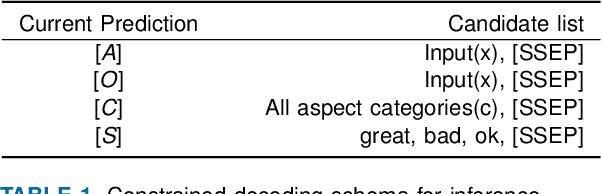
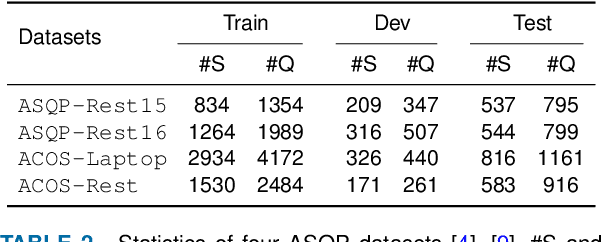

Aspect-based sentiment analysis (ABSA) aims to identify four sentiment elements, including aspect term, aspect category, opinion term, and sentiment polarity. These elements construct the complete picture of sentiments. The most challenging task, aspect sentiment quad prediction (ASQP), predicts these elements simultaneously, hindered by difficulties in accurately coupling different sentiment elements. A key challenge is insufficient annotated data that limits the capability of models in semantic understanding and reasoning about quad prediction. To address this, we propose stepwise task augmentation and relation learning (STAR), a strategy inspired by human reasoning. STAR constructs auxiliary data to learn quadruple relationships incrementally by augmenting with pairwise and overall relation tasks derived from training data. By encouraging the model to infer causal relationships among sentiment elements without requiring additional annotations, STAR effectively enhances quad prediction. Extensive experiments demonstrate the proposed STAR exhibits superior performance on four benchmark datasets.
Multi-Task Learning with LLMs for Implicit Sentiment Analysis: Data-level and Task-level Automatic Weight Learning
Dec 12, 2024

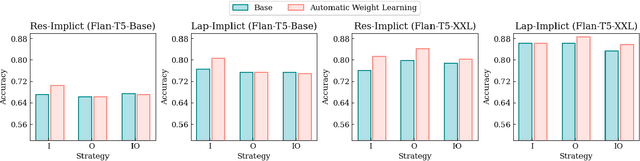

Implicit sentiment analysis (ISA) presents significant challenges due to the absence of salient cue words. Previous methods have struggled with insufficient data and limited reasoning capabilities to infer underlying opinions. Integrating multi-task learning (MTL) with large language models (LLMs) offers the potential to enable models of varying sizes to reliably perceive and recognize genuine opinions in ISA. However, existing MTL approaches are constrained by two sources of uncertainty: data-level uncertainty, arising from hallucination problems in LLM-generated contextual information, and task-level uncertainty, stemming from the varying capacities of models to process contextual information. To handle these uncertainties, we introduce MT-ISA, a novel MTL framework that enhances ISA by leveraging the generation and reasoning capabilities of LLMs through automatic MTL. Specifically, MT-ISA constructs auxiliary tasks using generative LLMs to supplement sentiment elements and incorporates automatic MTL to fully exploit auxiliary data. We introduce data-level and task-level automatic weight learning (AWL), which dynamically identifies relationships and prioritizes more reliable data and critical tasks, enabling models of varying sizes to adaptively learn fine-grained weights based on their reasoning capabilities. We investigate three strategies for data-level AWL, while also introducing homoscedastic uncertainty for task-level AWL. Extensive experiments reveal that models of varying sizes achieve an optimal balance between primary prediction and auxiliary tasks in MT-ISA. This underscores the effectiveness and adaptability of our approach.
RVISA: Reasoning and Verification for Implicit Sentiment Analysis
Jul 02, 2024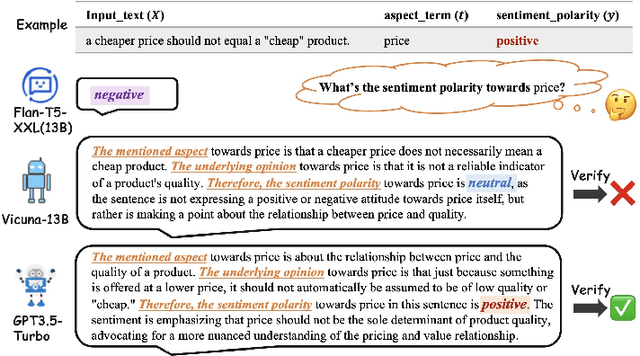
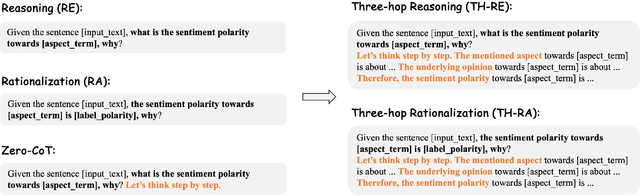
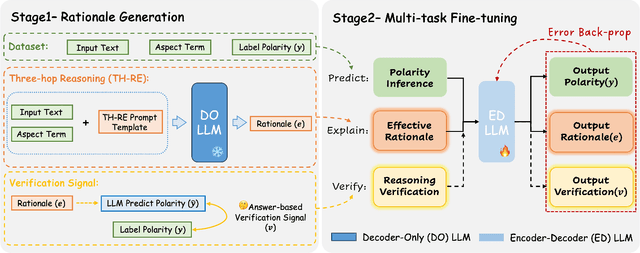

With an increasing social demand for fine-grained sentiment analysis (SA), implicit sentiment analysis (ISA) poses a significant challenge with the absence of salient cue words in expressions. It necessitates reliable reasoning to understand how the sentiment is aroused and thus determine implicit sentiments. In the era of Large Language Models (LLMs), Encoder-Decoder (ED) LLMs have gained popularity to serve as backbone models for SA applications, considering impressive text comprehension and reasoning ability among diverse tasks. On the other hand, Decoder-only (DO) LLMs exhibit superior natural language generation and in-context learning capabilities. However, their responses may contain misleading or inaccurate information. To identify implicit sentiment with reliable reasoning, this study proposes RVISA, a two-stage reasoning framework that harnesses the generation ability of DO LLMs and the reasoning ability of ED LLMs to train an enhanced reasoner. Specifically, we adopt three-hop reasoning prompting to explicitly furnish sentiment elements as cues. The generated rationales are utilized to fine-tune an ED LLM into a skilled reasoner. Additionally, we develop a straightforward yet effective verification mechanism to ensure the reliability of the reasoning learning. We evaluated the proposed method on two benchmark datasets and achieved state-of-the-art results in ISA performance.