 Add to Chrome
 Add to Firefox
 Add to Edge
Synergizing Discriminative Exemplars and Self-Refined Experience for MLLM-based In-Context Learning in Medical Diagnosis
Mar 29, 2026
General Multimodal Large Language Models (MLLMs) often underperform in capturing domain-specific nuances in medical diagnosis, trailing behind fully supervised baselines. Although fine-tuning provides a remedy, the high costs of expert annotation and massive computational overhead limit its scalability. To bridge this gap without updating the weights of the pre-trained backbone of the MLLM, we propose a Clinician Mimetic Workflow. This is a novel In-Context Learning (ICL) framework designed to synergize Discriminative Exemplar Coreset Selection (DECS) and Self-Refined Experience Summarization (SRES). Specifically, DECS simulates a clinician's ability to reference "anchor cases" by selecting discriminative visual coresets from noisy data at the computational level; meanwhile, SRES mimics the cognition and reflection in clinical diagnosis by distilling diverse rollouts into a dynamic textual Experience Bank. Extensive evaluation across all 12 datasets of the MedMNIST 2D benchmark demonstrates that our method outperforms zero-shot general and medical MLLMs. Simultaneously, it achieves performance levels comparable to fully supervised vision models and domain-specific fine-tuned MLLMs, setting a new benchmark for parameter-efficient medical in-context learning. Our code is available at an anonymous repository: https://anonymous.4open.science/r/Synergizing-Discriminative-Exemplars-and-Self-Refined-Experience-ED74.

CDFormer: Cross-Domain Few-Shot Object Detection Transformer Against Feature Confusion
May 02, 2025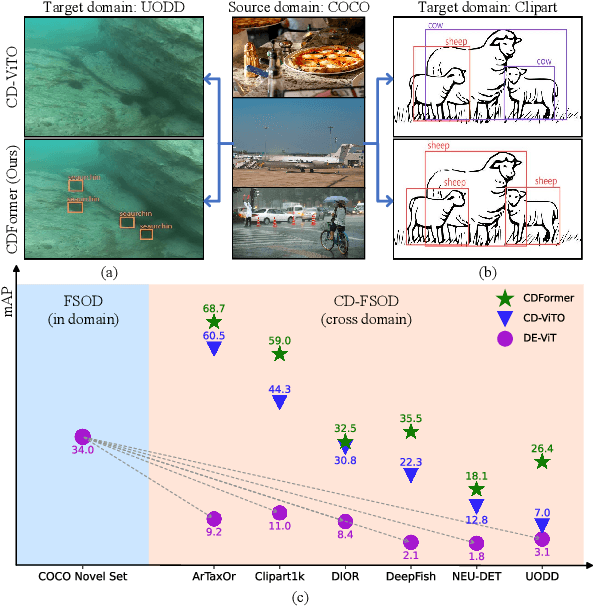
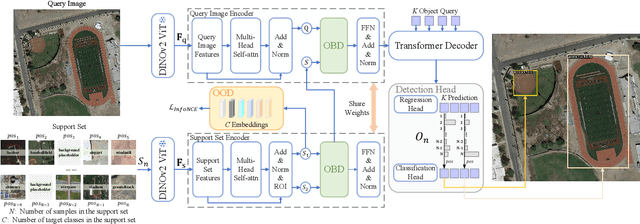
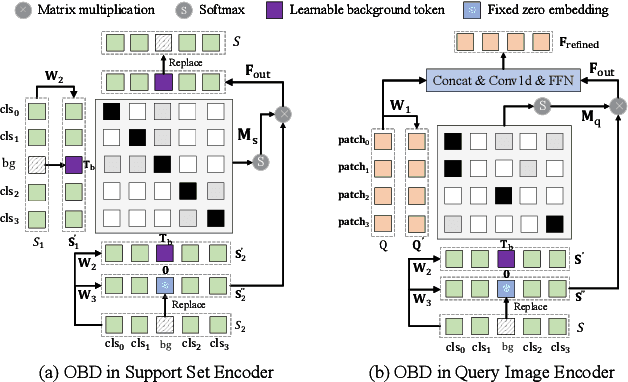
Cross-domain few-shot object detection (CD-FSOD) aims to detect novel objects across different domains with limited class instances. Feature confusion, including object-background confusion and object-object confusion, presents significant challenges in both cross-domain and few-shot settings. In this work, we introduce CDFormer, a cross-domain few-shot object detection transformer against feature confusion, to address these challenges. The method specifically tackles feature confusion through two key modules: object-background distinguishing (OBD) and object-object distinguishing (OOD). The OBD module leverages a learnable background token to differentiate between objects and background, while the OOD module enhances the distinction between objects of different classes. Experimental results demonstrate that CDFormer outperforms previous state-of-the-art approaches, achieving 12.9% mAP, 11.0% mAP, and 10.4% mAP improvements under the 1/5/10 shot settings, respectively, when fine-tuned.