 Add to Chrome
 Add to Firefox
 Add to Edge
Hybrid-Field Sparse Channel Representation and Recovery for XL-RIS-Assisted mmWave MIMO Systems
Jul 26, 2026
Extremely large-scale reconfigurable intelligent surface (XL-RIS)-assisted communication is regarded as a key enabling technology for future 6G networks. However, hybrid-field channel estimation for XL-RIS-assisted systems is challenging due to the high-dimensional cascaded channel and the coexistence of far-field and near-field propagation. In this case, traditional full-dimensional sparse recovery methods require a large cascaded dictionary and suffer from severe computational and storage burdens. To address these challenges, we develop a double-timescale channel estimation framework that decouples sparse dictionary representation and recovery. Then, by exploiting the quasi-static property of the channel at the base station (BS) and RIS side, we propose a Dirichlet kernel-based off-grid dictionary compression (DK-ODC) scheme for sparse representation, which reduces the dimension of the corresponding dictionary as well as mitigates BS-side angular off-grid error. Furthermore, for the dynamic channel at the user equipment (UE) and RIS side, we propose a subspace-aware incremental variational Bayesian learning (SI-VBL) algorithm, which enables incremental learning of sparse channels by exploiting the identified low-dimensional subspace and pruning threshold. Analysis and simulation results confirm that the proposed framework avoids full-dimensional Bayesian recovery and achieves a favorable tradeoff among estimation accuracy, computational complexity, and storage overhead.

Restoration Flow Matching-Based Channel Refinement and Equalization Correction for MIMO Semantic Communications
Jul 26, 2026In multiple-input multiple-output (MIMO) semantic communication, imperfect channel state information (CSI) and equalization mismatch can seriously degrade semantic reconstruction quality. To address this issue, we propose a unified restoration flow matching (RFM)-based framework for channel refinement and equalization correction. Specifically, the channel RFM (CRFM) module is developed to refine the coarse channel, thereby improving channel estimation accuracy. Based on the refined channel, the developed semantic RFM (SRFM) module is employed to correct the residual distortions in the post-equalization latent space. The key idea is to formulate the two cascaded inverse problems of channel estimation and equalization as the unified conditional restoration task, in which the learned conditional velocity field guides the perturbed distribution towards the target distribution. To enhance the robustness of these two modules under various distortion conditions, we develop a dual-anchor perturbation training strategy that jointly learns near-manifold refinement and large-error correction, and implement inference through a few-step deterministic ordinary differential equation (ODE) solver. Extensive experiments on MIMO channels and visual semantic transmission tasks demonstrate that the proposed scheme improves key metrics for channel estimation and semantic reconstruction quality. Moreover, compared with representative diffusion-based generative baselines, the proposed method requires fewer sampling steps.
VQ-DSC-R: Robust Vector Quantized-Enabled Digital Semantic Communication With OFDM Transmission
Feb 05, 2026Digital mapping of semantic features is essential for achieving interoperability between semantic communication and practical digital infrastructure. However, current research efforts predominantly concentrate on analog semantic communication with simplified channel models. To bridge these gaps, we develop a robust vector quantized-enabled digital semantic communication (VQ-DSC-R) system built upon orthogonal frequency division multiplexing (OFDM) transmission. Our work encompasses the framework design of VQ-DSC-R, followed by a comprehensive optimization study. Firstly, we design a Swin Transformer-based backbone for hierarchical semantic feature extraction, integrated with VQ modules that map the features into a shared semantic quantized codebook (SQC) for efficient index transmission. Secondly, we propose a differentiable vector quantization with adaptive noise-variance (ANDVQ) scheme to mitigate quantization errors in SQC, which dynamically adjusts the quantization process using K-nearest neighbor statistics, while exponential moving average mechanism stabilizes SQC training. Thirdly, for robust index transmission over multipath fading channel and noise, we develop a conditional diffusion model (CDM) to refine channel state information, and design an attention-based module to dynamically adapt to channel noise. The entire VQ-DSC-R system is optimized via a three-stage training strategy. Extensive experiments demonstrate superiority of VQ-DSC-R over benchmark schemes, achieving high compression ratios and robust performance in practical scenarios.
AEGIS: White-Box Attack Path Generation using LLMs and Training Effectiveness Evaluation for Large-Scale Cyber Defence Exercises
Jan 30, 2026Creating attack paths for cyber defence exercises requires substantial expert effort. Existing automation requires vulnerability graphs or exploit sets curated in advance, limiting where it can be applied. We present AEGIS, a system that generates attack paths using LLMs, white-box access, and Monte Carlo Tree Search over real exploit execution. LLM-based search discovers exploits dynamically without pre-existing vulnerability graphs, while white-box access enables validating exploits in isolation before committing to attack paths. Evaluation at CIDeX 2025, a large-scale exercise spanning 46 IT hosts, showed that AEGIS-generated paths are comparable to human-authored scenarios across four dimensions of training experience (perceived learning, engagement, believability, challenge). Results were measured with a validated questionnaire extensible to general simulation-based training. By automating exploit chain discovery and validation, AEGIS reduces scenario development from months to days, shifting expert effort from technical validation to scenario design.
Vector Quantized-Aided XL-MIMO CSI Feedback with Channel Adaptive Transmission
Jan 12, 2026Efficient channel state information (CSI) feedback is critical for 6G extremely large-scale multiple-input multiple-output (XL-MIMO) systems to mitigate channel interference. However, the massive antenna scale imposes a severe burden on feedback overhead. Meanwhile, existing quantized feedback methods face dual challenges of limited quantization precision and insufficient channel robustness when compressing high-dimensional channel features into discrete symbols. To reduce these gaps, guided by the deep joint source-channel coding (DJSCC) framework, we propose a vector quantized (VQ)-aided scheme for CSI feedback in XL-MIMO systems considering the near-field effect, named VQ-DJSCC-F. Firstly, taking advantage of the sparsity of near-field channels in the polar-delay domain, we extract energy-concentrated features to reduce dimensionality. Then, we simultaneously design the Transformer and CNN (convolutional neural network) architectures as the backbones to hierarchically extract CSI features, followed by VQ modules projecting features into a discrete latent space. The entropy loss regularization in synergy with an exponential moving average (EMA) update strategy is introduced to maximize quantization precision. Furthermore, we develop an attention mechanism-driven channel adaptation module to mitigate the impact of wireless channel fading on the transmission of index sequences. Simulation results demonstrate that the proposed scheme achieves superior CSI reconstruction accuracy with lower feedback overheads under varying channel conditions.
Flow matching-based generative models for MIMO channel estimation
Nov 14, 2025Diffusion model (DM)-based channel estimation, which generates channel samples via a posteriori sampling stepwise with denoising process, has shown potential in high-precision channel state information (CSI) acquisition. However, slow sampling speed is an essential challenge for recent developed DM-based schemes. To alleviate this problem, we propose a novel flow matching (FM)-based generative model for multiple-input multiple-output (MIMO) channel estimation. We first formulate the channel estimation problem within FM framework, where the conditional probability path is constructed from the noisy channel distribution to the true channel distribution. In this case, the path evolves along the straight-line trajectory at a constant speed. Then, guided by this, we derive the velocity field that depends solely on the noise statistics to guide generative models training. Furthermore, during the sampling phase, we utilize the trained velocity field as prior information for channel estimation, which allows for quick and reliable noise channel enhancement via ordinary differential equation (ODE) Euler solver. Finally, numerical results demonstrate that the proposed FM-based channel estimation scheme can significantly reduce the sampling overhead compared to other popular DM-based schemes, such as the score matching (SM)-based scheme. Meanwhile, it achieves superior channel estimation accuracy under different channel conditions.
EfficientGS: Streamlining Gaussian Splatting for Large-Scale High-Resolution Scene Representation
Apr 19, 2024

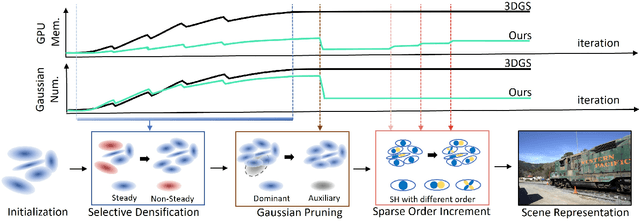
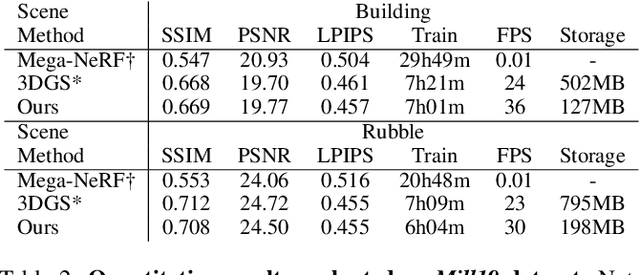
In the domain of 3D scene representation, 3D Gaussian Splatting (3DGS) has emerged as a pivotal technology. However, its application to large-scale, high-resolution scenes (exceeding 4k$\times$4k pixels) is hindered by the excessive computational requirements for managing a large number of Gaussians. Addressing this, we introduce 'EfficientGS', an advanced approach that optimizes 3DGS for high-resolution, large-scale scenes. We analyze the densification process in 3DGS and identify areas of Gaussian over-proliferation. We propose a selective strategy, limiting Gaussian increase to key primitives, thereby enhancing the representational efficiency. Additionally, we develop a pruning mechanism to remove redundant Gaussians, those that are merely auxiliary to adjacent ones. For further enhancement, we integrate a sparse order increment for Spherical Harmonics (SH), designed to alleviate storage constraints and reduce training overhead. Our empirical evaluations, conducted on a range of datasets including extensive 4K+ aerial images, demonstrate that 'EfficientGS' not only expedites training and rendering times but also achieves this with a model size approximately tenfold smaller than conventional 3DGS while maintaining high rendering fidelity.
C2F2NeUS: Cascade Cost Frustum Fusion for High Fidelity and Generalizable Neural Surface Reconstruction
Jun 16, 2023There is an emerging effort to combine the two popular technical paths, i.e., the multi-view stereo (MVS) and neural implicit surface (NIS), in scene reconstruction from sparse views. In this paper, we introduce a novel integration scheme that combines the multi-view stereo with neural signed distance function representations, which potentially overcomes the limitations of both methods. MVS uses per-view depth estimation and cross-view fusion to generate accurate surface, while NIS relies on a common coordinate volume. Based on this, we propose to construct per-view cost frustum for finer geometry estimation, and then fuse cross-view frustums and estimate the implicit signed distance functions to tackle noise and hole issues. We further apply a cascade frustum fusion strategy to effectively captures global-local information and structural consistency. Finally, we apply cascade sampling and a pseudo-geometric loss to foster stronger integration between the two architectures. Extensive experiments demonstrate that our method reconstructs robust surfaces and outperforms existing state-of-the-art methods.